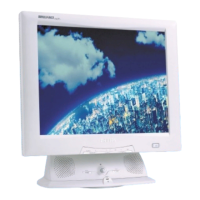
170S6 LCD
84
Repair Tips
0.Warning
All ICs and many other semi-conductors are susceptible to
electrostaticdischarges (ESD). Careless handling during
repair can reduce life drastically. When repairing, makesure
that you are connectedwith thesamepotential as the mass
of th
e unitvia a wristwrap with resistance.Keep components
and toolsalso atthesamepotential!
1. Servicing of SMDs (Surface Mounted Devices)
1.1 Generalcautions on handling and storage
-Oxidation on the terminals of SMDs resultsin poorsoldering.
Do not handleSMDs with bare hands.
-Avoidusing storageplaces that are sensitive to oxidation
such as places with sulphur or chlorine gas,dire
ct sunlight,
high temperatures orahigh degree of humidity. The
capacitance or resistance value of theSMDs maybe
affectedbythis.
- Rough handling of circuitboards containing SMDs may
cause damage to the com
ponentsaswell as the circuit
boards. Circuitboards containing SMDs should never be
bent or flexed. Different circuitboardmaterialsexpand and
contract atdifferent rates whenheatedor cooled and the
compone
ntsand/orsolder connections maybe damaged
due to thestress.Never rub orscrape chip componentsas
this maycause the value of the component to change.
Similarly, do not slide the circuitboard across any surfa
ce.
1.2RemovalofSMDs
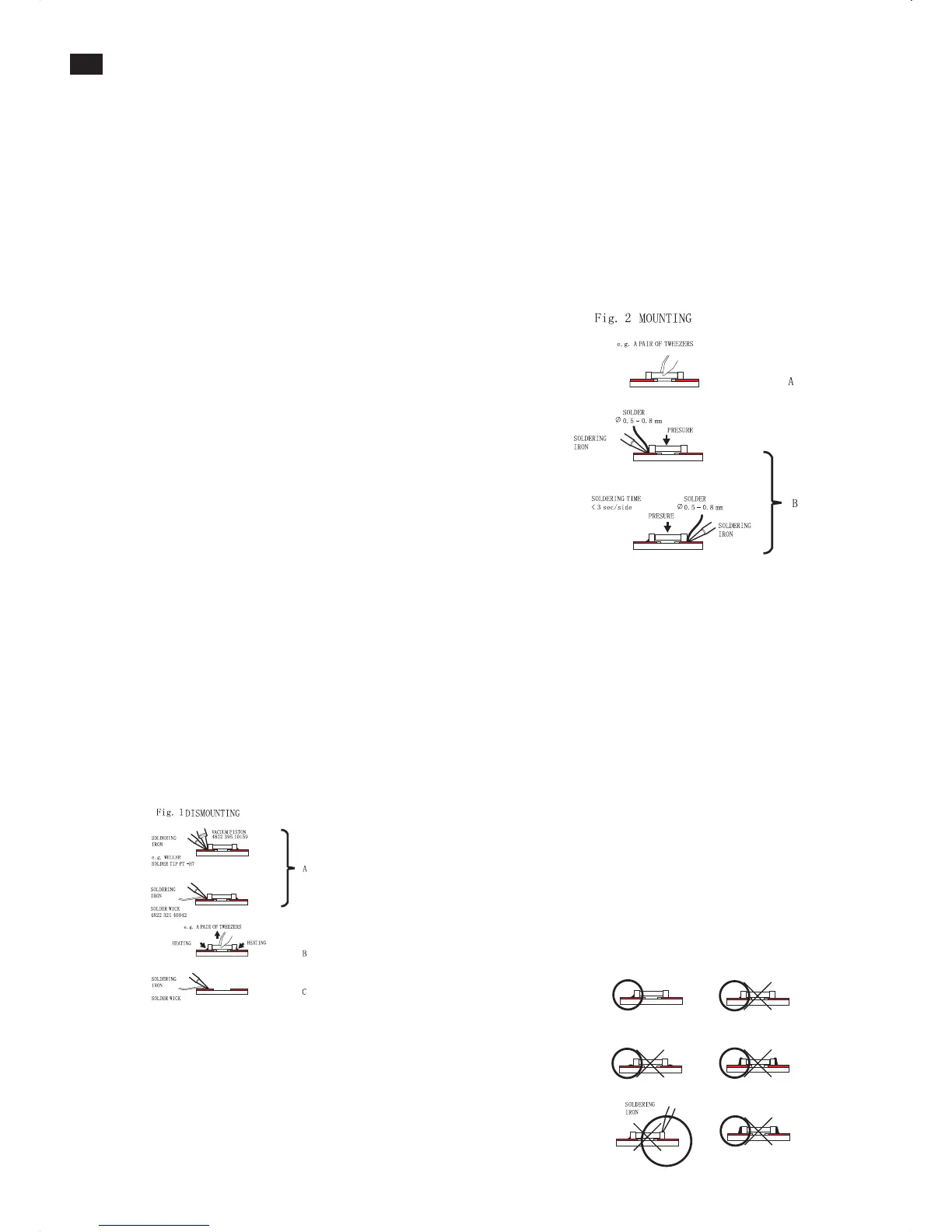
-Heatthesolder (for2-3 seconds) at each terminalofthe
chip.Bymeans of litz wire and aslight horizontalforce,
small components canberemovedwith thesoldering iron.
Theycan alsoberemovedwith asolder sucker (see Fig.
1A)
While holding theSMD with a pair of tweezers,takeitoffgently using the
soldering iron's heat appliedtoeach terminal(see Fig. 1 B).
- Remove theexcess solder on thesolder lands by means of
litz wire orasolder sucker (see Fig. 1C).
1.3 Caution on removal
-Whenhandling thesoldering.iron. use suitable pressure a nd be careful.
-When removing the chip, do not use undue force with the pair of tweezers.
- Thesoldering iron to be used(approx. 30 W) should
preferably beequippedwith a thermal control (soldering
temperature: 225to250C).
- The chip, onceremoved, mustnever bereused.
1.4 Attachment of SMDs
- Locate theSMD on thesolder lands by means of tweezers
and solder the component on oneside.Ensure thatthe
component is positionedcorrectly on thesolder lands (see Fig.2A).
-Next complete thesoldering of the terminals of th
e
component (see Fiq. 2B).
2. Caution when attaching SMDs
-When soldering theSMD terminals, do not touch them
directly with thesoldering iron. Thesoldering should be
doneasquickly as possible,care mustbe takentoavoid
damage to the terminals of theSMDs themselves.
-Keep theSMD's
body in contact with the printedboardwhen
soldering.
- Thesoldering iron to be used(approx. 30 W)should
preferably beequippedwith a thermal control (soldering
temperature: 225to250C).
- Soldering should not be done outside thesolder land.
- Soldering flux (of ro
sin) maybe used, but should not be
acidic.
- After soldering, lettheSMD cool down gradually at room
temperature.
- The quantity of solder mustbeproportionaltothesize of the
solder land. If the quantity is too great, theSMD might
crack or thes
older lands might be torn loose from the
printedboard(see Fig. 3).
Fig.3 Examples
Right


 To Next Page