EasyManua.ls Logo

Philips FR 940 - Operation

Philips FR 940
14 pages
Print Icon
To Next Page IconTo Next Page
To Previous Page IconTo Previous Page
Loading...
OPERATION
eR
ysy6uq
10
11
12
13
14
15
16
17
source
séiecT
~
24
23
22.
21
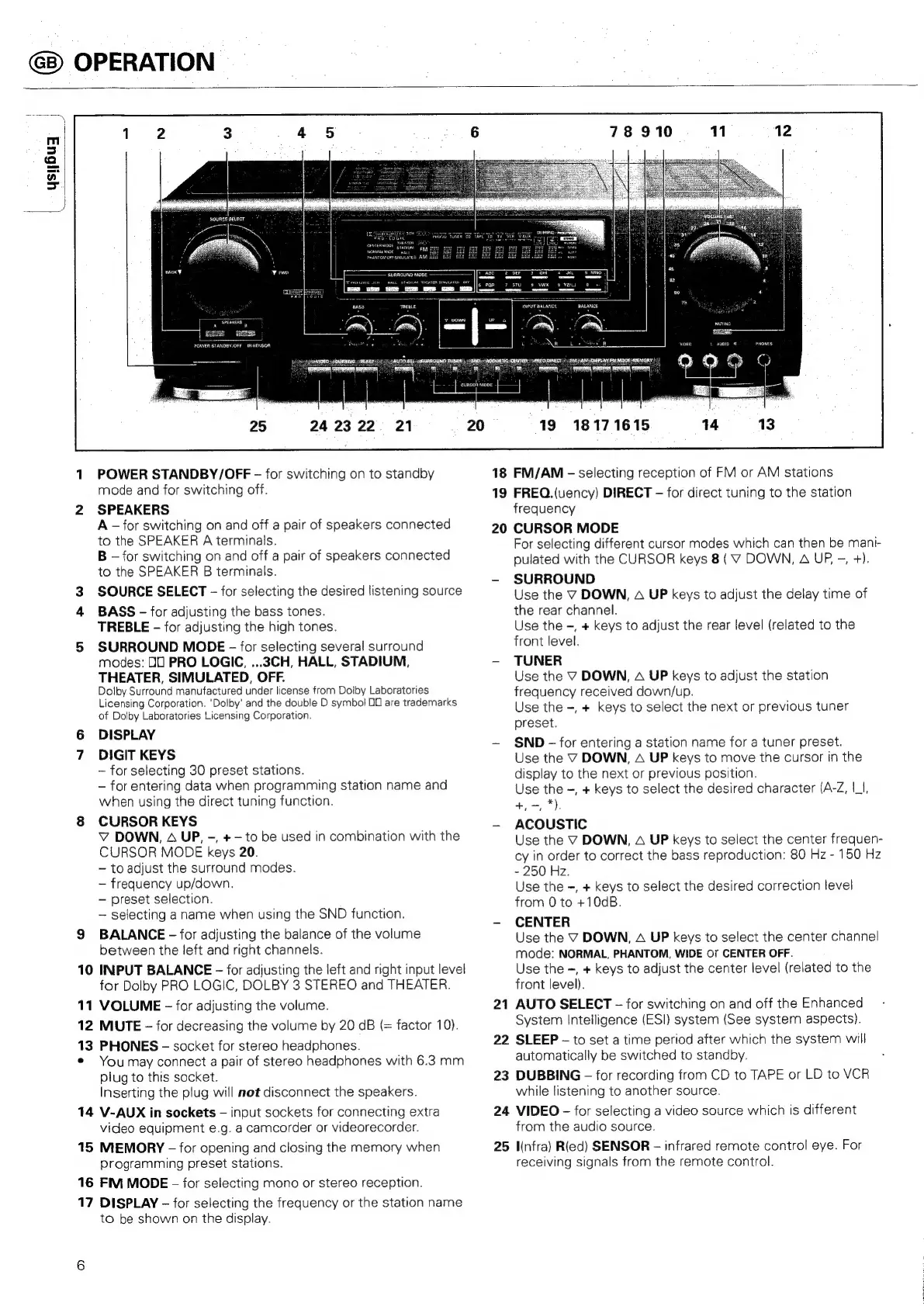
POWER
STANDBY/OFF
-
for
switching
on
to
standby
mode
and
for
switching
off.
SPEAKERS
A
—-
for
switching
on
and
off
a
pair
of
speakers
connected
to
the
SPEAKER
A
terminals.
B
for
switching
on
and
off
a
pair
of
speakers
connected
to
the
SPEAKER
B
terminals.
SOURCE
SELECT
-
for
selecting
the
desired
listening
source
BASS
-
for
adjusting
the
bass
tones.
TREBLE
-
for
adjusting
the
high
tones.
SURROUND
MODE
-
for
selecting
several
surround
modes:
D0
PRO
LOGIC,
...3CH,
HALL,
STADIUM,
THEATER,
SIMULATED,
OFF.
Dolby
Surround
manufactured
under
license
from
Dolby
Laboratories
Licensing
Corporation.
‘Dolby’
and
the
double
D
symbol!
DD
are
trademarks
of
Dolby
Laboratories
Licensing
Corporation.
DISPLAY
DIGIT
KEYS
~
for
selecting
30
preset
stations.
-
for
entering
data
when
programming
station
name
and
when
using
the
direct
tuning
function.
CURSOR
KEYS
Vv
DOWN,
A
UP,
-,
+
-
to
be
used
in
combination
with
the
CURSOR
MODE
keys
20.
to
adjust
the
surround
modes.
frequency
up/down.
preset
selection.
selecting
a
name
when
using
the
SND
function.
BALANCE
-
for
adjusting
the
balance
of
the
volume
between
the
left
and
right
channels.
INPUT
BALANCE
-
for
adjusting
the
left
and
right
input
level
for
Dolby
PRO
LOGIC,
DOLBY
3
STEREO
and
THEATER.
VOLUME
-
for
adjusting
the
volume.
MIUTE
for
decreasing
the
volume
by
20
dB
(=
factor
10).
PHONES
-
socket
for
stereo
headphones.
You
may
connect
a
pair
of
stereo
headphones
with
6.3
mm
plug
to
thts
socket.
Inserting
the
plug
will
not
disconnect
the
speakers.
V-AUX
in
sockets
input
sockets
for
connecting
extra
video
equipment
e.g.
a
camcorder
or
videorecorder.
MEMORY
-
for
opening
and
closing
the
memory
when
programming
preset
stations.
FM
MODE
-
for
selecting
mono
or
stereo
reception.
DISPLAY
for
selecting
the
frequency
or
the
station
name
to
be
shown
on
the
display.
18
19
20
21
22
23
24
25
INPUT
BALANCE
LIN.
62
ran
19
18171615
FM/AM
-
selecting
reception
of
FM
or
AM
stations
FREQ.(uency)
DIRECT
for
direct
tuning
to
the
station
frequency
CURSOR
MODE
For
selecting
different
cursor
modes
which
can
then
be
mani-
pulated
with
the
CURSOR
keys
8
(V
DOWN,
A
UP,
-,
+).
SURROUND
Use
the
V
DOWN,
A
UP
keys
to
adjust
the
delay
time
of
the
rear
channel.
Use
the
-,
+
keys
to
adjust
the
rear
level
(related
to
the
front
level.
TUNER
Use
the
V
DOWN,
A
UP
keys
to
adjust
the
station
frequency
received
down/up.
Use
the
-,
+
keys
to
select
the
next
or
previous
tuner
preset.
SND
-
for
entering
a
station
name
for
a
tuner
preset.
Use
the
V
DOWN,
A
UP
keys
to
move
the
cursor
in
the
display
to
the
next
or
previous
position.
Use
the
-,
+
keys
to
select
the
desired
character
(A-Z,
|_I,
+,-,
*).
ACOUSTIC
Use
the
V
DOWN,
A
UP
keys
to
select
the
center
frequen-
cy
in
order
to
correct
the
bass
reproduction:
80
Hz
-
150
Hz
-
250
Hz.
Use
the
-,
+
keys
to
select
the
desired
correction
level
from
0
to
+100B.
CENTER
Use
the
V
DOWN,
A
UP
keys
to
select
the
center
channel
mode:
NORMAL,
PHANTOM,
WIDE
Or
CENTER
OFF.
Use
the
-,
+
keys
to
adjust
the
center
level
(related
to
the
front
level).
AUTO
SELECT
-
for
switching
on
and
off
the
Enhanced
System
Intelligence
(ESI)
system
(See
system
aspects).
SLEEP
-
to
set
a
time
period
after
which
the
system
will
automatically
be
switched
to
standby.
DUBBING
-
for
recording
from
CD
to
TAPE
or
LD
to
VCR
while
listening
to
another
source.
VIDEO
-
for
selecting
a
video
source
which
is
different
from
the
audio
source.
I(nfra)
R(ed)
SENSOR
-
infrared
remote
control
eye.
For
receiving
signals
from
the
remote
control.