EasyManua.ls Logo

Philips PM 5390 - Checking and Adjusting; Recommended Test Equipment; General Information

Philips PM 5390
88 pages
Print Icon
To Next Page IconTo Next Page
To Previous Page IconTo Previous Page
Loading...
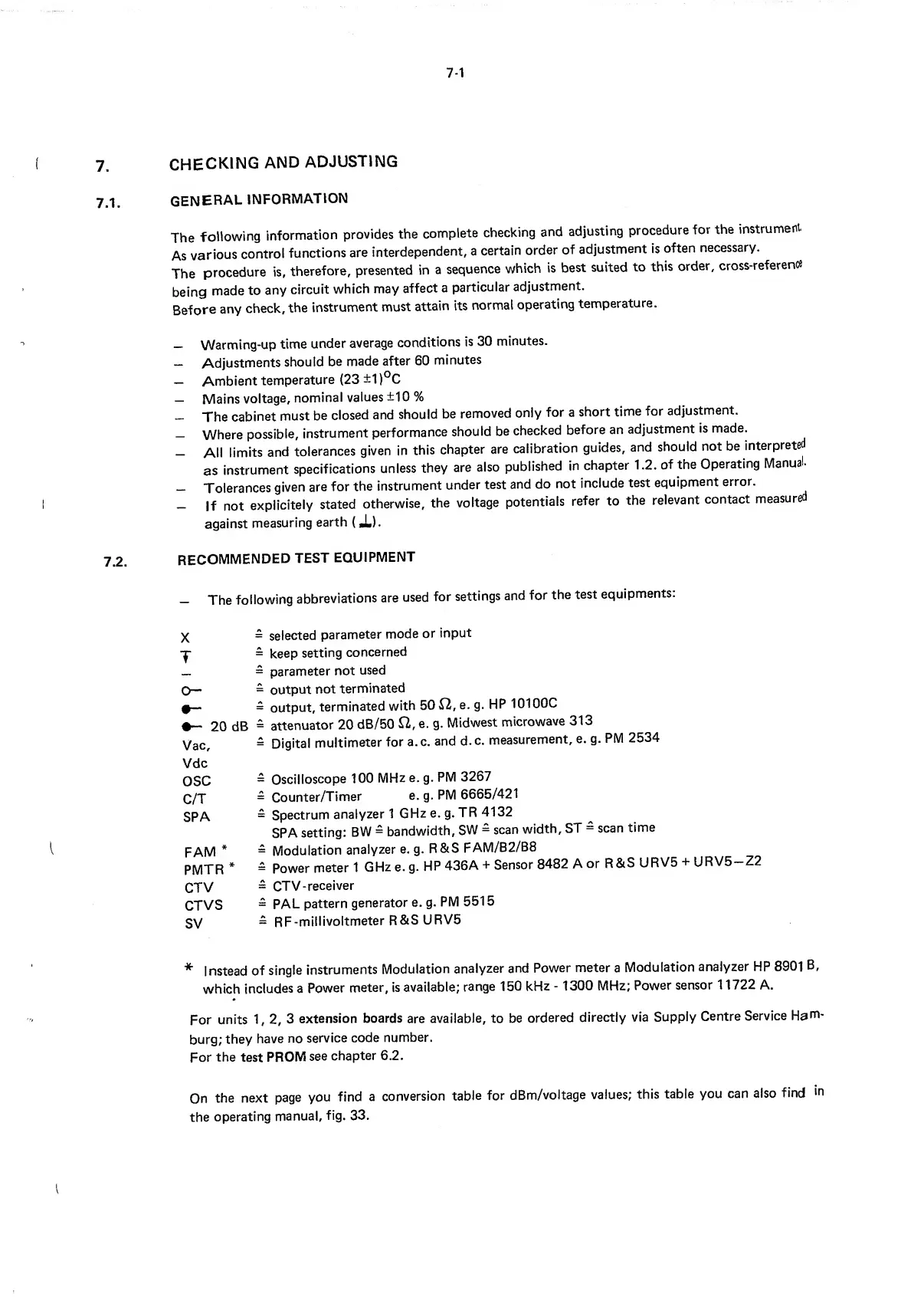
CHECKING
AND
ADJUSTING
GENERAL
INFORMATION
The
following
information
provides
the
complete
checking
and
adjusting
procedure
for
the
instrument
As
various
control
functions
are
interdependent,
a
certain
order
of
adjustment
is
often
necessary.
The
procedure
is,
therefore,
presented
in
a
sequence
which
is
best
suited
to
this
order,
cross-reference
being
made
to
any
circuit
which may
affect
a
particular
adjustment.
Before
any
check,
the
instrument
must
attain
its
normal
operating
temperature.
Warming-up
time
under
average
conditions
is
30
minutes.
Adjustments
should
be
made
after
60
minutes
Ambient
temperature
(23
±1)®C
Mains
voltage,
nominal
values
±10
%
The
cabinet
must
be
closed
and
should
be
removed
only
for a
short
time
for
adjustment.
Where
possible,
instrument
performance
should
be
checked
before
an
adjustment
is made.
All
limits
and
tolerances
given in
this
chapter
are
calibration
guides,
and
should
not be
interprets
as
instrument
specifications
unless
they
are
also
published
in
chapter
1.2.
of
the
Operating
Manual-
Tolerances
given
are
for
the
instrument
under
test
and
do
not
include
test
equipment
error,
If
not
explicitely
stated
otherwise,
the
voltage
potentials
refer to
the
relevant
contact
measured
against
measuring
earth
(
»L).
RECOMMENDED
TEST
EQUIPMENT
The
following
abbreviations
are
used
for
settings
and
for
the
test
equipments:
X
T
o-
20 dB
Vac,
Vdc
OSC
C/T
SPA
FAM
*
PMTR*
CTV
CTVS
SV
=
selected
parameter
mode
or
input
=
keep
setting
concerned
=
parameter
not
used
=
output
not
terminated
=
output,
terminated
with
50
^2,
e.
g.
HP
10100C
=
attenuator
20
dB/50
Ji,
e.
g.
Midwest
microwave
313
=
Digital
multimeter
for
a.c.
and
d.c,
measurement,
e.
g.
PM
2534
=
Oscilloscope
100
MHz
e.
g.
PM
3267
=
Counter/Timer
e.
g.
PM
6665/421
=
Spectrum
analyzer
1
GHz
e.
g.
TR
4132
SPA
setting:
BW
=
bandwidth,
SW
=
scan
width,
ST
=
scan
time
=
Modulation
analyzer
e.
g.
R&S
FAM/B2/B8
=
Power
meter
1
GHz e.
g.
HP
436A
+
Sensor
8482 A
or
R&S
URV5
+ URV5-Z2
=
CTV
-receiver
=
PAL
pattern
generator
e.
g.
PM
551
5
=
RF-millivoltmeter
R&S
URV5
*
Instead
of
single
instruments
Modulation
analyzer
and
Power
meter
a
Modulation
analyzer
HP
8901
B,
which
includes
a
Power
meter, is
available;
range
150
kHz
-
1300 MHz;
Power
sensor
11722
A.
For
units
1, 2,
3
extension
boards
are
available,
to
be
ordered
directly
via Supply
Centre
Service h\a^
burg;
they
have
no
service
code
number.
For
the
test
PROM
see
chapter
6.2.
On
the next
page
you
find
a
conversion
table
for
dBm/voltage
values;
this
table
you
can
also
find
in
the
operating
manual,
fig. 33.

Table of Contents