PHONIC CORPORATION
Page 8
MM1705a USER
’
S MANUAL
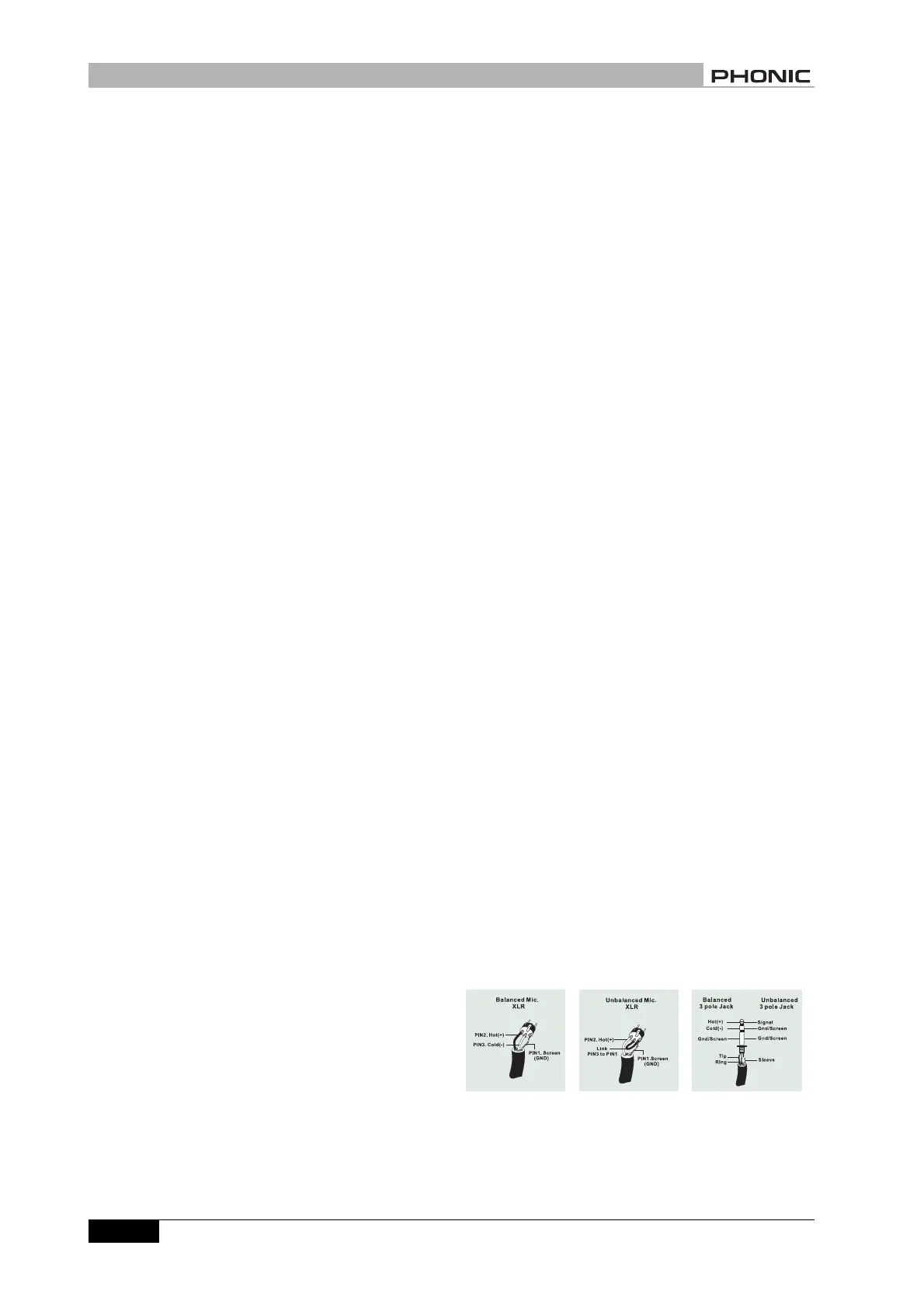
UNBALANCED & BALANCED
UNBALANCED & BALANCED
Unbalanced & Balanced Connection
Most of the mistakes in audio installations are be-
cause of incorrect and defective audio connections.
In order to perfectly complete your installation; please
pay special attention to the following section unless
you are already familiar with balanced/unbalanced
operations.
What is an unbalanced system?
You can find this kind of system in most of home
audio-video systems. They have one conductor to
carry the signal, and another conductor for a ground.
Normally, for lower level signals, the ground conduc-
tor shields the signal conductor.
What is a balanced system?
A balanced system transmits the signal via 2 con-
ductors plus one ground shielding conductor. The 2
signal conductors carry the same signal but out of
phase. For the balanced input stage, the amplifier
will boost the difference of the 2 signal conductors
and remove the identical part (known as common
mode signal) of the 2 signals . Because the real sig-
nal is carried by the 2 conductors out of phase, so it
is perfectly carried to the input. At the same time,
interference that occurs during transmission will be
identical (common mode). Because the signal con-
ductors are run together, there is no chance they
can be different, and all the interference will be re-
moved by the balanced input amplifier.
The difference between 2 operations:
Because of the common mode interference immu-
nity of a balanced system, the ground conductor
doesn’t need to carry any electrical current, which
means the ground of the 2 connected units has an
identical ground level which is vital to an interference
free system. Let’s look back to the unbalanced sys-
tem. The signal electrical current goes from the sig-
nal conductor to the ground conductor, and that
means the ground level of the 2 connected units are
not identical. This means the system is much easierto
experience noise interference.Running long cables
is easy for a balanced system but difficult for an
unbalanced system, and lower noise levels are a con-
stant characteristic of a balanced system. Because
a balanced system needs 2 conductors for the signal
and 1 conductor for the ground, a minimum of 3 con-
ductors are needed for wiring a balanced system. So
a dedicated system separates the ground and shields
the 2 conductors.
Please read following section for properly wiring bal-
anced and unbalanced systems:
The Correct Wiring for Balanced Operation
Always connect the main power with 3 plugs. Make
sure the power system ground is working properly.
Don’t use a ground insulator plug adapter without
properly connecting the ground individually. This is
vital to making a successful audio system connec-
tion.
Always connect the ground pin (PIN 1 in XLR) to the
source unit, and disconnect this pin on the destina-
tion unit. This connection topology is to avoid creat-
ing a grounding loop between the signal and power
ground. Utilize only the power ground, because it al-
ways has a lower resistance and better distribution
than the signal ground.
If there is hum, a possible reason is a bad ground
connection for the system. In case you can not find
the fault, try connecting the ground pin of the input
connectors. If the hum is reduced or eliminated, check
your power grounding system. Special attention is
needed when you use the equipment racks with some
distance between them, and/or use a large quantity
of power amplifiers. Check the power ground between
the racks and power distribution strips with your elec-
trical supply engineer. Make sure there is one, and
only one, proper ground point for the audio system
(or connected video system).
aaaaaaaaaaaaa
aaaaaaaaaaaaa
aaaaaaaaaaaaa
aaaaaaaaaaaaa
aaaaaaaaaaaaa
aaaaaaaaaaaaa
aaaaaaaaaaaaa
aaaaaaaaaaaaa
aaaaaaaaaaaaa
aaaaaaaaaaaaa
aaaaaaaaaaaaa
aaaaaaaaaaaaa
aaaaaaaaaaaaa
aaaaaaaaaaaaa
aaaaaaa
aaaaaaa
aaaaaaa
aaaaaaa
aaaaaaa


 To Next Page