4
1.0 PREFACE
In most of the professional audio applications, multiple speakers are employed for covering the whole audi-
ence area as well as frequency band. When sound waves are generated with multiple speakers, proper ar-
rangement is a standard and recommended practice by audio design engineers and installation technicians.
Phonic provides this active crossover as part of the speaker system, which work together with speaker drivers,
highs or lows, and amplifiers, big or small. This crossover will be successful if you carefully design and align
the whole speaker system according to the following explanation and recommended practice.
1.1 MULTIPLE-WAY SPEAKER SYSTEMS
Full bandwidth covering 20Hz to 20KHz as human audible band, no single speaker driver can cover this range
with wave length differ by 1000 times with good quality and sufficient sound pressure level. To deal with this
limit, audio engineers need to use multiple speaker drivers for different frequency band, and we call these
designs as multiple-way system. Multiple-way means different speakers covering different frequency band,
and multiple speakers could be in the same band.
For professional applications, 2-way and 3-way designs are most popular configuration. To build a 2-way or 3-
way speaker system, crossover network is needed to divide the frequency band into high and low (or high, mid,
low) section. Crossover can be passive or active. Passive crossover can be found in smaller speaker system
that is assembled with inductors, capacitors, and resistors. Amplifier send in the signal to the passive cross-
over network and then to the high and low frequency speakers accordingly.
Active crossover did this differently, it is positioned before the power amplifiers. Then, the power amplifier
send the signal directly to the high or low frequency speakers directly without the passive crossover inserted.
The benefit are:
! More solid bass for lower resistance between speaker and amplifier that maintain effective damping factor.
! Lower inter-modulation distortion (IMD).
! Save the insertion loss, normally in the range of 1 to 3 dB. That means save the lost from 20% to 50%.
! Increase power efficiency for less composite signal that will demand lower voltage swing of power amplifiers,
and still provide the same sound pressure level.
! Save the high frequency drivers from damage by large low frequency signal clipping the power amplifiers
which generate high level harmonic signal. This is the phenomenon that underpower amplifier will burn
tweeter when clipping.
If the user doesnt follow the exact procedure to set-up the speaker system with active crossover, the result is
always very bad and worst than passive crossover speakers. Because the passive crossover was already
properly adjusted by the designer and maker.
OK, lets see how we can get the best of the system performance with Phonic PCR2213.
1.2 PCR2213 THE ULTIMATE CROSSOVER FOR ADVANCED SPEAKER
SYSTEM
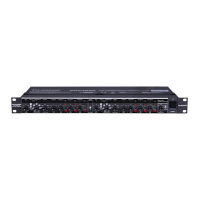
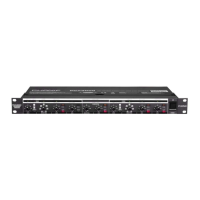
The PCR2213 is a very high quality active crossover. It is designed with 2, 3 or more way speaker systems in
mind with 1, 2 or more PCR2213 to achieve it. The PCR2213 may be used with large sound systems in
auditoriums, theaters, pubs, amusement parks, or touring concerts. Also for high quality bi-amp stage monitors,
or adding a mono sub-woofer for studio monitors in a control room.
The Phonic PCR2213 is a high precision tool with a lot of advanced features:
! Stereo 2-way or mono 3-way operation.
! Reasonable ways speaker system with multiple PCR2213.
! Industrial standard state variable 24 dB/octave Linkwitz-Riley filters with zero phase error at crossover


 To Next Page