EasyManua.ls Logo

Pilz 20407-6NL-06 - User Manual

Pilz 20407-6NL-06
16 pages
Print Icon
To Next Page IconTo Next Page
Loading...
- 1 -
Safety Regulations
The unit may only be installed and
operated by personnel who are familiar
with both these instructions and the current
regulations for safety at work and accident
prevention. Follow VDE and local
regulations especially as regards
preventative measures.
Transport, storage and operating
conditions should all conform to
EN 60068-2-6
Any guarantee is void following opening of
the housing or unauthorised modifications.
The unit should be panel mounted,
otherwise dampness or dust could lead to
function impairment.
Adequate protection must be provided on
all output contacts especially with
capacitive and inductive loads.
Note for overvoltage category III:
If voltages higher than low voltage
(>50 VAC or >120 VDC) are present on
the unit, connected control elements and
sensors must have a rated insulation
voltage of at least 250 V.
Sicherheitsbestimmungen
Das Gerät darf nur von Personen installiert
und in Betrieb genommen werden, die mit
dieser Betriebsanleitung und den gel-
tenden Vorschriften über Arbeitssicherheit
und Unfallverhütung vertraut sind.
Beachten Sie die VDE- sowie die örtlichen
Vorschriften, insbesondere hinsichtlich
Schutzmaßnahmen.
Beim Transport, der Lagerung und im
Betrieb die Bedingungen nach EN 60068-
2-6 einhalten (s. technische Daten).
Durch Öffnen des Gehäuses oder eigen-
mächtige Umbauten erlischt jegliche Ge-
währleistung.
Montieren Sie das Gerät in einen Schalt-
schrank; Staub und Feuchtigkeit können
sonst zu Beeinträchtigungen der Funktio-
nen führen.
Sorgen Sie an allen Ausgangskontakten
bei kapazitiven und induktiven Lasten für
eine ausreichende Schutzbeschaltung.
Hinweis für Überspannungskategorie III:
Wenn am Gerät höhere Spannungen als
Kleinspannung (>50 V AC oder
>120 V DC) anliegen, müssen angeschlos-
sene Bedienelemente und Sensoren eine
Bemessungsisolationsspannung von mind.
250 V aufweisen.
Conseils préliminaires
La mise en oeuvre de l’appareil doit être
effectuée par une personne spécialisée en
installations électriques, en tenant compte
des prescriptions des différentes normes
applicables (NF, EN, VDE...) notamment
au niveau des risques encourus en cas de
défaillance de l’équipement électrique.
Respecter les exigences de la norme
EN 60068-2-6 lors du transport, du
stockage et de l'utilisation de l'appareil.
L’ouverture de l’appareil ou sa modification
annule automatiquement la garantie.
L’appareil doit être monté dans une ar-
moire; l’humidité et la poussière pouvant
entraîner des aléas de fonctionnement.
Vérifiez que le pouvoir de coupure des
contacts de sortie est suffisant en cas de
circuits capacitifs ou inductifs.
Remarque relative à la catégorie de
surtensions III :
Si l’appareil est alimenté avec des tensions
supérieures à la basse tension (>50 V AC
ou >120 V DC), les éléments de commande
et les capteurs raccordés doivent supporter
une tension d’isolement assignée d’au
moins 250 V.
Bestimmungsgemäße Verwendung
Das Sicherheitsschaltgerät dient dem
sicherheitsgerichteten Unterbrechen eines
Sicherheitsstromkreises. Das Sicherheits-
schaltgerät erfüllt Forderungen der
EN 60947-5-1, EN 60204-1 und VDE 0113-
1 und darf eingesetzt werden in Anwendun-
gen mit
Not-Halt-Tastern
Schutztüren
Das Gerät ist nicht für die Absicherung von
berührungslosen Verdeckungen geeignet,
da kein dynamischer Start möglich ist.
Beachten Sie unbedingt die Sicherheitsab-
stände nach EN 294 und die Mindestab-
stände nach EN 349.
Gerätebeschreibung
Das Sicherheitsschaltgerät PNOZ X2.5P ist
in einem S-99-Gehäuse untergebracht. Die
Versorgungsspannung beträgt 24 V DC.
Merkmale:
Relaisausgänge: 2 Sicherheitskontakte
(Schließer), zwangsgeführt
Anschlussmöglichkeit für Not-Halt-Taster,
Schutztürgrenztaster und Starttaster
Statusanzeigen
1 Halbleiterausgang
Überwachung externer Schütze möglich
keine galvanische Trennung
Das Schaltgerät erfüllt folgende Sicherheits-
anforderungen:
Schaltung ist redundant mit Selbstüberwa-
chung aufgebaut.
Sicherheitseinrichtung bleibt auch bei Aus-
fall eines Bauteils wirksam.
Domaines d’utilisation
Le bloc logique de sécurité sert à
interrompre en toute sécurité un circuit de
sécurité. Le bloc logique de sécurité satisfait
aux exigences des normes EN 60947-5-1,
EN 60204-1 et VDE 0113-1 et peut être
utilisé dans des applications avec des
poussoirs d'arrêt d'urgence
protecteurs mobiles
Le relais n’est pas adapté pour la
surveillance de barrages immatériels car un
réarmement dynamique n’est pas possible.
Veuillez respecter impérativement les
distances de sécurité d’après la
norme EN 294 et les distances minimales
d’après la norme EN 349.
Description de l’appareil
Inséré dans un boîtier S-99, le bloc logique
de sécurité PNOZ X2.5P est alimenté en
24 V DC.
Particularités :
Sorties disponibles : 2 contacts à
fermeture de sécurité
Bornes de raccordement pour poussoirs
AU, détecteurs de position et poussoir de
validation
LEDs de visualisation
1 Sortie statique
Auto-contrôle des contacteurs externes
possible
pas d'isolation galvanique
Le relais PNOZ X2.5P répond aux exigences
suivantes :
conception redondante avec auto-
surveillance
Authorised Applications
The safety relay provides a safety-related
interruption of a safety circuit. The safety
relay meets the requirements of EN 60947-5-
1, EN 60204-1 and VDE 0113-1 and may be
used in applications with
E-STOP pushbuttons
Safety gates
The unit is not suitable for use with non-
contact guards, e.g. ESPE as a dynamic start
is not possible.
Safety distances in accordance with EN 294
and minimum distances in accordance with
EN 349 must be observed.
Description
The Safety Relay PNOZ X2.5P is enclosed in
a S-99 housing. The version available is for
24 V DC operation only.
Features:
Relay outputs: 2 safety contacts (N/O),
positive-guided
Connections for Emergency Stop Button,
Safety Gate Limit Switch and Reset button
Status Indicators
1 Semiconductor output
Feedback Control Loop for monitoring of
external contactors/relays possible
No galvanic separation
The relay complies with the following safety
requirements:
The circuit is redundant with built-in self-
monitoring.
20407-6NL-06
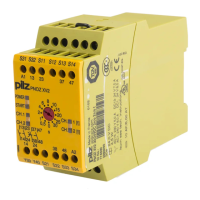
PNOZ X2.5P
4 D Betriebsanleitung
4 GB Operating instructions
4 F Manuel d'utilisation
4 E Instrucciones de uso
4 I Istruzioni per l`uso
4 NL Gebruiksaanwijzing

Question and Answer IconNeed help?

Do you have a question about the Pilz 20407-6NL-06 and is the answer not in the manual?

Overview

The Pilz PNOZ X2.5P is a safety relay designed for safety-related interruption of safety circuits, housed in an S-99 enclosure and operating on a 24 V DC supply. It complies with EN 60947-5-1, EN 60204-1, and VDE 0113-1, making it suitable for applications involving E-STOP pushbuttons and safety gates. However, it is not suitable for non-contact guards (e.g., ESPE) as dynamic start is not possible. Safety distances in accordance with EN 294 and EN 349 must be observed.

Function Description:

The safety relay ensures a safety-oriented interruption of a safety circuit. Upon application of the operating voltage, the "POWER" LED illuminates. The unit becomes operational when the reset circuit S33-S34 is closed.

  • Input Circuit Closed (e.g., Emergency Stop button not pressed): Relays K1 and K2 energize and self-retain. The "CH.1" and "CH.2" status indicators illuminate. The safety contacts (23-24/33-34) close. The semiconductor output Y11-Y12 conducts, and its status indicator illuminates.
  • Input Circuit Opened (e.g., Emergency Stop is pressed): The semiconductor output Y11-Y12 switches off, and its status indicator extinguishes. Relays K1 and K2 de-energize. The "CH.1" and "CH.2" status indicators extinguish. The safety contacts (23-24/33-34) open redundantly.

The safety function remains effective even in the event of a component failure. The correct opening and closing of the safety function relays are automatically tested during each on-off cycle.

Important Technical Specifications:

  • Electrical Data:

    • Supply Voltage (UB): 24 V DC
    • Voltage Tolerance (UB): -15% to +10%
    • Power Consumption at UB: 1.5 W
    • Residual Ripple: 20% DC
    • Voltage and Current (Input Circuit): 24 V DC, 25 mA
    • Voltage and Current (Reset and Feedback Loop): 24 V DC, 50 mA
    • Number of Output Contacts (Safety Contacts): 2
    • Utilization Category (EN 60947-4-1): AC1: 240 V (0.01-6.0 A, 1500 VA), DC1: 24 V (0.01-6.0 A, 150 W)
    • Utilization Category (EN 60947-5-1): AC15: 230 V (5.0 A), DC13: 24 V (4.0 A)
    • Conventional Thermal Current: 6.0 A
    • Contact Material: AgSnO2 + 0.2 µm Au
    • External Contact Fuse Protection (EN 60947-5-1, Ik = 1 kA): 6 A (quick-acting), 4 A (slow-acting)
    • Circuit Breaker (Characteristic B/C): 24 V AC/DC, 4 A
    • Semiconductor Output (Short-circuit proof): 24 V DC, 100 mA (external supply voltage, +/- 20% voltage tolerance)
    • Max. Overall Cable Resistance (Rimax): Input circuit (single-channel) 50 Ohm, Input circuit (dual-channel with detection of shorts across contacts) 20 Ohm
    • Min. Input Resistance when Switching On: 64 Ohm
  • Safety-Related Characteristics of the Safety Outputs:

    • PL (EN ISO 13849-1:2006): PL e (Cat. 4)
    • Category (EN 954-1): Cat. 4
    • SIL CL (EN IEC 62061): SIL CL 3
    • PFH (EN IEC 62061): 2.31E-09
    • SIL (IEC 61511): SIL 3
    • PFD (IEC 61511): 2.03E-06
    • TM [year] (EN ISO 13849-1:2006): 20
  • Times:

    • Switch-on Delay (Automatic Reset): typ. 90 ms, max. 180 ms
    • Switch-on Delay (Manual Reset): typ. 35 ms, max. 180 ms
    • Delay-on De-energisation (at E-STOP): typ. 15 ms, max. 30 ms
    • Delay-on De-energisation (with power failure): typ. 60 ms, max. 90 ms
    • Recovery Time (max. switching frequency 1/s, after E-STOP): 50 ms
    • Recovery Time (max. switching frequency 1/s, after power failure): 150 ms
    • Simultaneity Channel 1 and 2: ∞
    • Supply Interruption before De-energisation: 20 ms
  • Environmental Data:

    • EMC: EN 60947-5-1, EN 61000-6-2
    • Vibration (EN 60068-2-6): 10-55 Hz, 0.35 mm amplitude
    • Climate Suitability: EN 60068-2-78
    • Pollution Degree (EN 60947-1): 2
    • Overvoltage Category (EN 60947-1): III/II
    • Rated Insulation Voltage: 250 V
    • Rated Impulse Withstand Voltage: 4 kV
    • Ambient Temperature: -10 to +55 °C
    • Storage Temperature: -40 to +85 °C
    • Protection Type (Mounting): IP54 (cabinet), IP40 (housing), IP20 (terminals)
  • Mechanical Data:

    • Housing Material: PPO UL 94 V0 (housing), ABS UL 94 V0 (front)
    • Cable Cross Section (Screw Terminals): 0.25-2.5 mm² (1 core, flexible), 0.25-1.0 mm² (2 cores, flexible with crimp connectors, without insulating sleeve), 0.20-1.5 mm² (without crimp connectors or with TWIN crimp connectors)
    • Cable Cross Section (Spring-loaded Terminals): 0.20-1.50 mm² (flexible without crimp connectors)
    • Torque Setting (Connection Terminal Screw): 0.5 Nm
    • Termination Points per Connection: 2
    • Stripping Length: 8 mm
    • Dimensions (H x W x D): 94 x 22.5 x 121 mm (screw terminals), 101 x 22.5 x 121 mm (spring-loaded terminals)
    • Fitting Position: Any
    • Weight: 190 g

Usage Features:

  • Installation: The safety relay must be panel mounted in an enclosure with a minimum IP54 protection rating. It attaches to a DIN rail (35 mm) via a notch on the rear. For vertical mounting, it should be secured with a fixing bracket.
  • Operating Modes:
    • Single-channel operation: Input wiring according to VDE 0113 part 1 and EN 60204-1. No redundancy in the input circuit. Earth faults in the reset circuit are detected. Earth faults in the Emergency Stop circuit trigger the internal electronic fuse.
    • Two-channel operation: Redundancy in the input circuit. Earth faults in the Emergency Stop circuit and shorts across the emergency stop pushbutton are detected.
    • Automatic reset: The unit is active as soon as the input circuit is closed.
    • Manual reset: The unit is only active when a start button has been pressed.
    • Contact Expansion: The number of available contacts can be increased by connecting external contactors/relays.
  • Wiring Examples: The manual provides connection examples for Emergency Stop wiring, safety gate control, semiconductor output, and contact expansion via external contactors. For automatic reset configurations, external circuitry measures should be used to prevent unintended start-up after power loss.

Maintenance Features:

  • Troubleshooting:
    • Earth Fault: Supply voltage fails, and safety contacts open via an electronic fuse. After removing the fault cause and switching off the operating voltage for approximately 1 minute, the unit will be ready for operation.
    • Contact Failure: If contacts are welded, no further activation is possible after the input circuit opens.
    • "POWER" LED not illuminated: Indicates a short-circuit or loss of supply voltage.
  • Fuse Reset: If the internal fuse is triggered (e.g., during a short-circuit test), remove the short circuit and switch off the operating voltage for approximately 1 minute to reset the fuse.
  • Service Life: The service life graphs indicate the number of switching cycles after which wear-related failures may occur. Wear is primarily caused by electrical load, with mechanical wear being negligible. The PFH value depends on switching frequency and relay output load. If service life graphs are not available, the stated PFH value can be used, as it accounts for the relay's B10d value and other component failure rates.
  • Contact Protection: To prolong service life, adequate arc suppression must be provided on all output contacts. For capacitive loads, potential current peaks should be considered. For DC contactors, freewheeling diodes should be used for arc suppression. Using semiconductor outputs for switching 24 V DC loads is recommended.

Pilz 20407-6NL-06 Specifications

General IconGeneral
BrandPilz
Model20407-6NL-06
CategoryRelays
LanguageEnglish

Related product manuals