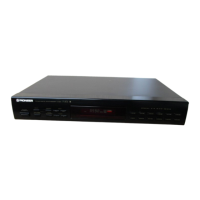
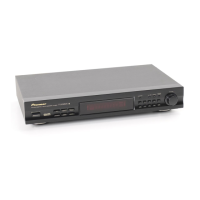
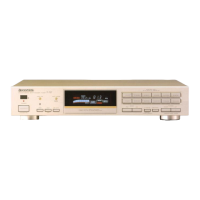
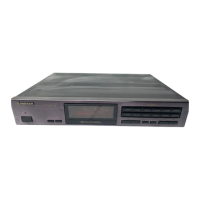
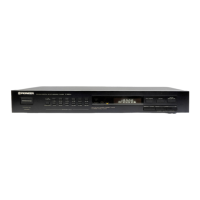
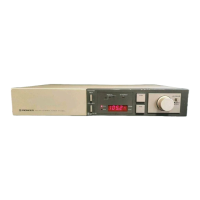
The Pioneer F-204 is an FM/AM Digital-Synthesizer Tuner designed to provide high-quality radio reception with convenient features for ease of use.
Function Description
The F-204 is a tuner that allows users to receive both FM and AM radio broadcasts. Its digital synthesizer technology ensures stable and accurate tuning. A key feature is its ability to preset up to 36 FM and AM stations, divided into three modes (12 stations per mode), for instant recall of favorite stations, particularly useful in areas with crowded frequency bands.
The tuner offers both auto and manual tuning modes. In auto tuning, it automatically searches for broadcasting stations and stops when one is found. Manual tuning allows for precise, step-by-step frequency adjustments.
A notable feature is the MPX (multiplex) MODE switch, which allows users to select between AUTO and MONO reception. When set to MONO, stereo broadcasts that are affected by noise can be tuned in with greater clarity, improving reception quality in challenging signal conditions. This MONO reception mode can be preset for individual broadcasting stations.
The RF ATT button is another useful feature for FM reception. When set to ON, it reduces sound distortion caused by strong FM signals from nearby stations. This button's status can be preset for each station in memory.
The unit also includes a POWER (STANDBY/ON) switch. In the ON position, power is supplied and the unit becomes operational. In STANDBY, the main power flow is cut, but a minute flow of power maintains operation readiness, allowing memory backup as long as the power cord is plugged in. If the power cord is unplugged, the memory will be retained for several days.
The FM/AM CHANNEL STEP switch, located on the rear panel, allows adjustment of the channel allotment plan. This switch is factory-set to the power requirements of the destination and can be adjusted for different regions (e.g., 100 kHz/10 kHz for FM/AM or 50 kHz/9 kHz for FM/AM). Changing this setting will erase previously memorized stations.
Important Technical Specifications
FM Tuner Section:
- Frequency Range: 87.5 MHz to 108 MHz
- Usable Sensitivity (IHF): 12.7 dBf (1.2 µV/75 Ω)
- 50 dB Quieting Sensitivity:
- Mono: 18 dBf (2.2 µV/75 Ω)
- Stereo: 38.3 dBf (22.6 µV/75 Ω)
- Signal-to-Noise Ratio:
- Mono: 78 dB (at 85 dBf)
- Stereo: 74 dB (at 85 dBf)
- Distortion (1 kHz): 0.3%
- Alternate Channel Selectivity (300 kHz): 60 dB
- Stereo Separation (1 kHz): 40 dB
- Frequency Response: 30 Hz to 15 kHz ±1 dB
- Image Response Ratio: 50 dB
- IF Response Ratio: 90 dB
- Antenna Input: 75 Ω unbalanced
- Output: 650 mV (100% MOD.)
AM Tuner Section:
- Frequency Range:
- Australian model: 531 kHz - 1,602 kHz
- Multi-voltage model: 531 kHz - 1,602 kHz (step 9 kHz) / 530 kHz - 1,700 kHz (step 10 kHz)
- Sensitivity (IHF, Loop antenna): 350 µV/m
- Selectivity: 20 dB
- Signal-to-Noise Ratio: 50 dB
- Antenna: Loop Antenna
- Output: 150 mV (30% MOD.)
Miscellaneous:
- Power Requirements:
- Australian model: a.c. 240 Volts~, 50/60 Hz
- Multi-voltage models: AC 110/120-127/220/240 V (switchable), 50/60 Hz
- Power Consumption: 10 W
- Dimensions: 420 (W) x 70.0 (H) x 284 (D) mm
- Weight (without package): 2.6 kg
Usage Features
The F-204 is designed for straightforward operation.
- Tuning: Users can select between auto and manual tuning modes using the TUNING AUTO/MANU button. The TUNING (-)/(+) buttons are used to locate stations. In auto mode, holding the button scans for the next station; in manual mode, quick presses adjust the frequency step by step.
- Band Selection: The BAND (FM/AM) selector buttons allow switching between FM and AM reception bands.
- Presetting Stations: To memorize a station, tune to the desired frequency, press the MEMORY button (the display will flash), and then press a STATION CALL button corresponding to the desired preset number. Stations can be stored in three modes (1-12, 13-24, 25-36) by pressing the STATION CALL button once, twice, or three times, respectively.
- Recalling Stations: To recall a preset station, simply press the corresponding STATION CALL button.
- Last Station Memory: The tuner automatically recalls the last station received before power was turned off or before the band was changed.
- Antenna Connections: The tuner comes with an AM loop antenna and an FM T-type antenna. Proper connection and placement of these antennas are crucial for good reception. For weak signals or noisy conditions, external FM and AM antennas can be connected. A 75 Ω coaxial cable is recommended for external FM antennas to reduce extraneous noise.
- Control Jacks: For integrated control with other Pioneer components bearing an "ER" mark, the tuner's CONTROL IN jack can be connected to a component's CONTROL OUT jack using the supplied control cord. This enables remote control of the tuner via the connected component's remote control unit.
Maintenance Features
- Location: Install the tuner in a well-ventilated area, away from direct sunlight, hot appliances, radiators, and sources of excessive heat, dampness, dust, or oily smoke. Avoid unstable or inclined surfaces.
- Power Cord: Handle the power cord by the plug, avoid pulling the cord, and do not touch it with wet hands. Ensure the cord is not pinched, knotted, or stepped on. Regularly inspect the power cord for damage.
- External Surfaces: Use a polishing cloth or dry cloth to wipe off dust and dirt. For very dirty surfaces, use a soft cloth dipped in a diluted neutral cleanser, wrung out well, then wipe with a dry cloth. Avoid furniture wax, cleaners, thinners, benzine, insecticide sprays, or other chemicals, as they can corrode the surfaces.
- Condensation: If the unit is moved from a cold to a warm room or if the room temperature suddenly increases, condensation may form inside. To prevent this, allow the unit to stand for about an hour or gradually raise the room temperature.
- Troubleshooting: The manual provides a comprehensive troubleshooting guide for common issues like no power, no sound, and sound distortion, along with recommended remedies. In cases of abnormal functioning due to static electricity or external interference, turning the power off and on again, or unplugging and replugging the AC power cord, can restore normal operation.

 Need help?

 To Next Page
 General