EasyManua.ls Logo

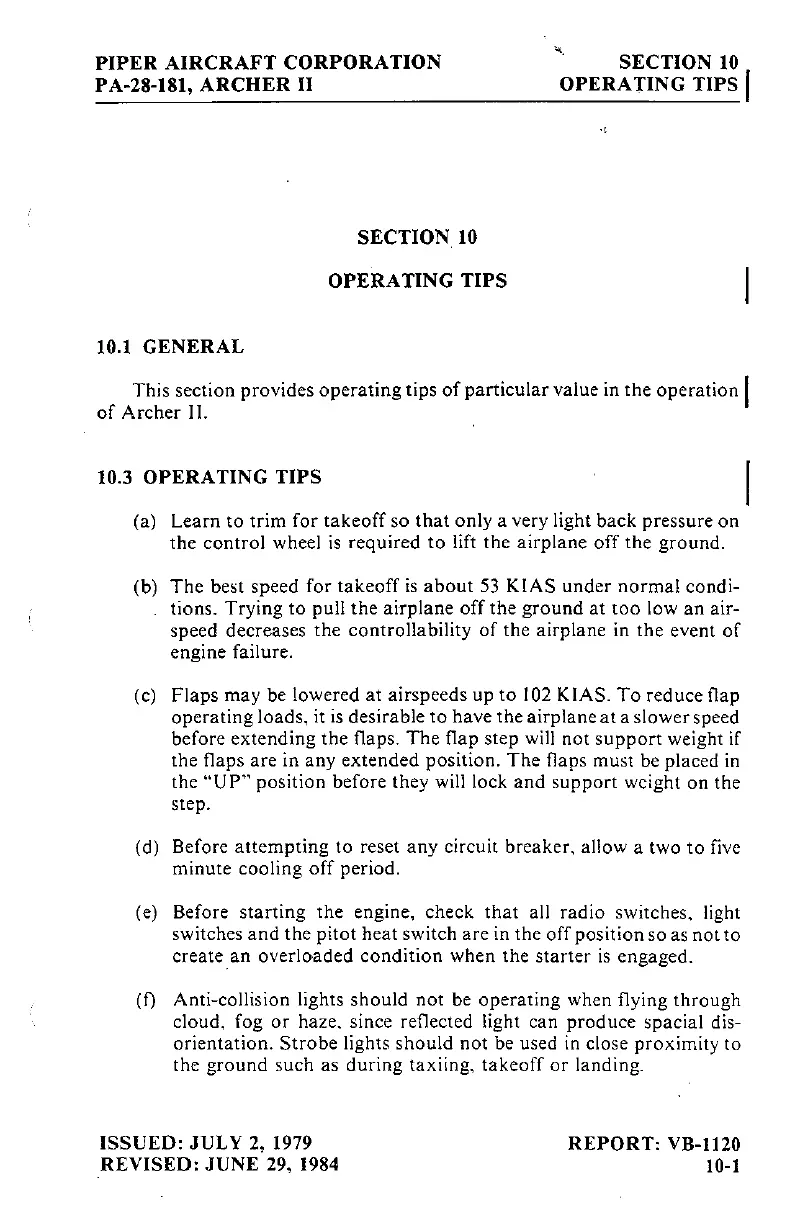
Piper ARCHER II - Operating Tips; Learn to trim for takeoff; Best speed for takeoff; Flaps may be lowered

Piper ARCHER II
286 pages
Print Icon
To Next Page IconTo Next Page
To Previous Page IconTo Previous Page
Loading...
PIPER
AIRCRAFT
CORPORATION
*
SECTION
10
PA-28-181,
ARCHER
II
OPERATING
TIPS
|
SECTION
10
OPERATING
TIPS
|
10.1
GENERAL
This
section
provides
operating
tips
of
particular
value
in
the
operation
|
of
Archer
II.
10.3
OPERATING
TIPS
;
|
(a)
Learn
to
trim
for
takeoff
so
that
only
a
very
light
back
pressure
on
the
control
wheel
is
required
to
lift
the
airplane
off
the
ground.
(b)
The
best
speed
for
takeoff
is
about
53
KIAS
under
norma!
condi-
.
tions.
Trying
to
pull
the
airplane
off
the
ground
at
too
low
an
air-
speed
decreases
the
controllability
of
the
airplane
in
the
event
of
engine
failure.
(c)
Flaps
may
be
lowered
at
airspeeds
up
to
102
KIAS.
To
reduce
flap
operating
loads,
it
is
desirable
to
have
the
airplane
at
a
slower
speed
before
extending
the
flaps.
The
flap
step
will
not
support
weight
if
the
flaps
are
in
any
extended
position.
The
flaps
must
be
placed
in
the
“UP”
position
before
they
will
lock
and
support
weight
on
the
step.
(d)
Before
attempting
to
reset
any
circuit
breaker,
allow
a
two
to
five
minute
cooling
off
period.
(e)
Before
starting
the
engine,
check
that
all
radio
switches,
light
switches
and
the
pitot
heat
switch
are
in
the
off
position
so
as
notto
create
an
overloaded
condition
when
the
starter
is
engaged.
(f}
Anti-collision
lights
should
not
be
operating
when
flying
through
cloud,
fog
or
haze,
since
reflected
light
can
produce
spacial
dis-
orientation.
Strobe
lights
should
not
be
used
in
close
proximity
to
the
ground
such
as
during
taxiing,
takeoff
or
landing.
ISSUED:
JULY
2,
1979
REPORT:
VB-1120
REVISED:
JUNE
29,
1984
10-1

Table of Contents

Related product manuals