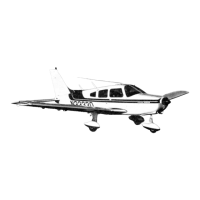
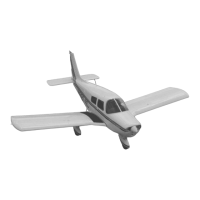
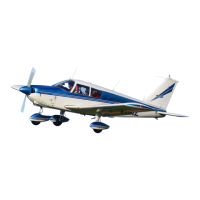
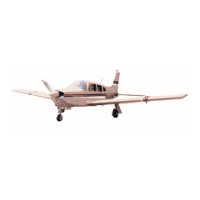
ARROW I1
Check vacuum gauge. Indicator should read 5" Hg
f
.I" Hg at 2000 RPM. Check both the
oil temperature and pressure. The temperature may
be
low for some time if the engine is being
run for the first time of the day, but as long as the pressure is within limits the engine is ready
for takeoff. For air conditioner ground check, refer to page 7-10.
Check the annunciator panel lights with the press-to-test button*.
The propeller control should be moved through its complete range to check for proper
operation and then placed to full increase RPM for take-off. To obtain maximum RPM, push
the pedestal-mounted control fully toward the instrument panel. In cold weather the propeller
control should be cycled at least three times to ensure that warm engine oil has circulated
through the system.
The electric fuel pump should be turned off momentarily during ground check to make
sure that the engine driven pump is operating. The electric fuel pump should be on during
take-off to prevent loss of power should the engine driven pump fail. The engine is warm
enough for take-off when the throttle can be opened without the engine faltering.
TAKE-OFF
Just before take-off the following items should be checked:
1. Fuel
-
on proper tank
2. Electric fuel pump
-
ON
3. Engine gauges
-
checked
4.
Flight instruments
-
checked and set as required
5. Master Switch
-
ON
6. Alternate air
-
closed
7. Prop
-
set
8.
Mixture
-
set
9.
Seat backs
-
erect
10. Fasten
beltstharness
11. Empty seats
-
seat belts snugly fastened
12. Flaps
-
exercised and set
1
3.
Trim' tab
-
set
14. Controls
-
free
15. Door
-
latched
16. Air condition
-
OFF
The takeoff technique is conventional for the Cherokee Arrow
11.
The tab should be set
slightly aft of neutral, with the exact setting determined by the loading of the aircraft. Allow
the airplane to accelerate to 60 to 70 MPH. Then ease back on the wheel enough to let the
airplane fly from the ground.
*Serial nos. 7535001 and up
7-4
OPERATING INSTRUCTIONS
REVISED:
JUNE
27,1975


 To Next Page
 Loading...