9.1 PGH Filter Overview:
The lter has dened the sound of Pittsburgh Modular from the moment it was introduced. A
distinct sound that has been tweaked to perfection. It offers a warm, organic sweep through
the full frequency range. The lowpass lter is gummy and relaxed while the highpass is clean
and dened. The goal was to produce a lter that did not have a dead spot; where every turn
of the frequency knob produces something interesting.
9.2 PGH Filter Response:
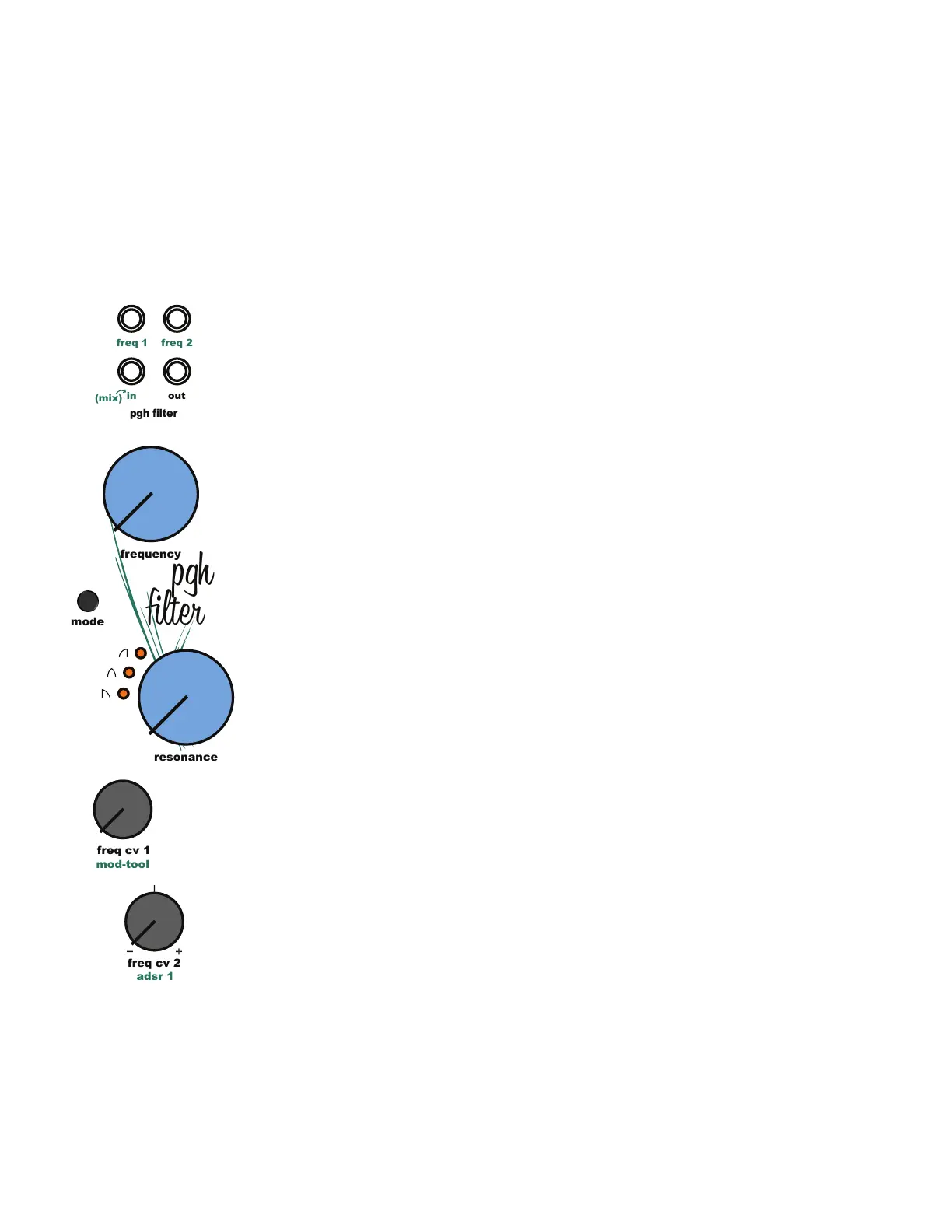
The PGH Filter module is a voltage controlled, analog, 2 pole, 12db state variable lter. State
variable topology offers several lter output responses, highpass , bandpass , lowpass ,
and notch . Select a lter response using the [Filter Mode Button]. Each response produces
a very smooth and natural sounding sweep.
Filter Response Options
1. Lowpass Filter [Lowpass LED]
2. Lowpass + Bandpass Filter [Lowpass and Bandpass LED]
3. Bandpass Filter [Bandpass LED]
4. Bandpass + Highpass Filter [Bandpass and Highpass LED]
5. Highpass Filter [Highpass LED]
6. Lowpass + Highpass Filter (Notch Filter) [Lowpass and Highpass LED]
7. Random Filter Response [All LEDs ON]
9.3 PGH Filter Resonance:
One of the more interesting aspects of a state variable lter is the ability to offer near innite
resonance without self-oscillating by amplifying a narrow band of frequencies around the lter
Cutoff frequency. This helps to shape the smooth, musical sound of the PGH Filter. The amount
of resonance available is headroom dependent. Smaller incoming audio signals allow more
headroom for resonance and larger incoming audio signals allow less headroom for
resonance.
9.4 PGH Filter Frequency Modulation:
The frequency of the lter can be modulated using a pair of CV inputs [Filter Frequency CV 1
Input Jack] and [Filter Frequency CV 2 Input Jack].
[Filter Frequency CV 1 Input Jack] Input passes through an attenuator and is normaled to the
[Multi Output Jack]. This input is best for bipolar modulation sources like the LFO.
[Filter Frequency CV 2 Input Jack] Input passes through an attenuverter and is normaled to the
[ADSR 1 Output Jack] This input is best for unipolar modulation sources like the ADSR because it
allow the modulation to be applied positively or negatively.
9 PGH Filter Module
freq cv 1
pgh lter
out
freq 2freq 1
in
mode
mod-tool
(mix)
pgh
lter
resonance
frequency
freq cv 2
adsr 1
_
_
_


 To Next Page