EasyManua.ls Logo

Poly IP 6000 - User Manual

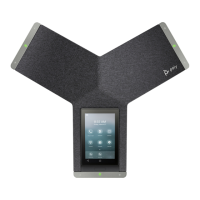
Poly IP 6000
2 pages
Print Icon
To Next Page IconTo Next Page
Loading...
POLY IP 6000
QUICK START
USER’S GUIDE
Basic Phone Features
Placing Calls
Answering Calls
Press , enter the phone number, and
then press the Send soft key.
Press the Answer soft key.
To ignore an incoming call, press the
Reject soft key.
During a call, press
End Call soft key.
During a call, press . If you use
external microphones, you can also press
on the microphones. The console
LEDs will glow red.
You can hear all other parties while Mute
is enabled. The other parties cannot hear
To turn o Mute, press again.
During a call, press the
console LEDs will blink red.
To resume the call, press the
Resume soft key.
To call the last number you dialed, press
To prevent your phone from ringing,
enable Do Not Disturb. See Using Do
Not Disturb.
Ending Calls
Muting the Microphone
you.
Holding and Resuming Calls
Redialing Numbers
.
Transferring Calls
To transfer a call:
1. During a call, press the Trnsfer soft
key. The active call is placed on hold.
2. Enter the number of the party to which
you want to transfer the call, and then
press the Send soft key.
To cancel the transfer before the call
connects, press the Cancel soft key.
The original call resumes.
3. When you hear the ring-back sound, or
after you speak with the second party,
press the Trnsfer soft key.
Forwarding Calls
To enable call forwarding:
1. From the idle screen, press the
Forward soft key.
2. Select the forwarding type you want to
enable:
Always —To forward all incoming
calls.
No Answer —To forward all
unanswered incoming calls.
Busy—To forward calls that arrive
when you are already in a call.
3. Enter a number to forward calls to. For
No Answer, enter the number of rings
before forwarding.
4. Press the Enable soft key.
To disable call forwarding:
1. From the idle screen, press the
Forward soft key.
2. Select the forwarding type you want to
disable.
3. Press the Disable soft key.
You can automatically transfer the call
without speaking to the second party.
After you complete step 1, press the
Blind soft key. Then, complete step 2.
Hosting Conference Calls
You can create a conference with up to
two other parties.
To host a conference:
1. Call the rst party.
2. After the rst party answers, press the
Confrnc soft key. The active call is
placed on hold.
3. Enter the number of the second party,
and then press the Send soft key.
4. When the second party answers, press
the Confrnc soft key. All parties are
now joined in the conference. You can
do the following:
To put the conference on hold,
press the Hold
soft key. To resume
the conference, press the
Resume soft key.
To end the conference, press the
End Call soft key. (The other
parties will remain connected.)
To end the conference and split the
conference into two separate calls
on hold, press the Split soft key.
Speed Dialing
To place a call using a speed dial index
number:
1. Press .
2. Enter the contact’s speed dial index
number. Or, if you do not know the
index number, scroll to the contact and
press the Dial soft key.
If you have an active call and a call on
hold, you can create a conference
between all three
parties by pressing
the Join soft key.
To change speed dial index numbers,
see Updating Contact Directory.
Question and Answer IconNeed help?

Do you have a question about the Poly IP 6000 and is the answer not in the manual?

Summary

Basic Phone Features

Placing Calls

Steps to initiate a phone call by dialing a number and pressing the Send soft key.

Answering Calls

How to accept or reject incoming calls and manage Do Not Disturb settings.

Ending Calls

Procedure to terminate an active call by pressing the End Call soft key.

Muting the Microphone

How to mute and unmute the microphone during a call, with visual indicators.

Holding and Resuming Calls

Steps to place a call on hold and retrieve it using soft keys.

Redialing Numbers

How to redial the last dialed number by pressing a specific key.

Call Management Features

Transferring Calls

Guide to transferring an active call to another party or performing a blind transfer.

Forwarding Calls

Steps to enable or disable call forwarding for different scenarios (always, no answer, busy).

Hosting Conference Calls

How to create and manage conference calls with multiple parties, including hold and split options.

Speed Dialing

How to place calls using speed dial index numbers for quick access.

Phone Configuration and Settings

Using Do Not Disturb

Steps to activate or toggle the Do Not Disturb feature to prevent incoming calls.

Using Call Lists

How to access and manage lists of missed, received, or placed calls.

Accessing Voice Mail

Procedure to listen to voice mail messages via the Message Center.

Updating Contact Directory

Adding, editing, and searching contacts, including setting speed dial numbers.

Updating Ring Tones

How to change the phone's incoming ring tone and assign custom tones to contacts.

Adjusting Speaker and Ringer Volume

How to change the speaker volume during calls and the ringer volume when idle.

Overview

This document serves as a quick start user's guide for the Poly IP 6000, a communication device designed for various calling functions, including basic calls, transfers, forwarding, and conference calls. It also covers features for customizing the device, such as updating contact directories, changing ring tones, and adjusting volume.

Function Description

The Poly IP 6000 is primarily a voice communication device. Its core function is to facilitate telephone calls, allowing users to make, receive, and manage calls efficiently. It supports standard calling features like placing and answering calls, as well as more advanced functionalities such as call transferring, call forwarding, and hosting multi-party conference calls. The device also incorporates features for call management, including muting the microphone, holding and resuming calls, and redialing previously dialed numbers. For personalization and ease of use, it allows for the creation and management of a contact directory, customization of ring tones, and adjustment of audio volumes. The device also includes a "Do Not Disturb" feature to prevent interruptions and provides access to call lists for missed, received, and placed calls, enhancing call tracking and management. Voice mail access is also integrated, indicated by visual and auditory cues.

Usage Features

Basic Call Handling:

  • Placing Calls: To initiate a call, users press the "Dial" button, enter the desired phone number, and then press the "Send" soft key.
  • Answering Calls: Incoming calls are answered by pressing the "Answer" soft key. Users can choose to ignore an incoming call by pressing the "Reject" soft key.
  • Ending Calls: During an active call, pressing the "End Call" soft key terminates the conversation.
  • Redialing: The device allows for quick redialing of the last number called by pressing a dedicated redial button.

Call Management:

  • Muting the Microphone: During a call, users can mute their microphone by pressing the "Mute" button. If external microphones are in use, they can also be muted. A red LED indicator confirms that the microphone is muted, allowing the user to hear other parties while preventing others from hearing them. Pressing the "Mute" button again deactivates the mute function.
  • Holding and Resuming Calls: An active call can be placed on hold by pressing the "Hold" button. The console LEDs will blink red to indicate a held call. To resume the call, the "Resume" soft key is pressed.
  • Do Not Disturb: To prevent the phone from ringing, users can enable "Do Not Disturb" through the menu. This feature can be toggled on and off as needed.

Advanced Call Features:

  • Transferring Calls: The device supports call transfers. During an active call, pressing the "Transfer" soft key places the current call on hold. The user then enters the number of the party to whom the call is to be transferred and presses "Send." The transfer can be canceled before connection by pressing "Cancel." Once the second party answers or after speaking with them, pressing "Transfer" completes the transfer. A "Blind" transfer option is also available, allowing the call to be transferred without speaking to the second party.
  • Forwarding Calls: Call forwarding can be enabled from the idle screen. Users select a forwarding type: "Always" (forwards all incoming calls), "No Answer" (forwards unanswered calls), or "Busy" (forwards calls when the user is already on a call). A destination number for forwarding must be entered, and for "No Answer," the number of rings before forwarding can be specified. The "Enable" soft key activates forwarding, and the "Disable" soft key deactivates it.
  • Hosting Conference Calls: The device allows users to host a conference call with up to two other parties. The process involves calling the first party, and once they answer, pressing the "Conference" soft key. This places the first call on hold. The user then dials the second party, and once they answer, pressing "Conference" again joins all parties into the conference. During a conference, users can put the conference on hold, resume it, end the entire conference, or split the conference into two separate held calls. If an active call and a held call exist, a "Join" soft key can be used to create a conference with all three parties.

Contact Management and Personalization:

  • Speed Dialing: Calls can be placed using speed dial index numbers. Users press a dedicated speed dial button, enter the contact's index number, or scroll to the contact and press "Dial."
  • Call Lists: The device maintains lists of missed, received, and placed calls. Users can access these lists through the menu to view call details, dial a number from the list, edit a number before dialing, remove a call from the list, or save a contact to the directory.
  • Updating Contact Directory: Contacts can be added to the directory by accessing the "Contact Directory" through the menu. Users enter contact information, including first and last name, phone number, and optionally, a speed dial index number, ring type, and a "Divert Contact" (a third party to whom calls from this contact will be sent). Options for "Auto Reject" (diverts calls to voicemail) and "Auto Divert" (diverts calls to the specified Divert Contact) can also be enabled or disabled. Existing contacts can be edited, and the directory can be searched by entering characters of a contact's name.
  • Updating Ring Tones: Users can change the incoming ring tone for the phone globally or set distinctive ring tones for specific contacts. To change the global ring tone, users navigate to "Settings > Basic > Ring Type" in the menu, scroll through available ring types, and can preview them before selecting. To set a ring tone for a contact, users edit the contact in the directory and navigate to the "Ring Type" field, entering a number corresponding to a desired ring type.
  • Adjusting Speaker and Ringer Volume: Speaker volume can be adjusted during a call using dedicated volume buttons. Ringer volume can be adjusted when the phone is idle using the same volume buttons. The device also allows for a silent ring option through ring tone settings, complementing the "Do Not Disturb" feature.

Voice Mail Access:

  • The device provides visual cues (an icon on the screen, flashing red LEDs) and auditory cues (a stutter dial tone) to indicate new voice mail messages. Users can access their voice mail by navigating to "Features > Messages > Message Center" in the menu, pressing the "Connect" soft key, and then following the voice or visual prompts.

Maintenance Features

The document does not explicitly detail maintenance features in the traditional sense (e.g., cleaning instructions, troubleshooting steps for hardware issues). However, it does cover aspects of software and configuration maintenance that contribute to the device's ongoing usability and performance:

  • Updating Contact Directory: The ability to add, edit, and search contacts ensures that the user's contact information remains current and accessible, which is a form of data maintenance.
  • Customizing Ring Tones and Volume: These features allow users to maintain their preferred audio settings, adapting the device to their environment and personal preferences over time.
  • Managing Call Forwarding and Do Not Disturb: These settings can be enabled and disabled as needed, allowing users to adapt the phone's behavior to changing schedules or needs, which is a form of operational maintenance.
  • Accessing Call Lists: The call lists provide a record of call history, which can be reviewed and managed (e.g., removing calls from the list), contributing to the organization of call data.

In essence, the "maintenance" described in this guide focuses on user-driven configuration and data management to ensure the device remains tailored to the user's communication needs and preferences. There are no explicit instructions for physical cleaning, software updates, or hardware troubleshooting within this quick start guide.

Poly IP 6000 Specifications

General IconGeneral
ProtocolsSIP, H.323
DisplayBacklit LCD
Audio QualityWideband audio
Echo CancellationYes
Noise ReductionYes
ConnectivityEthernet
PowerPower over Ethernet (PoE)
SpeakerphoneFull-duplex
ExpandabilityOptional expansion microphones
CompatibilityCompatible with major UC platforms

Related product manuals