3
g) If devices are provided for the
connection of dust extraction and
collection facilities, ensure these are
connected and properly used. Use of
dust collection can reduce dust-related
hazards.
4) POWER TOOL USE AND CARE
a) Do not force the power tool. Use the
correct power tool for your application.
The correct power tool will do the job
better and safer at the rate for which it was
designed.
b) Do not use the power tool if the switch
does not turn it on and off. Any power
tool that cannot be controlled with the
switch is dangerous and must be repaired.
c) Disconnect the plug from the power
source and/or the battery pack from
the power tool before making any
adjustments, changing accessories,
or storing power tools. Such preventive
safety measures reduce the risk of starting
the power tool accidentally.
d) Store idle power tools out of the reach
of children and do not allow persons
unfamiliar with the power tool or these
instructions to operate the power tool.
Power tools are dangerous in the hands of
untrained users.
e) Maintain power tools. Check for
misalignment or binding of moving
parts, breakage of parts and any other
condition that may affect the power
tool’s operation. If damaged, have the
power tool repaired before use. Many
accidents are caused by poorly maintained
power tools.
f) Keep cutting tools sharp and clean.
Properly maintained cutting tools with
sharp cutting edges are less likely to bind
and are easier to control.
g) Use the power tool, accessories and
tool bits, etc. in accordance with these
instructions, taking into account the
working conditions and the work to
be performed. Use of the power tool for
operations different from those intended
could result in a hazardous situation.
5) SERVICE
a) Have your power tool serviced by a
qualified repair person using only
identical replacement parts. This will
ensure that the safety of the power
tool is maintained.
SAFETY INSTRUCTIONS FOR ALL
OPERATIONS
Safety Warnings Common for Grinding,
Sanding, Wire Brushing, or Abrasive,
Cutting-Off Operations
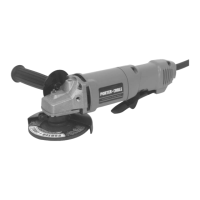
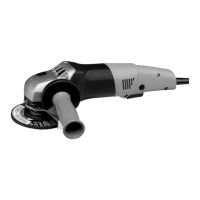
a) This power tool is intended to
function as a grinder, sander,
wire brush, or cut-off tool. Read
all safety warnings, instructions,
illustrations and specifications
provided with this power tool. Failure
to follow all instructions listed below
may result in electric shock, fire and/or
serious injury.
b) Do not use accessories which
are not specifically designed
and recommended by the tool
manufacturer. Just because the
accessory can be attached to your
power tool, it does not assure safe
operation.
c
) The rated speed of the accessory
must be at least equal to the maximum
speed marked on the power tool.
Accessories running faster than their
rated speed can break and fly apart.
d) The outside diameter and the
thickness of your accessory must
be within the capacity rating of
your power tool. Incorrectly sized
accessories cannot be adequately
guarded or controlled.
e) The arbor size of wheels,
flanges, backing pads or any
other accessory must properly
fit the spindle of the power tool.
Accessories with arbor holes that do
not match the mounting hardware of
the power tool will run out of balance,
vibrate excessively and may cause
loss of control.
f) Do not use a damaged accessory.
Before each use inspect the
accessory such as abrasive wheel
for chips and cracks, backing pad
for cracks, tear or excess wear,
wire brush for loose or cracked
wires. If power tool or accessory
is dropped, inspect for damage or
install an undamaged accessory.
After inspecting and installing an
accessory, position yourself and
bystanders away from the plane of
the rotating accessory and run the
power tool at maximum no-load
speed for one minute. Damaged
accessories will normally break apart
during this test time.
g) Wear personal protective equipment.
Depending on application, use face
shield, safety goggles or safety
glasses. As appropriate, wear dust
mask, hearing protectors, gloves
and work shop apron capable of
stopping small abrasive or workpiece
fragments. The eye protection must
be capable of stopping flying debris
generated by various operations.
The dust mask or respirator must be
capable of filtrating particles generated
by your operation. Prolonged exposure
to high intensity noise may cause
hearing loss.
h) Keep bystanders a safe distance away
from work area. Anyone entering


 To Next Page