6
California to cause cancer, birth defects
or other reproductive harm. Some
examples of these chemicals are:
• leadfromlead-basedpaints,
• crystallinesilicafrombricksandcement
and other masonry products, and
• arsenicandchromiumfrom
chemically-treated lumber.
Your risk from these exposures varies,
depending on how often you do this type
of work. To reduce your exposure to these
chemicals: work in a well ventilated area,
and work with approved safety equipment,
such as those dust masks that are specially
designed to filter out microscopic particles.
•Avoid prolonged contact with dust
from power sanding, sawing, grinding,
drilling, and other construction
activities. Wear protective clothing
and wash exposed areas with soap
and water. Allowing dust to get into your
mouth, eyes, or lay on the skin may
promote absorption of harmful chemicals.
WARNING:
Use of this tool can
generate and/or disperse dust, which may
cause serious and permanent respiratory or
other injury. Always use NIOSH/OSHA
approved respiratory protection appropriate
for the dust exposure. Direct particles away
from face and body.
WARNING: Do not operate this tool
for long periods of time. Vibration caused
by the operating action of this tool may
cause permanent injury to fingers, hands,
and arms. Use gloves to provide extra
cushion, take frequent rest periods, and
limit daily time of use.
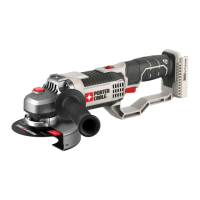
WARNING: When not in use, place
grinder on a stable surface where it will
not move inadvertently, roll or cause a
tripping or falling hazard. The grinder may
stand upright on the battery pack but may
be easily knocked over. Serious personal
injury may result.
CAUTION: To reduce the risk of
personal injury, use extra care when
working into a corner or edge because a
sudden, sharp movement of the tool may
be experienced when the wheel or other
accessory contacts a secondary surface or
a surface edge.
•
When using an extension cord, be sure to
use one heavy enough to carry the current
your product will draw. An undersized cord
will cause a drop in line voltage resulting
in loss of power and overheating. The
following table shows the correct size
to use depending on cord length and
nameplate ampere rating. If in doubt, use
the next heavier gage. The smaller the
gage number, the heavier the cord.
SYMBOLS
The label on your tool may include the
following symbols. The symbols and their
definitions are as follows:
V ..................volts
A ..................amperes
Hz ................hertz
W .................watts
min ..............minutes
...............alternating current
or DC ...direct current
n
o ................no load speed
................Class I Construction
(grounded)
................earthing terminal
...............safety alert symbol
...........Class II Construction
(double insulated)
.../min or rpm...revolutions or
reciprocation per minute
SPM ............Strokes per minute
5/8 -11 …………. Arbor size and Thread
count per inch
............
Read instruction manual before use
................Use proper eye protection
................Use proper hearing protection
...................
Use proper respiratory protection
SAVE THESE INSTRUCTIONS
Minimum Gauge for Cord Sets
Volts Total Length of Cord in Feet
120V 0-25 26-50 51-100 101-150
(0-7,6m)(7,6-15,2m)(15,2-30,4m)(30,4-45,7m)
Ampere Rating
More Not more American Wire Gauge
Than Than
6 - 10 18 16 14 12


 To Next Page