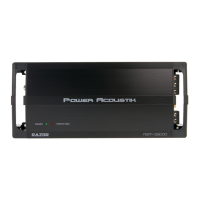
The Power Acoustik Platinum Series amplifiers (Models A.75, A.100, A.125) are high-quality car audio amplifiers designed for robust performance and reliability. These amplifiers are "over built" with a focus on durability and sound quality, utilizing advanced components and protective features.
Function Description:
The Power Acoustik Platinum Series amplifiers are designed to amplify audio signals from a head unit, pre-amp, or crossover, delivering power to speakers in a car audio system. They can operate in stereo, mono (bridged), or mixed-mono modes, offering flexibility for various audio setups. The amplifiers are equipped with a regulated power supply and high-current MOSFETs to ensure stable and efficient power delivery. The audio section features high-current Darlington outputs for clear and powerful sound reproduction.
Important Technical Specifications:
- Power Output (at 13.8Vdc input):
- Stereo Mode (4Ω/Ch):
- Model A.75: 75W/Ch @ 4Ω
- Model A.100: 100W/Ch @ 4Ω
- Model A.125: 125W/Ch @ 4Ω
- Stereo Mode (2Ω/Ch):
- Model A.75: 120W/Ch @ 2Ω
- Model A.100: 150W/Ch @ 2Ω
- Model A.125: 180W/Ch @ 2Ω
- Mono Mode (4Ω/Ch, Bridged):
- Model A.75: 180W/Br @ 4Ω
- Model A.100: 240W/Br @ 4Ω
- Model A.125: 300W/Br @ 4Ω
- Total Harmonic Distortion + Noise (THD+N) at rated power 4 ohms: 0.01%
- Signal to Noise Ratio: 100dB
- Frequency Response: 5Hz to 50,000Hz
- Power Supply: Low noise MOSFET power supply with 35 Amp high current MOSFETs.
- Filter Capacitors: Large computer-grade filter capacitors, glued to the PCB to prevent breakage.
- Transformer: High efficiency potted transformer for low noise.
- Input/Output Terminals: Gold plated RCA.
- Stability: 2 ohm stable in stereo mode.
- Heatsink: Massive extruded heatsink for efficient heat dissipation.
- Origin: Made in the U.S.A.
Usage Features:
- Installation: It is strongly recommended to have the amplifier installed by a professional dealer or installer. If self-installing, careful adherence to instructions is crucial. The amplifier should be mounted in an area with adequate ventilation (e.g., trunk or under the seat) to dissipate heat, avoiding upside-down mounting to prevent premature thermal protection. Secure mounting is essential.
- Input Connections: Connect right and left RCA outputs from the head unit, pre-amp, or crossover to the amplifier's corresponding inputs. In bridge mode, only one input is needed due to the internal bridging switch. High-quality cables should be used, and signal cables should be routed away from power and high tension lines.
- Power Connections:
- Power (+): Use 8-12 gauge power cable from the battery positive (+), with a fuse or circuit breaker placed approximately 18 inches or less from the battery. Ensure a clean and secure connection, coated with terminal grease or petroleum jelly. Route power cables away from signal and high tension lines.
- Ground (-): Use the same gauge cable as the power connection. Securely connect the ground terminal to a clean grounding location on the chassis, no more than three feet from the amplifier. Coat with terminal grease or petroleum jelly.
- Remote: Connect to the remote turn-on lead of the head unit or cascaded from another remote device. For head units without auto antenna output, a separate switch may be needed for manual on/off control.
- Speaker Connections:
- Stereo Operation: Connect right positive (+) and negative (-) speaker leads to the corresponding amplifier terminals, maintaining correct polarity for both left and right speakers.
- Mono Operation: Connect the speaker positive (+) to the amplifier's right positive (+) and the speaker negative (-) to the amplifier's left negative (-).
- Mixed-Mono Systems: Can be built using stereo and mono hookups simultaneously, potentially requiring a passive crossover. The subwoofer system MUST NOT be lower than 4Ω, and the satellite system not less than 2Ω per channel.
- Operating Modes:
- Stereo Mode: Connect RCA inputs, set stereo/mono switch to stereo, turn gain counter-clockwise to low, and connect power, ground, remote, and speaker wires.
- Mono Mode: Connect one RCA input, set stereo/mono switch to mono, turn gain counter-clockwise to low, and connect power, ground, remote, and speaker wires. Important: Do not use less than a 4Ω load in mono bridged mode. Each channel "sees" half the actual load impedance (a 4Ω speaker load is "seen" as a 2Ω load).
- Mixed Mono Mode: For three-channel capacity, connect highpass (satellite) speakers as per normal stereo hookup and lowpass (subwoofer) as per mono mode hookup. Utilize suitable passive crossovers and avoid overlapping crossover points to prevent lower impedances and amplifier failure.
- Level Adjustments: Set the input gain level to match the head unit or crossover's rated output level, avoiding clipping. To set, turn amplifier gain to minimum, head unit volume to a nominal point (1 or 2 O'clock), then increase amplifier gain until audible distortion begins, then back down slightly. This maximizes dynamic range, signal-to-noise ratio, and noise immunity.
- Fusing: Use a fuse NO LARGER than specified:
- 4Ω/Ch: Model A.75 (20 Ampere), Model A.100 (25 Ampere), Model A.125 (30 Ampere).
- 2Ω/Ch: Model A.75 (35 Ampere), Model A.100 (40 Ampere), Model A.125 (45 Ampere).
- Mono Mode (4Ω/Ch): Model A.75 (35 Ampere), Model A.100 (40 Ampere), Model A.125 (45 Ampere).
Maintenance Features:
- Protection Circuitry: Features four-way protection: Speaker to ground, Direct Speaker short, Thermal (overheat), and High/Low inhibit. This protects both the amplifier and the audio system.
- Soft Start Operation: Ensures a smooth power-up sequence.
- LED Power/Protect Indicator: Provides visual feedback on the amplifier's status.
- Component Durability: Capacitors are glued to the printed circuit board to eliminate breakage, enhancing long-term reliability.
- Heat Management: The massive extruded heatsink and proper mounting ensure efficient heat dissipation, preventing thermal issues.

 Need help?
 General



 To Next Page