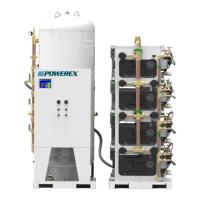
Dew Point Monitor
Powerex • 150 Producon Drive • Harrison, OH 45030 • USA
P 1.888.769.7979 • F 513.367.3125 • www.powerexinc.com
IN907800AV • 08/2018
Page 28 of 40
Integrated Dew Point Monitor Maintenance
Sensor Calibraon and Adjustment
The sensor is fully calibrated as shipped from the factory (see
calibraon sheet included in the main system manual). With the
Daily Auto-Calibraon feature (listed below) the sensor may not need
replacement for up to 10 years. The manufacturer recommended
replacement interval is 2 years from system start-up or if sensor
should malfuncon.
Replacing the Filter
The sensor is protected with a stainless steel sintered lter. The
ltering grade is 34 um.
The lter is recommended to be changed whenever it looks dirty or
as a part of the periodical maintenance procedure. The recommended
replacement interval depends heavily on the applicaon and can vary
from less than a year to several years. Dirty or corroded lter may
cause increased response mes. In case the sensor is used in a drying
system with silica gel (or other drying agent) the dust from the dryer
may collect on the sensor slowing the response but also generang a
micro climate around the sensor altering the dew point at the sensor.
This is easily corrected by changing or cleaning the lter.
Touching the sensor may damage it. Special
aenon shall be paid to avoid touching the sensor
when removing and replacing lters.
Daily Auto-Calibraon
The Daily Auto-Calibraon feature of the sensor is an automac
procedure which greatly reduces the possible dri in the dry end of
the dew point measurement. It is performed at one hour intervals, and
when the power is switched on. During auto-calibraon the sensor
is warmed for a short period (< 1 min) and the sensor capacitance
values are evaluated at the elevated temperature. The possible dry
end dri is then corrected to correspond to the calibrated values.
During the auto-calibraon the transmier outputs the Td value prior
to the procedure. Auto-calibraon is carried out only if several criteria
for the measurement environment are fullled. This ensures the
reliability of the adjustments, and maintains the excellent long term
stability that the patented technology oers. These criteria include
e.g. a suciently stable enough moisture level in the measured
atmosphere. If the condions are not fullled, the auto-calibraon
funcon is postponed unl the sased condions are reached.
Sensor Purge
Sensor purge is also an automac procedure that minimizes the
dri at the wet end readings of the dew point measurement. Sensor
purge is performed once a day or when the power is switched on.
The sensor is heated for several minutes which will then evaporate all
excess molecules out of the sensor polymer. This, together with the
auto-calibraon results in a very small dri of the sensor due to the
very linear behavior of the polymer technology.
Sensor Warming in High Humidity
Addionally the sensor has a warming feature which prevents the
sensor and lter from becoming wet in high humidity. High humidity
can be present when the dew point temperature rises close to the gas
temperature. Sensor warming is switched on automacally when the
humidity level in the measured gas increases to a level where dew
can start to form. The advantage of sensor warming is rapid response
of dew point measurement. A wet sensor and lter would otherwise
result in a dew point equal to ambient temperature (i.e. RH=100%). If
the sensor becomes soaked in any way, it will fully recover and return
back to normal operaon aer it dries out.



 To Next Page
 Loading...