PowerMax Pool Heater
Page 7
total input rating of all equipment located in the
enclosure. This opening must not be less than the sum
of the areas of all vent connectors in the confined
space.
Other methods of introducing combustion and
ventilation air are acceptable, providing they conform
to the requirements in the applicable codes listed
above.
In Canada, consult local building and safety
codes or, in absence of such requirements, follow
CAN/CGA B149.
Boiler Each Opening*
Model Square inches Square cm
500 125 807
750 188 1213
1000 250 1613
1250 313 2020
1500 375 2420
1750 438 2826
2000 500 3226
*Net Free Area in Square Inches / Square cm
Area indicated is for one of two openings; one at floor
level and one at the ceiling, so the total net free area
could be double the figures indicated.
This chart is for use when communicating directly with the
outdoors. For special conditions and alternate methods,
refer to the latest edition of ANSI Z223.1.
Note: Check with louver manufacturers for net free area
of louvers. Correct for screen resistance to the net free
area if a screen is installed. Check all local codes
applicable to combustion air.
Table 3. Combustion Air Openings.
2.1.2 Intake Combustion Air
Never obtain combustion air from the pool area.
Corrosion of and/or damage to the pool heater may
result. The combustion air can be taken through the
wall, or through the roof. When taken from the wall, it
must be taken from out-of-doors by means of the
horizontal wall terminal (see Table 2). When taken
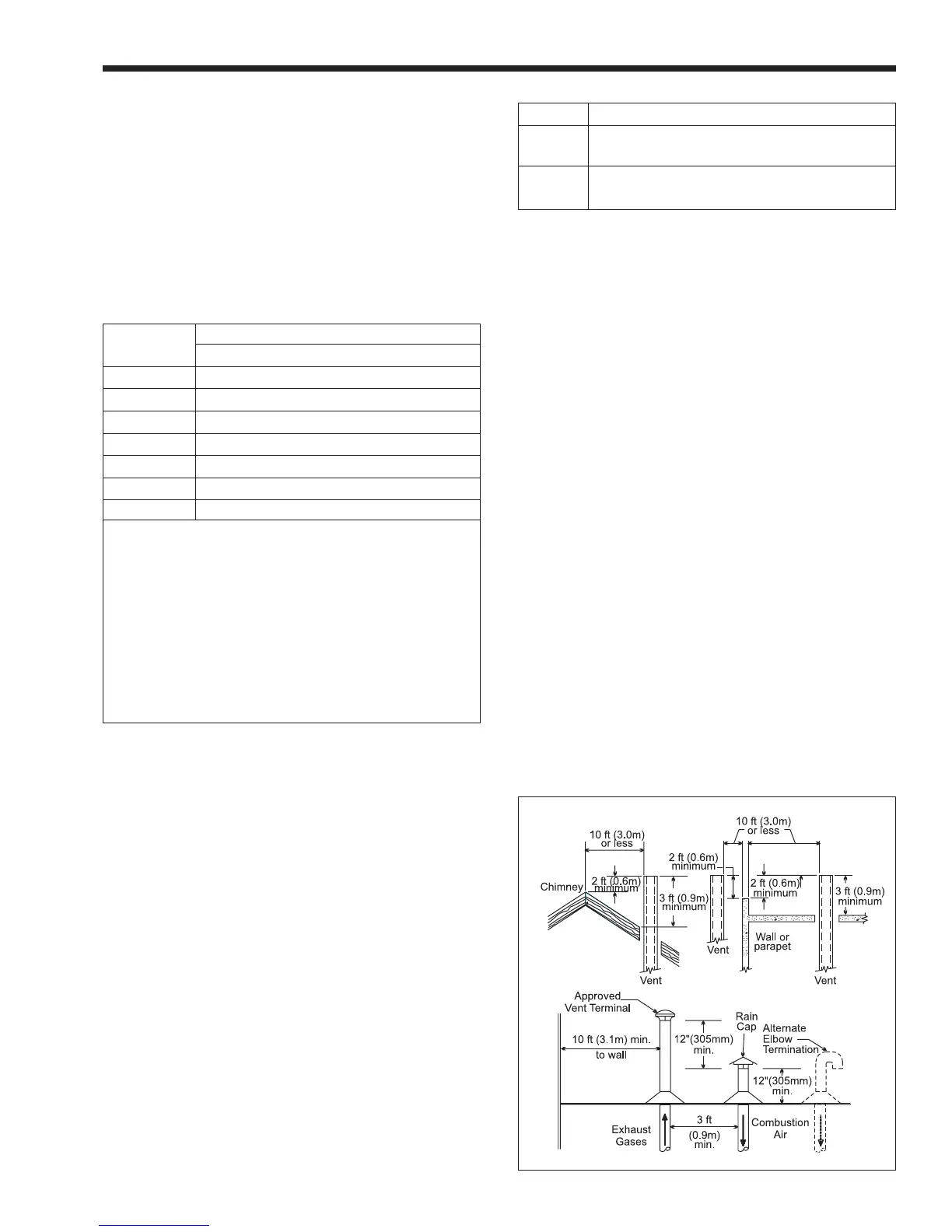
from the roof, a field-supplied rain cap or an elbow
arrangement must be used to prevent entry of rain
water (see Figure 2).
Use single-wall galvanized pipe, per table 4,
for the combustion air intake (see Table 1 for
appropriate size). Route the intake to the heater as
directly as possible. Seal all joints with tape. Provide
adequate hangers. The unit must not support the
weight of the combustion air intake pipe. Maximum
linear pipe length allowed is 50 feet (15.2m). Three
elbows have been calculated into the 50-foot (15.2m)
linear run. Subtract 10 allowable linear feet (3.0m) for
every additional elbow used (see Table 1). When
fewer than 3 elbows are used, the maximum linear
pipe length allowed is still 50 feet (15.2m).
Term Description
Pipe
Single-wall galvanized steel pipe, 24 gauge
minimum (either insulated or non-insulated)
Joint
Permanent duct tape or aluminum tape
Sealing
Table 4. Required Combustion Air Piping Material.
The connection for the intake air pipe is on the
filter box. The PowerMax appliances may have
venting and combustion air ducting attached to the top
or the back. They are shipped with the connections at
the top. For attaching either or both pipes to the back,
the mounting flanges are reversible by removing the
mounting screws and orienting the flanges in the
desired position. Replace the screws after positioning
flanges. Run a bead of silicone around the collar and
slide the pipe over the collar. Secure with sheet metal
screws.
In addition to air needed for combustion, air shall
also be supplied for ventilation, including all air
required for comfort and proper working conditions
for personnel. The PowerMax loses less than 1 percent
of its input rating to the room, but other heat sources
may be present.
2.2 Venting
2.2.1 Vent Categories
Depending upon desired PowerMax venting, it
may be considered a Category I or a Category III
appliance. In general, a vertical vent system will be a
Category I system. However, in rare instances, a
heater's vertical vent system may be considered
Category III. In the U.S., the National Fuel Gas Code
(American National Standard Z223.1-Latest Edition),
or in Canada the CSA B149.1 (latest edition), defines
Figure 2. Combustion Air and Vent Through Roof.


 To Next Page