Need help?
Do you have a question about the Powervar ABCEG601 and is the answer not in the manual?
Explains the danger symbol for imminent hazards, death, or severe injury.
Explains the caution symbol for potentially hazardous situations leading to injury or damage.
Explains the warning symbol for potentially hazardous situations, serious injury, or death.
Explains the attention symbol for situations causing operator injury or equipment damage.
Describes specific electrical and explosion warning symbols and their meanings.
Expresses gratitude for purchasing a POWERVAR product and introduces the GTS series.
Instructions on how to register the purchased UPM online for product registration.
Describes the GTS Series UPM as advanced, line interactive, true sinewave UPS products.
Illustrates the basic operational flow of the GTS Series UPM with a diagram.
Explains the true, low distortion sinewave output for compatibility with sensitive electronics.
Details how Voltage Manager monitors and adjusts input voltage to prevent erroneous inverter operations.
Describes the Start Manager feature for enabling battery startup from AC or battery power.
Outlines options for data protection, monitoring, and software use with MopUPS Express.
Explains that batteries are user-replaceable and can be hot-swapped.
Warns about electrical shock, burns, fire, or explosion risks from batteries and proper precautions.
Highlights hazardous voltages within the UPM and the need for 20-amp circuit protection.
Notes that the UPM has an internal battery, making output receptacles live even without AC supply.
Lists precautions like not disassembling, avoiding water, blocking vents, and proper placement.
Details safety for leakage current, computer rooms, socket-outlet installation, and battery disconnection.
Warns against disposing batteries in fire, opening them, and recommends insulated tools.
Details energy hazard risks associated with 12V and 24V batteries during replacement.
States FCC compliance for Class A digital devices and provides measures to correct radio/TV interference.
Instructs on inspecting equipment for damage during shipment and filing claims.
Provides instructions for unpacking the unit, including caution about condensation and unit weight.
Details how to unpack and handle accessories, and manage packaging responsibly.
Specifies indoor use, protection from heat/humidity, and required airflow/clearance for placement.
Guides on connecting the power cord to a grounded receptacle and turning on the UPM.
Explains the expected LED indicators on the front panel during UPM startup.
Describes how to test the UPM backup function using the Test/Silence button or unplugging the cord.
Advises on performing monthly tests or configuring automatic self-tests via software.
Informs that batteries discharge during storage and may need charging for full backup time.
Recommends against using laser printers due to high current draw potentially overloading the UPM.
States the necessity of plugging in the battery plug(s) to operate the UPM.
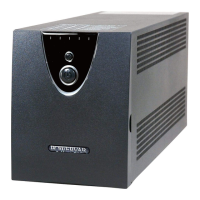
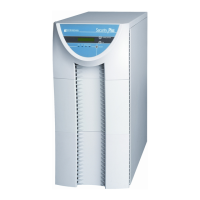
Shows visual representations of the 250/400 VA and 600 VA UPM models.
Explains the dual function of the On/Off button for turning the UPM on or off.
Details the Test/Silence button's use for self-testing and silencing alarms.
Describes the 4-segment LED displays for monitoring current load and battery charge status.
Explains the meaning of the PWR, BAT, and FLT LEDs for monitoring system status.
Describes the red Site Wiring Fault LED, its location, and what it indicates about the AC receptacle wiring.
Warns not to operate if the Site Wiring Fault LED is illuminated, citing fire/electrocution hazards.
Details the MopUPS Express port and the Smart USB (HID) input for Windows, macOS, and Linux.
Explains the RJ11 port for legacy UPS monitoring software using a basic signal interface.
Shows a diagram of the backpanel ports for RJ11 and USB communications.
Describes using native Windows/Linux power management via USB HID for automatic shutdown.
Lists added benefits of MopUPS Express like safe shutdown, configuration, and diagnostics.
Provides web links to learn more about MopUPS Express and ManageUPS CIO software.
Explains the RJ11 port for legacy signaling, open collectors, and converting signals to RS232.
Details the function and polarity of each pin in the RJ11 connector for UPS signaling.
Explains how to manually shut down the computer and UPM when power is lost without MopUPS Express.
Provides step-by-step instructions to use Start Manager for testing UPM and system operation without AC power.
Advises on storing the UPM in a suitable environment and charging batteries every six or two months.
Describes the sealed lead-acid batteries, their expected lifespan, and factors affecting it.
Explains the Low/Replace Battery LED, its meaning, and signs indicating battery replacement is needed.
Stresses that battery servicing must be performed or supervised by knowledgeable personnel.
Clarifies that only the battery assembly is user serviceable; other covers should not be removed.
Details safety measures for handling batteries, including avoiding short circuits and using insulated tools.
Informs on how to order replacement batteries from POWERVAR or other sources.
Warns about the risk of explosion if batteries are replaced with incorrect types and energy hazards.
Lists compatible battery brands, types, and ratings (e.g., Yuasa, CSB) for replacement.
Reiterates cautions against disposing batteries in fire or opening/mutilating them due to toxicity.
Provides a detailed, numbered procedure for removing and installing new batteries in the UPM.
Shows the rear panel configuration for 250 VA models in North American and International versions.
Illustrates the rear panel configuration for 400 VA models in North American and International versions.
Displays the rear panel layout for 600 VA models in North American and International versions.
Lists VA ratings, model numbers, frequency, voltage, and max output amps for NA models.
Lists VA ratings, model numbers, frequency, voltage, and max output amps for International models.
Provides efficiency percentages and output BTU/Hr for different VA ratings.
Describes voltage waveform, transfer time, and input frequency for AC and inverter modes.
Details dimensions and shipping weights for 250, 400, and 600 VA models.
Outlines temperature, humidity, and altitude limits for operation and storage.
Lists battery charger specifications and estimated charging times for different VA ratings.
Describes noise output voltage levels under specific ANSI/IEEE C62.41 conditions.
Details surge voltage withstand ratings based on ANSI/IEEE C62.41 standards.
Explains how the Voltage Manager boosts or bucks voltage based on main power fluctuations.
Lists safety agency certifications (UL, cUL, CE) and EMC conformance (FCC, EN, CISPR).
Addresses problems like UPM not powering up, no audible alarm, or overload conditions.
Covers issues with the Low/Replace Battery LED, site wiring faults, and short backup times.
Discusses problems where the computer won't turn on or MopUPS Express is not working.
Lists essential checks before troubleshooting, like outlet, voltage, and circuit breaker status.
Provides North American business hours, phone numbers, fax, and email for technical support.
Offers contact details for European headquarters and the company website for additional support.
Details the five-year warranty for the UPM product and two-year for batteries.
Outlines conditions that void the warranty, such as misuse, alteration, or unauthorized repair.
Lists addresses and phone numbers for POWERVAR offices in the USA, Canada, Europe/Asia, and Mexico.
Directs users to the POWERVAR website for additional product information and support.
 General
| VA Rating | 600 VA |
|---|---|
| Watts | 360 W |
| Input Voltage | 120 VAC |
| Output Voltage | 120 VAC |
| Input Voltage Range | 90-140 VAC |
| Humidity | 0-95% non-condensing |
| Transfer Time | 4 ms |
| Battery Type | Sealed Lead Acid |
| Operating Temperature | 0-40°C (32-104°F) |
| Warranty | 2 years |
| Outlets | 6 x NEMA 5-15R |


 To Next Page