
 Need help?
Do you have a question about the Powerware 9120 and is the answer not in the manual?
Notice regarding VCCI standards for Class A and Class B models.
Statements on compliance with FCC Part 15 and ICES-003 for Class A devices.
Statements on compliance with FCC Part 15 and ICES-003 for Class B devices.
Indicates a risk of electric shock and associated warnings.
Advises referring to the operator's manual for additional information.
Describes the RJ-45 receptacle for network interface connections.
Symbol indicates UPS batteries should not be discarded but recycled.
Instructions for checking equipment for shipping damage and filing claims.
Important safety instructions to follow during installation and maintenance.
Steps to install the UPS using plug and receptacle connections.
Diagram of the rear panel for the 700 VA, 120V model.
Diagram of the rear panel for the 1000 VA, 120V model.
Diagram of the rear panel for the 1500 VA, 120V model.
Diagram of the rear panel for the 2000 VA, 120V model.
Diagram of the rear panel for the 3000 VA, 120V model.
Diagram of the rear panel for the 3000 VA, 208V model.
Diagram of the rear panel for 700-1000 VA, 230V models.
Diagram of the rear panel for the 1500 VA, 230V model.
Diagram of the rear panel for the 2000 VA, 230V model.
Diagram of the rear panel for the 3000 VA, 230V model.
Warning for qualified personnel to perform electrical installation.
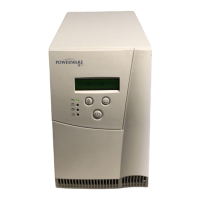
Description of the UPS front panel indicators and controls.
How to view UPS current settings and available parameters.
Steps to turn on the UPS and its initial states.
How to turn on the UPS without utility power.
Steps to turn off the UPS.
Describes the UPS state when turned off but connected to power.
Information on automatic and manual UPS and battery self-tests.
How to enter and use the UPS configuration mode.
How to use the REPO port to remotely switch off UPS power.
Guidance on keeping the UPS clean and at optimal temperature.
Recommendations for storing the UPS and recharging batteries.
Steps for replacing UPS batteries with hot-swappable feature.
Specifications for electrical input and output of the UPS models.
Environmental operating conditions and safety conformance standards.
Physical dimensions and weights of the UPS and EBM models.
Specifications related to the UPS batteries.
Explains audible alarms and how they indicate UPS conditions.
Methods to silence existing audible alarms for faults.
 General
| Output Waveform | Sine wave |
|---|---|
| Form Factor | Tower |
| Transfer Time | 0 ms |
| Humidity | 0-95% non-condensing |
| Output Voltage | 230V |
| Input Voltage | 230V |
| Battery Type | Sealed Lead Acid |
| Real Power | 500 W, 700 W, 1000 W, 1400 W, 2100 W |
| Output Frequency | 50/60 Hz |
| Typical Backup Time at Full Load | Varies by model |
| Communication Ports | RS-232, USB |
| Input Voltage Range | 160-286V |
| Power Capacity | 700 VA - 3000 VA |
| Typical Recharge Time | 3 hours |
| Operating Temperature | 0 to 40°C (32 to 104°F) |
| Storage Temperature | -15-45°C |
| Dimensions | Varies by model |
| Weight | Varies by model |
| Audible Noise | <50dB at 1 meter |
| Safety Approvals | UL, cUL, CE |
| Power Rating | 700 VA to 3000 VA |
| Typical Backup Time at Half Load | Varies by model, typically 10-20 minutes |


 To Next Page
