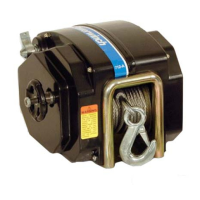
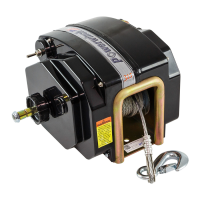
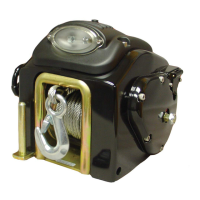
The Powerwinch RC23 and RC30 are 12-volt powered trailer winches designed for efficient boat loading and unloading. These winches offer a range of features aimed at enhancing user convenience and safety during operation.
Function Description
The primary function of the Powerwinch RC23 and RC30 is to assist in the loading and unloading of boats onto and from trailers. They are equipped with a motor that powers the cable in and out, significantly reducing the manual effort typically required with hand winches. The winches are designed for use with a 12V power source, typically a vehicle battery.
A key operational feature is the ability to perform a double line pull using a pulley block. This method can increase the winch's capacity, making it suitable for heavier loads. The pulley block assembly involves threading the cable through the block, hooking it to the boat's bow eye, and then attaching the cable hook to an eyebolt near the winch.
For control, the winches come with a wireless remote transmitter, allowing for remote operation. This enables the user to stand clear of the winch and the boat during operation, enhancing safety. The remote features an ON/OFF button, a button to pull the cable in, and a light button to control the winch's integrated spotlight. The remote operates best within a 10-15 foot range, with a maximum operating distance of 30-40 feet, depending on environmental conditions. To prevent accidental operation and preserve battery life, the remote should be turned off when not in use.
In situations where the remote is lost or damaged, or if there is no electrical power (e.g., a dead battery), the winch includes manual override options. A manual override switch is located on the back of the winch, allowing for direct control of the cable-in function. Additionally, an emergency hand crank is stored in the LH cover, providing a mechanical means to wind in the cable. It's crucial not to use the hand crank to assist a running motor, as this can lead to serious personal injury.
The winches also feature a clutch control knob. Loosening this knob allows the cable to freewheel out, facilitating quick unloading of the boat. Tightening the knob engages the brake, controlling the speed of the boat during unloading and securing it during loading. Over-tightening the clutch knob should be avoided to prevent damage to the clutch mechanism.
An integrated spotlight mounted in the housing provides illumination during operation, which is particularly useful in low-light conditions. The light can be operated either via a switch on the winch itself or through the remote control. The light automatically turns off after 20 minutes to prevent damage.
Usage Features
- Wireless Remote Operation: Provides convenience and safety by allowing the user to control the winch from a distance. The remote has distinct buttons for powering the cable in and controlling the spotlight.
- Remote Power-In / Freewheel-Out Operation: The winch offers powered cable retrieval and a freewheel function for quick cable release, making both loading and unloading processes more efficient.
- Manual Override Switch: A backup control option located on the winch itself, useful if the remote is unavailable or malfunctioning.
- Emergency Hand Crank: A mechanical solution for operating the winch in the absence of electrical power, ensuring the boat can always be loaded or unloaded.
- Spot Light Mounted in Housing: Enhances visibility during operation, especially in dimly lit environments. The light can be controlled remotely or directly on the winch.
- Clutch Control Knob: Allows for precise control over cable tension and speed during both loading and unloading, and acts as a brake to secure the load.
- Double Lining Capability: The design supports the use of a pulley block to increase the winch's pulling capacity for heavier boats.
- Easy Installation: The winch is designed for straightforward mounting on a trailer, often in the same position as an existing hand winch. Clearances and alignment with the boat's bow eye are important considerations during installation.
- Wiring Options: The winch can be permanently wired to the vehicle's battery, or temporary connections can be made using optional wiring kits.
Maintenance Features
- Cable Lubrication: Regular lubrication of the cable with appropriate wire rope spray (e.g., Whitmore's Wire Rope Spray, WD40) is recommended at least once a year. This involves spraying the shaft and cable as the cable is being wound, which helps maintain cable integrity and smooth operation.
- Gear Lubrication: The gears should be lubricated with a lithium-base grease after removing the covers. Care must be taken to avoid getting grease on the clutch lining.
- Cable Replacement: The manual provides detailed instructions for replacing the cable, including how to loosen the clutch knob, remove the old cable, insert the new cable, and secure it with a stop sleeve. It emphasizes using the exact Powerwinch replacement cable (p/n P7188800AJ) to ensure safe and optimum performance, and strictly prohibits replacing the cable with rope. Leather gloves are advised when handling the steel cable to prevent injury.
- In-Line Fuse Replacement: An in-line fuse, located under the top cover of the unit, protects the electrical components. The manual details how to access and replace this standard automotive AGC glass type fuse (5A, 250V). It warns against using the wrong fuse, which could cause damage or prevent operation.
- Remote Battery Replacement: The remote uses a 12V size A23 battery, which should be changed every 3 months or twice during the boating season for best performance. Instructions for opening the remote, noting battery polarity, and inserting a new battery are provided.
- Light Bulb Unit Replacement: For older units (prior to July 2012) with filament bulbs, instructions are given for removing the lens, gasket, and old bulb, and inserting a new one. For newer units (after July 2012) with LED assemblies, the LED light kit (p/n R001728) can be used as an update.
- Troubleshooting Guide: A comprehensive guide is included to help diagnose and resolve common issues such as the winch not operating, load slipping, the remote not working, or the light not turning on. This guide directs users to check power connections, circuit breakers, fuses, remote batteries, clutch lining, and wiring polarity.
- Safety Disconnect: A critical maintenance instruction is to always disconnect the power harness from the winch before attempting any installation, service, or maintenance to prevent shock hazards.


 To Next Page
 General