20
LAYOUTOPERATION
Helpful Hint: If diculty is observed in starting the arc, it may be time to readjust the point
gap setting found inside. The HF points tend to wear and get dirty over time. This is a
normal maintenance item and not something for warranty consideration. Proper point gap
adjustment is .035 “to .045”. Before attempting to adjust the point gap, be sure to unplug the
unit for 15 minutes before removing the rear plastic panel, and the steel case to access the
points located near the front of the unit. Do not remove the front panel! Use a feeler gauge to
adjust the points to the proper setting. Another possibility is that the air pressure is too low or
too high. Worn/loose consumables may cause this as well.
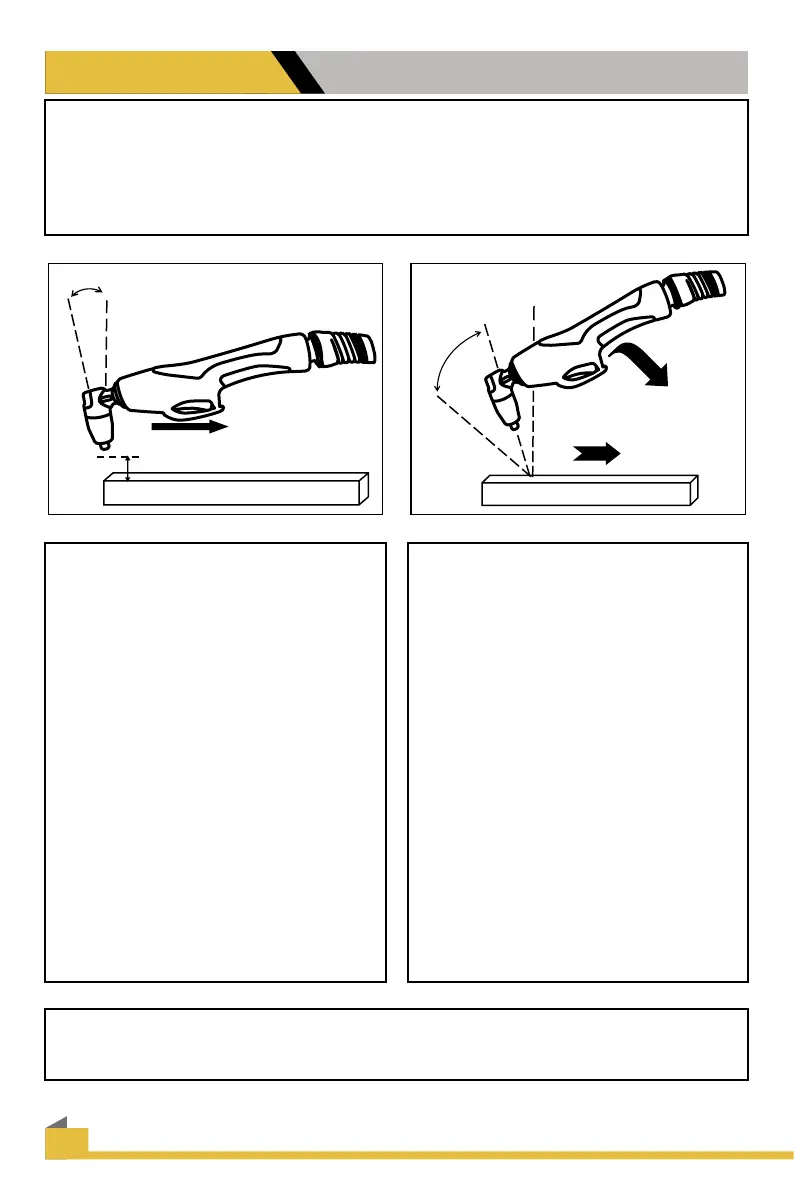
0°-15° EDGE START
TRAVEL
1/16”
40°-60°
PIERCE START
TRAVEL
Edge Starts are the best type of start if
possible to promote consumable and torch
life. This reduces blow back of molten
material and allows a smooth gradual start
of the cut. 1. Line up the hole on the tip
of the electrode on the edge of the cut.
Hold torch perpendicular to the cut initially,
about 1/16” o the metal. 2. Once the
arc starts, wait for the arc to penetrate all
the way through the metal. 3. As the torch
penetrates its ame all the way through
the metal, tilt the torch so there is a slight
lead in the ame if metal is thin. If it is
thick, keep holding torch in a nearly vertical
position. 4. Begin moving the torch in the
direction of the cut. Maintain 1/16” stando
height. 5. Move the torch fast enough so the
sparks and ame trail from the bottom edge
at an angle of no more than 30° and no less
than 10° from perpendicular to the metal.
Excess angle of sparks/ame indicate too
fast of travel speed or practical cut capacity
has been reached. Little or no angle
indicates too slow of travel speed.
IMPORTANT
Piercing starts often result in rapid
consumable wear and excess blow back
of molten metal deposited onto torch and
consumables. This should be done only as
necessary. 1. Tilt the torch in the direction
of travel or toward the side of the metal
to be discarded or wasted at a 40° to 60°
angle. Slide the yellow safety lock and
squeeze the trigger. 2. Once the arc starts,
wait for the arc to transfer from pilot arc to
the cutting arc. 3. As the torch penetrates it
ame at an angle rotate the torch slowly to
the vertical position, as the arc penetrates
the metal. Tilt the torch from 0°-15° for thin
metal cuts, or hold it nearly perpendicular
for thicker metal cuts. 4. Begin moving the
torch in the direction of the cut. Maintain
1/16” stando height. 5. Move the torch
fast enough so the sparks and ame trail
from the bottom edge at an angle of no
more than 30° and no less than 10° from
perpendicular to the metal. Excess angle
of sparks/ame indicate too fast of travel
speed or practical cut capacity has been
reached. Little or no angle indicates too
slow of travel speed.
Helpful
IMPORTANT: If you use a stando guide with the torch, it must be adjusted or bent to
provide no more than 1/8” stando, less if possible. Long stando heights reduce cut capacity
and quality. It also promotes rapid consumable wear and can prevent the pilot arc from
transferring.


 To Next Page
 Loading...