// MANUAL
1. BRAKE CONTROLS AND FEATURES
It’s very important to your safety that you learn and remember which
brake lever controls which brake on your bike. Traditionally, in the U.S.
the right brake lever controls the rear brake and the left brake lever
controls the front brake; but, to check how your bike’s brakes are set
up, squeeze one brake lever and look to see which brake, front or rear,
engages. Now do the same with the other brake lever. Make sure that
your hands can reach and squeeze the brake levers comfortably. If your
hands are too small to operate the levers comfortably, consult PROPAIN
or your dealer before riding the bike. The lever reach may be adjustable;
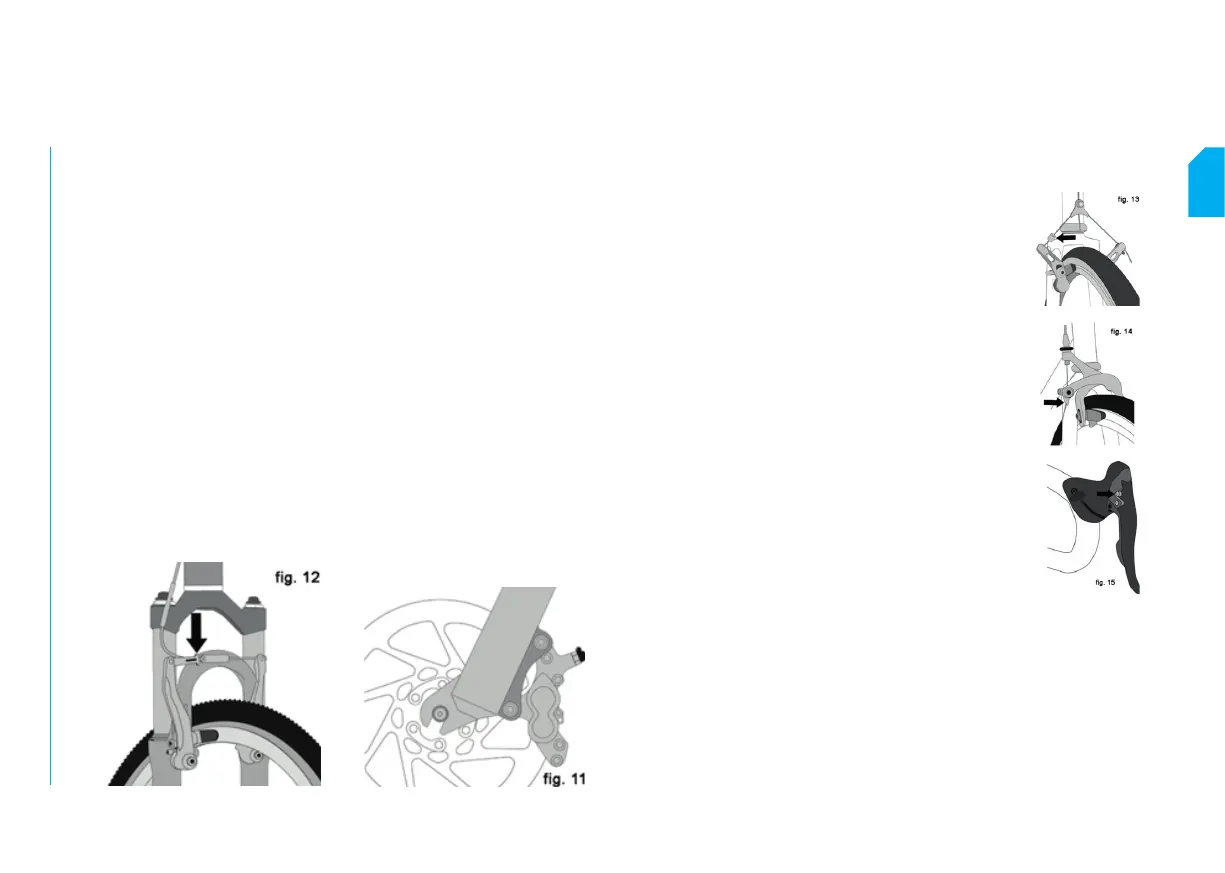
or you may need a different brake lever design. Most rim brakes have
some form of quick-release mechanism to allow the brake pads to clear
the tire when a wheel is removed or reinstalled. When the brake quick
release is in the open position, the brakes are inoperative. Ask PROPAIN
or your dealer to make sure that you understand the way the brake quick
release works on your bike (see gs. 12, 13. 14 & 15) and check each time to
make sure both brakes work correctly before you get on the bike.
2. HOW BRAKES WORK
The braking action of a bicycle is a function of the friction between the braking surfaces. To
make sure that you have maximum friction available, keep your wheel rims and brake pads or
the disk rotor and caliper clean and free of dirt, lubricants, waxes or polishes.
more progressive application of braking force. A modulator makes the initial brake lever
force more gentle, progressively increasing force until full force is achieved. If your bike
is equipped with a brake force modulator, take extra care in becoming familiar with its
performance characteristics. Some brake force modulators are adjustable. If you don’t
like the feel of your brakes, ask PROPAIN or your dealer about adjusting the brake force
modulation.
5. Disc brakes can get extremely hot with extended use. Be careful not to touch a disc
brake until it has had plenty of time to cool.
6. See the brake manufacturer’s instructions for operation and care of your brakes, and
for when brake pads must be replaced. If you do not have the manufacturer’s instruc-
tions, see your dealer or contact PROPAIN.
7. If replacing worn or damaged parts, use only manufacturer-approved genuine re-
placement parts.



 To Next Page