3.
Description of machine
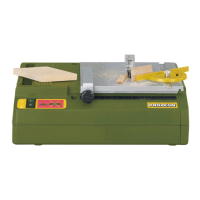
The FET table saw is awell thought-out machine for all occur-
ring sawing tasks in the range of small and fine applications.
Apowerful motor,solid mechanics, high-quality materials and
meticulous production make this areliable tool for all possible
sawing applications.
Depending on the utilised saw blades, all types of wood, many
non-ferrous metals, ceramics and plastics as well as many
other materials can be processed with the machine. The cor-
responding saw blades can be obtained from Proxxon and will
be mentioned in more detail later on.
The bench is made of stable aluminium die casting and forms
one unit together with the motor suspension: The guarantees
the highest strength and naturally also affects the precision of
the working results.
To guarantee the highest possible flexibility,weoffer different
types of limit stops that are included with the machine. So
there is something for every application:
There is alongitudinal stop that runs in aguide along the front
of the bench that can be easily shifted and arrested by hand,
or which can be used with the precisely adjustable graduated
scale.
Adjusting capabilities in the tenth of amillimetre range leave
nothing to be desired and make it easy to saw work pieces to
the desired, previously adjusted measure.
In addition there is asophisticated and precise angle stop
which can be extended with an aluminium profile strip with a
moving clamping piece for the exact reproduction of many
parts to be sawed out with equal angles and each with the
same dimensions.
The safety aspect was taken care of as well: The saw blade is
covered by asturdy saw blade guard which automatically
moves up when contact is made with the work piece, and
which only releases as much of the saw blade as necessary.
Caution!
For your own safety,itisunderstood that the saw may never
be operated without this protective guard!
The upper part of the device is hinged so that it can be opened
for cleaning and maintenance purposes. Thus the interior of
the device can be cleaned of chips and dust with avacuum
cleaner,for example. To exclude any kind of hazard, aswitch-
ing contact disconnects the electrics from the power mains
when the upper housing part is open.
But during all cleaning, maintenance and adjusting work (and
of course during sawing) please remember that your FSK is not
aplay toy but atool for woodworking and is thus apotential
source of danger!
Among others apush-rod for the secure feed of more compact
work pieces and two Allen keys are also included in the deliv-
ery.These can be stored in a„key parking slot“ on the right side
of the housing.
In the interests of your own safety,please carefully read
through and comply with the attached safety notes, which are
also mentioned in these instructions, and make sure that you
have also understood them!
4.
Legend (fig. 1)
1. Saw blade guard
2. Saw table
3. Saw blade
4. Connection for dust suction
5. Longitudinal stop
6. Key parking slot
7. Rubber connecting piece for suction
8. Allen key
9. Allen key
10. Push-rod
11.Angle stop
12. Knurled screw for fine adjusting
13. Motor unit
14. Angle scale for saw blade tilt
15. Saw blade adjustment for depth of cut
16. Clamping piece
17. Limit stop strip
18. Mains cable
19. On -Off switch
20. Scale for longitudinal stop
21. Extendable saw support
22. Auxiliary stop
5. Technical data
Rotational speed: 7000/min
Saw blade diameter max.: 85 mm
Depth of cut max. (0°): ca. 25 mm
Depth of cut max. (45°): ca. 17 mm
Saw blade drill hole: 10 mm
Splitting wedge thickness: 1.2 mm
Weight: 7kg
Blade body thickness: ≥1mm
Tooth thickness/setting: ≥1.5 mm
Dimensions (in mm):
Width: 300 mm
Depth: 320 mm
Height: 170 mm (with saw blade
guard approx. 220 mm)
Motor:
Voltage: 230 Volt, 50/60 Hz
Power consumption: 200 W
Short-term operation SO
10 min
Noise level: LPA89.7 dB(A)
LWA102.7 dB(A)
Vibration: <2.5 m/s
General measuring uncertainty K=3 dB
Noise/vibration information
The information on vibration and noise emission has been
determined in compliance with the prescribed standardised
and normative measuring methods and can be used to com-
pare electrical devices and tools with each other.
These values also allow apreliminary evaluation of the loads
caused by vibration and noise emissions.
20



 To Next Page