- 22 -
T
he following example applies to Incline 1 mm/revolution. The
table in the gear case (or Fig 25 in the instructions) indicates the
f
ollowing:
• L = 60/20
•
Z2 = 40/30
•
Z1 = -/50
• W = 30
w designates the cog wheel on the main spindle. It is fixed with a
threaded pin on the main spindle. Z1, Z2 and L designate the
a
xes of the intermediate wheels.
T
he leading figure always designates the tooth count of the axis
wheel facing us (i.e. the outer one) and the rear figure the tooth
count of the back wheel. This results in the following:
•
L designates the lower wheel pair. Here a cog wheel with 20
t
eeth is always mounted on the inner side. The tooth count on
the outside varies depending on the gear ratio selected. In our
example it is Z=60.
• Z2 has a rear (=right-hand) cog wheel of 30 teeth and the
l
eading one of 40 teeth.
•
On Axis Z1 a rear (=right-hand) cog wheel with 50 teeth is fit-
ted and a spacer ring (here always marked with „ - “) is fitted
at the front.
Important: As described above, you must also vary here the
spacing between axes in keeping with the gear ratio selected.
That is, slightly slacken the axes with a W/F 10 spanner and after
changing the cog wheels place a piece of paper between the
coggings and tighten the axes.
Thread cutting with the turning tool
Note:
For the following operations, the work piece must be machined
completely and have the correct thread outer diameter.
It is advisable to turn a chamfer at the beginning of the thread
and to turn a small groove at the end of the thread. The thread
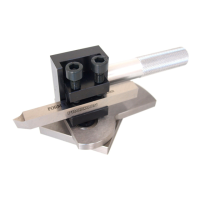
turning tool must be clamped at an angle of exactly 90°.
Important
When cutting threads, always work at the lowest speed
(80 rpm) because otherwise the feed is too fast (risk of injury).
1. Set the turning tool to the starting position.
2. Engage leadscrew (turn leadscrew switch 1 (Fig. 15) to the
right).
3. Switch on the machine.
4. Advance the turning tool slightly by means of the cross-slide.
5. Engage the support (lever 2 downwards).
6. When the desired thread length has been reached, retract the
cross-slide and switch off the machine at the direction switch.
7. Wait until the chuck has stopped. Turn the direction switch to
left to return the support.
8. Advance the turning tool again and repeat the procedure until
the required thread depth is reached.
Note:
During the entire procedure, the support and the leadscrew must
not be disengaged as this shifts the pitch of the thread.
T
he top slide is used to improve the quality of the thread. Advanc-
ing the thread tool is performed using the cross-slide as
d
escribed above. For this purpose, the top slide is adjusted by
0.025 mm (1 graduation) to the left and then to the right. The cut-
tings are thus only removed from one side.
O
nce the full thread depth has been reached, a final full cut is
m
ade by advancing slightly.
Cutting left-hand thread
Left-hand thread cutting involves the support running from left to
right with clockwise-turning chuck. This necessitates a reversal of
the rotating direction of the lead spindle. For this, the inner z=20
cog wheel on Axis L is to be removed and the position of the
b
earing pin adjusted. Proceed as follows here:
1. Push off Clip 6 of Axis L (Fig. 13), unscrew the axis at the
square end with a W/F 10 open-end spanner (as described
above) and remove together with the cog wheels.
2. Use an Allen key to unscrew the axis of the small cog wheel 1
(
Fig 16) and remove together with Cog wheel 2.
3. Screw Axis L with the cog wheels into the LOWER M6 thread
(Pos. 3) of the wheel arm (Caution: this is marked with an „L“).
Place spacer disk underneath, if needed!
Maintenance
Cleaning
Caution!
Always disconnect the mains plug for all adjustment and mainte-
nance work! Risk of serious injuries or damage due to inadvertent
starting up of the device, or hazard due to electric shock!
1. After use, thoroughly clean all chips from the machine using a
brush or handbrush. Do not use compressed air for cleaning.
2. Regularly lubricate or oil all moving parts, spindles and guides!
The outside of the housing can be cleaned with a soft, dry or damp
cloth. It is possible to use mild soap or other suitable cleaning
agent here. Solvents or cleaning agents containing alcohol (e.g.
petrol, cleaning alcohol etc.) should be avoided, since these can
attack the plastic housing casings as well as wash off the lubri-
cants.
Please observe:
Changing the power supply cord may only be carried out by our
Proxxon-Service-Department or a qualified specialist!
General
After use, thoroughly clean all cuttings from the machine using a
paintbrush or hand brush.
Grease or oil all parts according to the lubrication plan
(Fig. 17). When oiling the contact surfaces, move the slide back-
wards and forwards several times by hand so that oil enters the
guides.
A = oil / lubricate each time before use
B = oil / lubricate once a month
Also oil the flange unit of the leadscrew in the gearbox through
the hole provided for this purpose.



 To Next Page
 Loading...