7
7. Change the hydraulic oil at least
once every three years:
a.
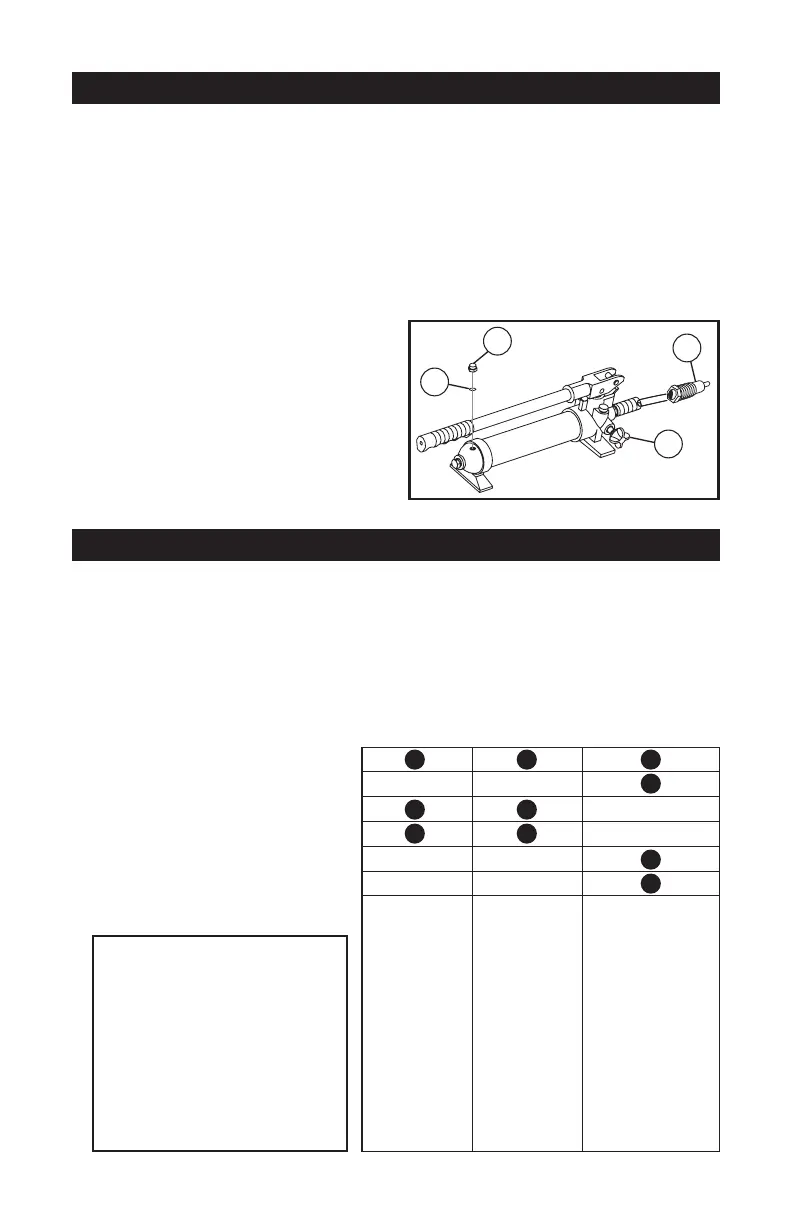
Set Pump (1) at on a level surface.
b.
Remove the Fill Screw (A). The
O-ring (B) should come off with it.
c. Tip the pump to allow the old
hydraulic oil to drain out of
the housing completely, and
dispose of the old hydraulic
oil in accordance with local
regulations.
d. With the Pump upright,
completely ll the housing with
a high quality hydraulic oil (not
included) until the oil just begins
to run out of the oil ll hole. Be
VERY CAREFUL not to allow dirt
or foreign matter into the system.
CARE & MAINTENANCE
A
B
C
D
Fig. 5
NOTE: Problems listed above
with more than one solution
may have a combination of
causes. Please be sure that
all solutions listed for each
problem have been checked
to eliminate possibility of
further trouble. Sometimes
solutions may need to be
repeated for best results.
TROUBLESHOOTING
This Performance Tool
®
product was constructed with quality materials and
workmanship and will give you many years of trouble free use when cared for
as described in the "Care & Maintenance" section on page 6-7. However, as
with any mechanical device, periodic adjustments are necessary to maintain a
peak level of performance. Should this product be displaying any of the following
symptoms, the simple procedures shown below will correct the problem.
WARNING: Remove all equipment from service before making adjustments.
Will not lift load
Will not hold load
Will not lift to full height
Pump feels “spongy” under load
Handle raises under load
Handle lowers under load
Power unit may
be low in fluid.
With pump on
level surface and
in down position,
remove filler
plug and add
clean hydraulic
jack fluid to level
of filler.
Power unit may
be air bound.
Open the
release valve a
minimum of 2 full
turns. Pump the
handle a
minimum of 20
full strokes to
purge air from
the system.
Valve may not be
closing completely.
To seat valves:
a.) Close release
valve.
b.) With pump in fully
lowered position,
manually raise
lifting arm as
high as possible.
c.) Open release
valve and allow
pump to descend
to lowered position
e. Make sure the O-ring (B) is still
in place around the Fill Screw
(A) and thread the Fill Screw into
the Pump securely. Do not use
thread seal tape.
f. Firmly close the Release Valve
(C) by turning it clockwise.
g. Clean with a clean cloth using a
detergent or mild solvent.



 To Previous Page