4
SETUP INSTRUCTIONS
RAM SETUP:
Note: When positioning the Ram
(3) use a smaller attachment on the
side that is to be bent instead of the
stationary side. If the stationary side is
in danger of being bent or damaged,
place a block of wood or other material
behind the Flat Base (9) to distribute
pressure over a greater area.
1. Clean the end of the hose and the
inlet on the Ram (3). Unscrew and
save the end plugs located on the
end of the hose and Ram (3).
2. Attach the hose to the Ram.
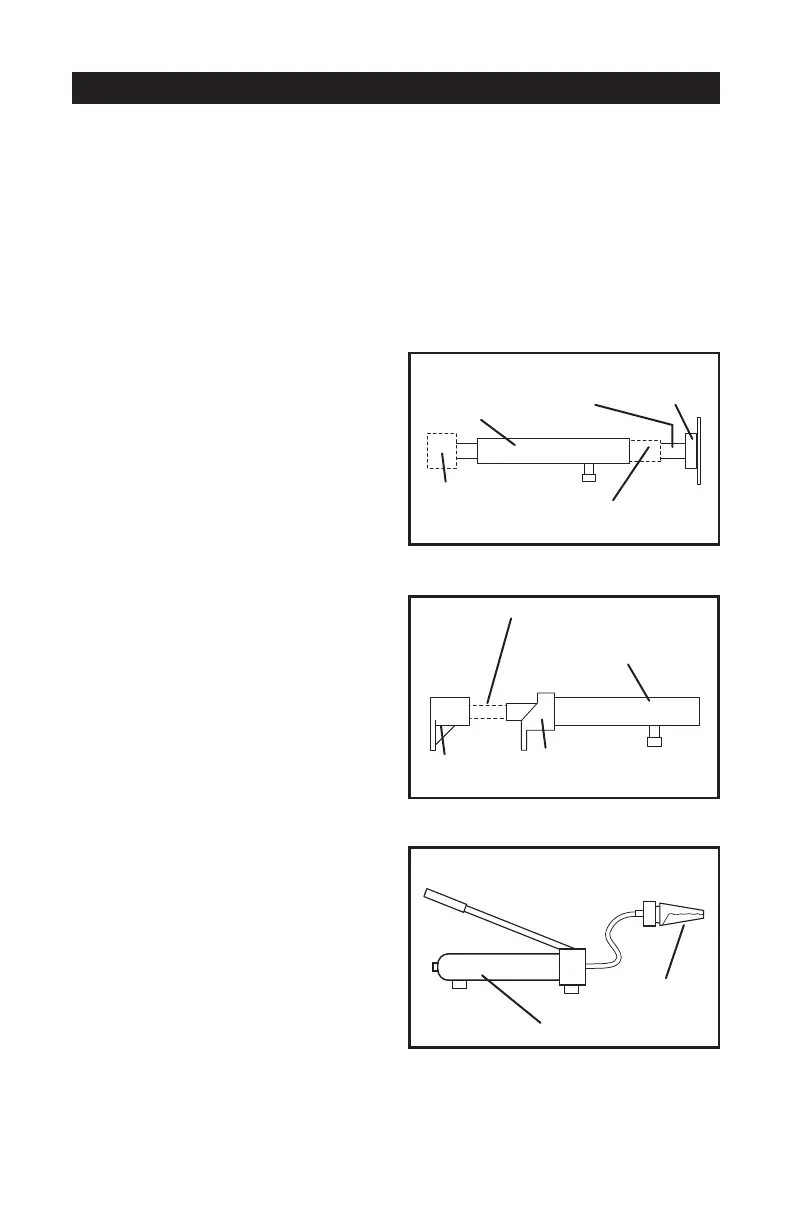
3. Assemble attachments as shown in
gure 1 and 2.
Note: If using the Plunger Toe (11) and
Ram Toe (10), thread the Ram Toe
onto the Ram completely and align the
Plunger Toe to it.
SPREADER WEDGE SETUP:
The Spreader Wedge (2) is used when
the Ram (3) is too long to t between
the stationary side and the damaged
area.
1.
Clean the end of the hose and the
inlet on the Spreader Wedge (2).
2.
Unscrew and save the end plugs
located on the end of the hose and
Spreader Wedge (2).
3.
Attach the hose to the Spreader
Wedge (2), as shown in gure 3.
8. The Ram Toe (10) and Plunger Toe (11) are used together to allow spreading
in areas that the Ram cannot t into.
Note: The Ram Toe (10) and Plunger Toe (11) must only be used together to
prevent an off center load.
Note: When positioning the Ram (3) use a smaller attachment on the side that
is to be bent instead of the stationary side. If the stationary side is in danger of
being bent or damaged, place a block of wood or other material behind the Flat
Base (9) to distribute pressure over a greater area.
Fig. 1
Fig. 2
Fig. 3
Ram (3)
Ram (3)
Spreader
Wedge (2)
Male
Connector (14)
Extension Bars (5-8)
as needed
Extension Bars (5-8)
as needed
Pump (1)
V-base (13) or
Flat Base (9)
Cap Head (15)
Rubber Head (16)
or Wedge Head (12)
Plunger
Toe (11)
Ram
Toe (10)



 To Next Page