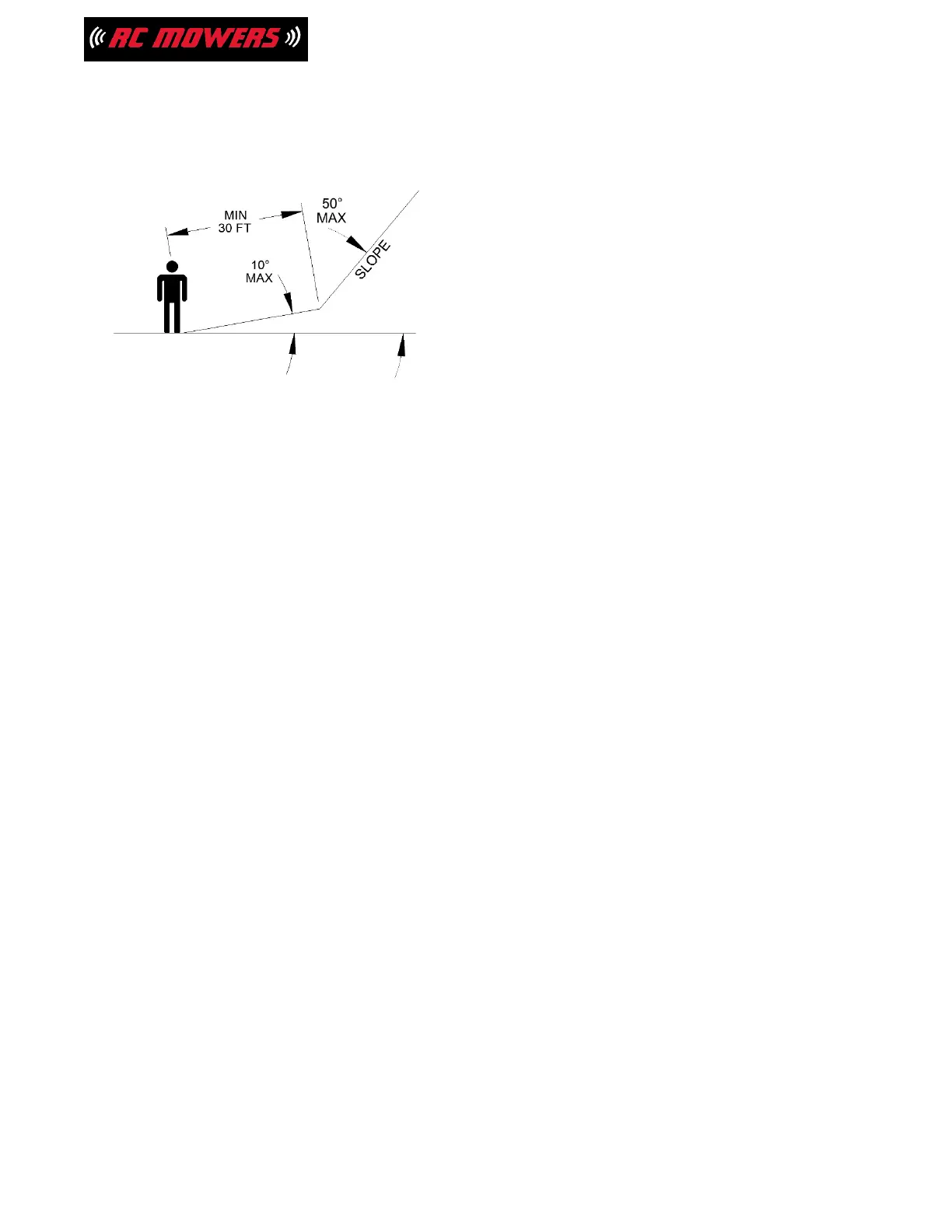
mower must cross the path of any person that is
downhill from the machine, those persons must be
on level ground, 30' back from where the slope
transitions above 10 degrees. (See Figure 14.)
Figure 14
While a rollover is rare, it is possible in certain
conditions. The machine is very heavy and if it were
to roll over a person, it will likely result in severe
injury or death.
If operating from the bottom of a slope, the operator
must know what is at the top of that slope and
beyond. There may be bystanders, steep drop-offs,
or other hazardous terrain.
The operator must have control of the area that is
not within direct sight so that onlookers are not able
to approach the machine without the operator
knowing.
MOWING TECHNIQUES
There are three basic techniques to mowing
embankments: 45° diagonal, horizontal, and vertical.
Diagonal
Running the mower on a diagonal 45° angle from
the slope is normally the best way to mow most
embankments.
This will allow you to easily turn the mower around at
the top and bottom, ensuring the cutting direction is
always at the front of the mower.
This also minimizes the possibility of erosion or track
marks. Mowing in this manner allows you to keep
moving from left to right on the slope to maintain a
safe operating distance from your machine.
Horizontal
Choose an area to mow that is about 100' long
from left to right.
Stand in a safe location above the mower and at
approximately half way from left to right of the
selected area.
Mow horizontally from side to side. Rotate the
mower at the end of your selected area (or before
you lose good visual line-of-sight from the mower)
then mow back toward the other end of the area.
Once the area is completely mowed, repeat this
process on the next section of the embankment.
Vertical
Mowing vertically (straight up and down the slope)
may work for certain situations. This is accomplished
by driving the machine up and down the slope,
turning it around when you reach the top or the
bottom.
When mowing in this manner you may continue to
move with the machine to your left or right and mow
up and down.
Ensure that you know what is at the top of the slope
and control who or what is beyond the sightline over
the hill.
The vertical mowing technique is not advised above
a 35° slope angle as this may cause the tracks to dig
into the terrain, lose grip, or even spin out (different
soil types and vegetation conditions affect traction).
APPROACHING TRANSITIONS:
When transitioning sharply from a steep slope to a
flat area at the bottom of the embankment (or into a
valley or ditch), do so at a diagonal 45° angle or less
to prevent the front or back of the machine from
digging into the terrain.
When transitioning over the crest of a hill (or when
exiting a ditch or valley onto a flat area), do so at a
vertical approach only.
The tracks are wide and the ground clearance over
the mowing deck is small, allowing hill crests and
other convex ground features to contact the mowing
deck if crossing these transitions at a diagonal or
horizontal approach (i.e., high centering).
When first mowing these areas, it may be helpful to
turn off the PTO switch to prevent scalping of the hill
until the operator understands the best approach to
prevent ground contact with the mowing deck.
APPLICATION OF TECHNIQUES
Soil/Sod types can affect mowing performance.
•
Loose soil/light sod – mow diagonal only.
•
Loose soil/heavy sod – mow diagonal or
horizontal.
•
Stable soil/light sod – mow diagonal or
horizontal.
•
Stable soil/heavy sod – mow diagonal,
horizontal, or vertical.
16


 To Next Page