41
LOW-FREQUENCY STRATEGIES
Although the array can (and usually should) be zoned for imple-
menting different equalization curves for high frequencies, identical
equalization should be maintained in all the low-frequency fi lters.
Different low-frequency equalization settings in the same array will
degrade the desired coupling effect. For the same reason, gain diffe-
rences are not recommended for line arrays, since adjusting various
zones with an overall amplitude control for each results in decrease
of Low-frequency headroom and directionality.
In any case, line arrays generally need a correction to compensate
for energy sum on lows.
In the next fi gure is shown the equalization that corresponds to
DSP settings for “cluster size set up”, referring to different number
of speakers from “2-3” up to “10+”. Increasing the number of
cabinets, response curves are decreased in order to compensate the
low-frequency section mutual coupling.
AMPLIFIER GAIN SETTINGS
In order to let the system work properly, all amplifi ers must be set to the same gain. Among other things, equal amplifi er
gains are required to maintain array coherence throughout the venue. This does not only mean the same input sensitivity,
but the same input to output voltage gain. Do not selectively boost or attenuate loudspeaker levels at the amplifi ers in
order to achieve consistent SPL at various distances. This is achieved by adjusting the array curvature.
USER EQUALIZATION
Normally, the only user adjustable signal processing needed is straightforward 1/3 octave equalization. This is to correct
for frequency response anomalies specifi c to a particular acoustical situation, type of program, or simply to satisfy a par-
ticular mixing engineer’s taste in frequency balance. An important benefi t of the TTL33-A/TTL31-A technology is that, by
inherently maintaining the sonic character throughout the audience, user equalization will affect the frequency balance
in all areas of the audience in the same way.
PHYSICAL SET-UP
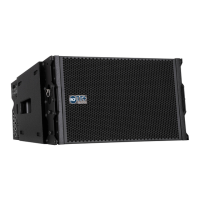
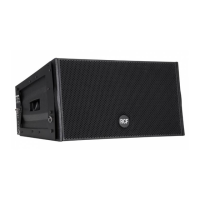
There are 8 splay angles engineered into the rigging for the TTL33-A/TTL31-As. These are set by changing the splay
between the rear of the enclosures rather than the front. This means that the fronts of all enclosures are always tight-
packed. The support of using RCF Shape Designer software greatly simplifi es the physical set-up.
USING SUBWOOFERS
GENERAL CONSIDERATIONS
Although the impressive low frequency performance of TTL33-A arrays allows them to be used without subwoofers for
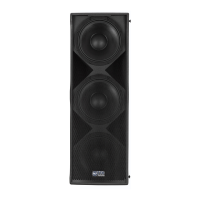
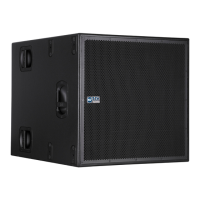
some events, subwoofers will normally be used for live musical performances. The recommended subwoofer are TTS28-A
and TTS18-A, specifi cally designed to complement TTL33-A line arrays.
NOTE: Bass performance is often highly program or venue-dependent, as well as subjective as to quantity and quality.
For this reason the type, quantity, and disposition of subwoofers may vary considerably with the application. The quantity
-40
+4
-38
-36
-34
-32
-30
-28
-26
-24
-22
-20
-18
-16
-14
-12
-10
-8
-6
-4
-2
+0
+2
d
B
u
20 20k50 100 200 500 1k 2k 5k 10k
Hz
TT


 To Next Page
 Loading...