RTL8201(L)
2002-01-18 Rev.1.04
20
VDD33
LED4
LED3
GND
LED2
LED0
LED1
R23
150
D3
LED
R19
150
R22
5.1K
D5
LED
D4
LED
D2
LED
R26
5.1K
R27
150
R24
5.1K
R20
5.1K
R18
5.1K
D1
LED
R21
150
R25
150
VDD33
LED4
LED3
GND
LED2
LED0
LED1
R23
150
D3
LED
R19
150
R22
5.1K
D5
LED
D4
LED
D2
LED
R26
5.1K
R27
150
R24
5.1K
R20
5.1K
R18
5.1K
D1
LED
R21
150
R25
150
7.5 LED and PHY Address Configuration
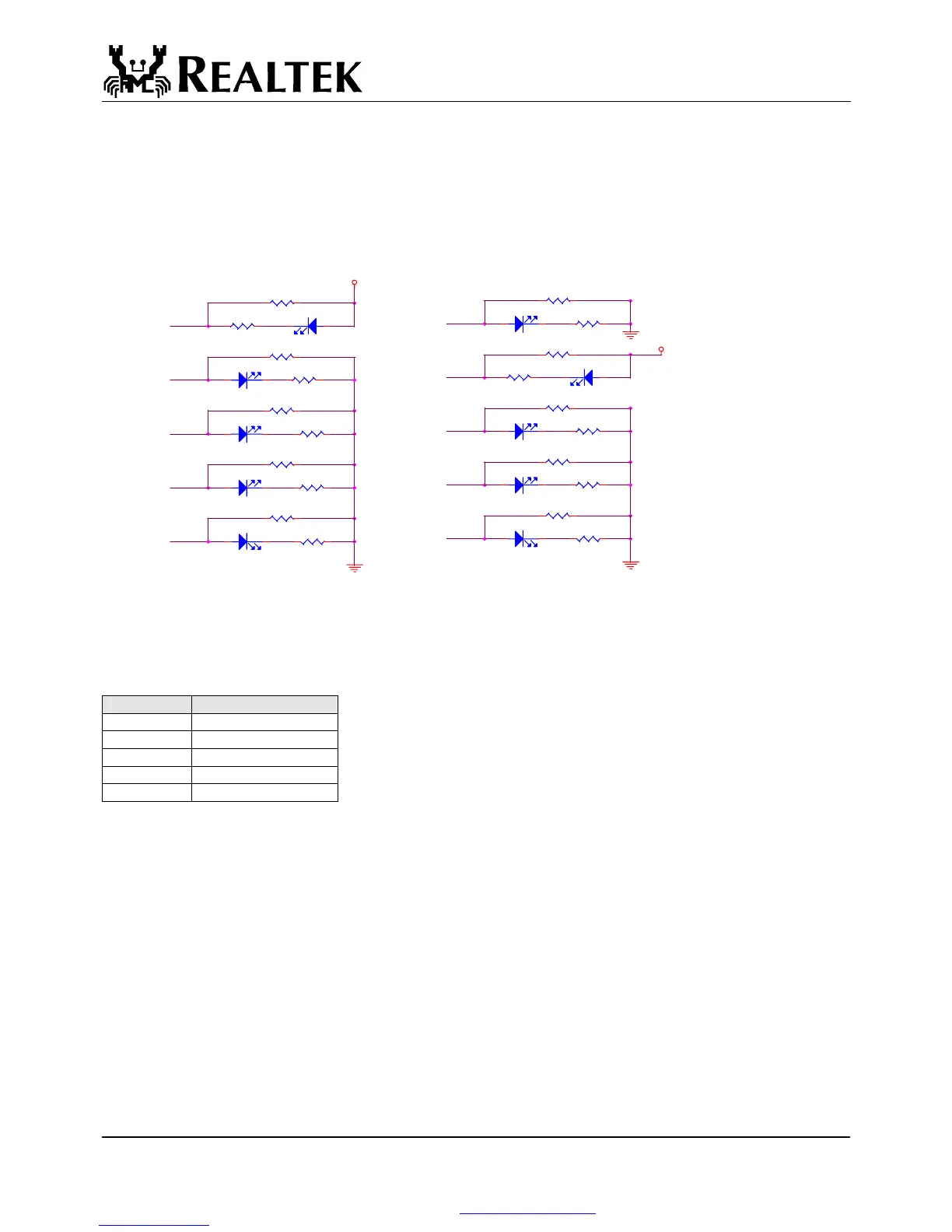
In order to reduce the pin count on the RTL8201, the LED pins are duplexed with the PHY address pin. Because the PHYAD
strap options share the LED output pins, the external combinations required for strapping and LED usage must be considered
in order to avoid contention. Specifically, when the LED outputs are used to drive LEDs directly, the active state of each
output driver is dependent on the logic level sampled by the corresponding PHYAD input upon power-up/reset. For example,
if a given PHYAD input is pulled low then the corresponding output will be configured as an active high driver.
Above are examples of LED and PHY address configurations. In the left figure, the PHY address is set to (00001b=01h). In
the right figure, the PHY address is set to (00010b=02h). In the above two PHY address designs, all useable LEDs have been
connected. It is not necessary to utilize all LED functions when designing for the RTL8201.
The LEDs are defined in the following table.
LED Description
LED0 Link
LED1 Full Duplex
LED2 Link 10-Activity
LED3 Link 100-Activity
LED4 Collision
7.6 Serial Network Interface
The RTL8201(L) also supports the traditional 7-wire serial interface to cooperate with legacy MACs or embedded systems. To
setup for this mode of operation, pull the MII/SNIB pin low and by doing so, the RTL8201(L) will ignore the setup of the
ANE and SPEED pins. In this mode, the RTL8201(L) will set the default to work in 10Mbps and Half-duplex mode. But the
RTL8201(L) may also support full duplex mode operation if the DUPLEX pin has been pulled high.
This interface consists of 10Mbps transmit and receive clock generated by PHY, 10Mbps transmit and receive serial data,
transmit enable, collision detect, and carry sense signals.
Tel: +49(0)234-9351135 · Fax: +49(0)234-9351137 E-MAIL:info@cornelius-consult.de http://www.cornelius-consult.de



 To Next Page