
 Need help?
Do you have a question about the Reer MINERVA and is the answer not in the manual?
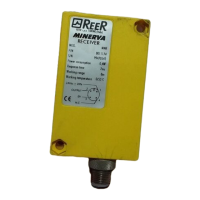
The MINERVA photoelectric safety barrier is a Type 2 electro-sensitive protective equipment (ESPE) designed for safeguarding machine operators from hazards on dangerous machinery. It consists of a separate emitter and receiver, which, when connected to a standard control unit (AU S3, AU S-TWIN, or AU S3M2), forms a safety system. The system detects the passage of a person's entire body, making it suitable for applications where protection against arms and hands is not the primary concern.
The MINERVA system operates by establishing an optical path between an emitter and a receiver. When this optical path is fully interrupted by an obstacle, the receiver discontinues the transmission of its output signal. Upon recognizing this interruption, the connected control unit immediately de-energizes its outputs, preventing dangerous machine movements.
The system incorporates a test function to ensure proper operation. This test is initiated by a command from the control unit, which temporarily turns off the emitter. The receiver then detects the interruption of the beam and cuts off its output signal. The control unit verifies that the receiver's reaction time, its outputs, and any external relays (K1-K2) conform to the expected parameters. This test is externally controlled via a button.
The MINERVA system is compatible with various control units, each offering different functionalities:
The system's protection function is not sufficient in situations where the machine's control unit cannot be electrically controlled or cannot promptly stop hazardous movements. It is also not suitable if the hazard involves falling or ejected items from the machine. For food processing applications, compatibility with chemical agents should be verified with the manufacturer. For all safety-related matters, consulting relevant safety authorities or industrial associations is recommended.
The MINERVA system is suitable for various industrial applications, including:
The system can be configured for single or double beam protection.
The system's effective capacity can be influenced by environmental conditions such as mist, vapours, dust, and dense fumes. Correction factors (Fc) are provided to adjust the maximum effective capacity in these cases.
Deflector mirrors can be used to protect and control areas accessible from multiple sides, creating "U" type protection. When using mirrors, it's essential to ensure the minimum safety distance is maintained on all access sides. The emitter-receiver distance is calculated as the sum of the lengths of all sides providing access to the controlled area. Each additional mirror employed reduces the maximum effective capacity by 10%. Accurate alignment between the emitter, mirrors, and receiver is crucial, and a maximum of three deflector mirrors is recommended.
Electrical connections are made via a pole male connector (M12) and a provided CM9 connector. It is important to ensure the power supply voltage conforms to the technical data (24Vdc ±20%). For connections longer than 50m, cables with a cross-sectional area of 1mm² should be used. The power supply to the barrier and control unit should be kept separate from other noise sources (e.g., electric motors, inverters). The control unit must be connected to a ground socket, and connecting wires for the control unit, photocell, test control, and system control should follow a different route than other power cables to ensure trouble-free operation.
The MINERVA photocell does not require special maintenance. However, regular cleaning of the emitter and receiver lenses is recommended to prevent dust accumulation, which can impair optical beam transmission and reception, potentially leading to equipment failure. Abrasive or corrosive products, solvents, or alcohol should not be used for cleaning, as they may harm the surfaces.
Before each work shift or power-up, a verification of the photocell's correct operation is necessary. This involves intercepting the beam with a non-transparent cylinder (12 mm diameter), first in the center of the area between the emitter and receiver, and then close to both components. During this process, it should be confirmed that the red LED lights up when the area is occupied, the green LED goes out when the area is free, and the control unit output switches accordingly.
If any fault persists after power cycling and checking electrical connections, alignment, and lens cleanliness, the equipment should be sent to the manufacturer's laboratories. When returning the equipment, it is important to provide the part number, date of installation, operating period, type of installation, and a clear description of the fault observed.
 General
| Type | Automatic Barrier |
|---|---|
| Model | MINERVA |
| Motor voltage | 24 V DC |
| Operating Temperature | -20°C to +55°C |
| Protection Rating | IP54 |
| Barrier Length | Up to 6 m |
| Control Options | Remote control, push button, loop detector |
| Power supply | 230V AC ±10% 50/60Hz |

 To Next Page