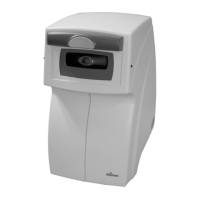
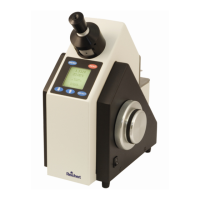
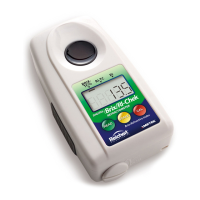
The Reichert AR200 Digital Handheld Refractometer is a high-precision optical instrument designed for measuring the refractive index (nD) and % Solids (Brix) of liquid solutions. Its primary purpose is to assist quality control personnel in Food and Beverage applications, but its advanced features also make it suitable for use in Medical, Pharmaceutical, Industrial Fluids, Chemical, and Petrochemical Industries.
Function Description:
The AR200 measures the refractive index of liquid solutions and can display results in various modes, including % Solids (Brix), % Solids-TC (Brix-Temperature Compensated), Refractive Index (nD), and Refractive Index-TC (temperature Compensated per ICUMSA Sucrose temperature Coefficient). The instrument features automatic temperature compensation (ATC) to correct readings over a range of 15°C to 40°C, referencing a 20°C reading. This feature accounts for the inverse relationship between refractive index and temperature. For accurate ATC, samples must be allowed to equilibrate to the prism surface temperature. The ATC mode is based on ICUMSA sucrose temperature coefficients, making it valid for sucrose (Brix) solutions when in Index-TC mode. For non-sucrose samples, users can download specific temperature coefficient calculation and correction information from the manufacturer's website or contact technical support.
The device operates on four AAA batteries, providing over 3000 readings per set. It includes an auto-off sleep mode after 30 seconds of inactivity and low battery detection.
Important Technical Specifications:
- Power: Four AAA batteries.
- Operating Time: 3000+ readings per set of batteries.
- Operation: Three-key operation ("CAL", "READ", "MENU") with on-screen prompts.
- Illumination: 589 nm LED.
- Range:
- Refractive Index (nD = 589nm Sodium D line): 1.3300 to 1.5600.
- % Solids (Brix-Sucrose per ICUMSA in Channel 1): 0 to 95%.
- User definable in channels 2-4.
- Readability:
- 0.0001 nD.
- 0.1% Solids.
- 0.1 °C Temperature.
- Accuracy:
- +/- 0.0001 nD.
- +/- 0.1% Solids (Brix).
- +/- 0.2°C Temperature.
- Temperature Compensation Range: 15°C – 40°C (59°F – 104°F) per ICUMSA in Channel 1, user definable in custom channels.
- Prism Assembly: Glass Prism sealed to Stainless Steel Well with solvent-resistant epoxy.
- Dimensions: 18cm (L) x 9cm (W) x 3.5cm (D) (7"L x 3.75"W x 1.37"D).
- Weight: 410g.
- Environmental Conditions:
- Temperature Range: 10°C – 45°C.
- Max. Relative Humidity: 80% for temperatures up to 31°C, decreasing linearly to 50% at 40°C.
- Pollution Degree 2.
- Altitude: Up to 2,000 meters.
Usage Features:
- Instrument Display: Digital display shows measurement values, operator instructions, and error messages.
- Keypad Controls: Soft-touch membrane keys:
- CAL: Prompts for water calibration; also acts as "Down" key for scrolling menu options/values.
- READ: Reads sample; also acts as "Up" key for scrolling menu options/values.
- MENU: Enters menu options; also functions as "Enter," "Exit," or "Cancel" based on screen prompts.
- Sample Well: Made of stainless steel with a glass prism. Samples must cover the entire prism surface for accurate readings.
- IR Window: Located on the bottom, used for PC communication via an optional docking station.
- Reading Modes: Users can select between nD, nD-TC, Brix, or Brix-TC modes.
- Calibration:
- Daily Single Point Calibration: Performed with distilled water (0.0 Brix-TC, 20.0°C).
- Multipoint Calibration: Supports up to 5 points (distilled water and 4 user-definable points, factory-set to match NIST certified standards). Two-point calibration (distilled water and a high refractive index NIST standard) is typically sufficient for required accuracy. Additional points and modification of existing points are available via the "Add/Delete/Edit" option, but require contacting technical support due to potential instrument corruption. Calibration should always start with the lowest refractive index sample (distilled water) and proceed to the highest.
- Channels:
- Channel 1 (ICUMSA Brix): Preprogrammed for % Sucrose or "Brix" scale per ICUMSA. TC readings in this channel are valid for Brix solutions only.
- Channels 2-4 (User Programmable): Custom scales or channels can be programmed at the factory or using the optional IR communications package to measure specific solutions with relevant temperature correction factors.
- Menu Options:
- Exit Menu: Exits the menu mode.
- Calibration: Accesses calibration options (Set Water, Span 1.40229, Span 1.51416, Add/Delete/Edit, Exit).
- Contrast: Adjusts display contrast.
- IR Linkup: For downloading stored values (up to 225 readings and 5-point calibration log) to a PC using the optional Docking Station (13951000).
- Set Clock: Sets time (12-hour am/pm or 24-hour military) and date (MDY format).
- Select Channel: Switches between available channels/scales (visible only if custom channels are added).
- Reading Mode: Changes between nD, nD-TC, Brix, or Brix-TC reading modes.
Maintenance Features:
- Care of Prism Surface: The prism surface and well must be cleaned immediately after each use. Strong acids or bases should not be used as samples or cleaning agents. Metal or sharp objects should not be used to clean or pry residue. Samples should be wiped off with a moist tissue. Warm water and soap are recommended for sucrose and oil-based residues, followed by distilled water cleaning. Any remaining moisture should be removed with a dry tissue.
- General Cleaning: Non-optical components can be cleaned with soap and water or methanol. Strong solvents like N,N-Dimethylformamide, N,N-Nimethylacetamide, cresols, phenols, other tar acids, Tetrahydrofuran, or some lacquer thinners should be avoided as they can deteriorate the prism seal or instrument components, especially at elevated temperatures. Acetone or acetone-based products should not be used.
- Storage: Always store the instrument with the well clean and dry.
- Calibration Oils: Recommended Extended Precision Standard Calibration Oils are manufactured by Cargille Labs (NIST traceable, +/-0.00005 nD accuracy, guaranteed temperature coefficients). Specific catalog numbers for calibration oils are provided (e.g., 13K41330, 13K41340, 13K41350, 13K41360), though values may vary by supplier.

 Need help?
 General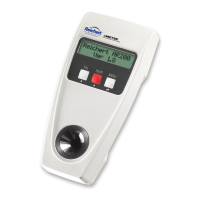

 To Next Page