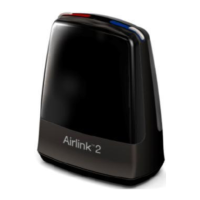
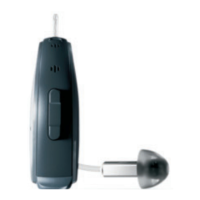
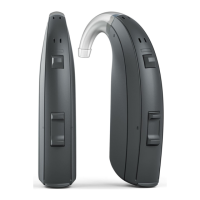
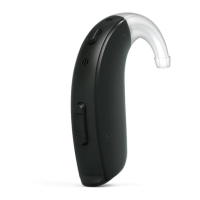
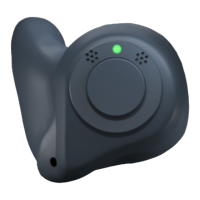
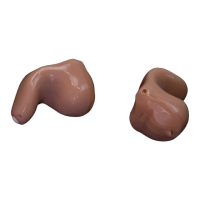
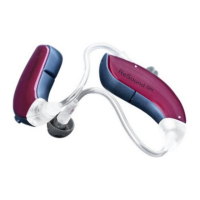
This document provides a technical manual for the ReSound SYDNEY RIE Platform, covering both VERSO and ALERA models of hearing aids. The manual details product information, color overviews for housing parts, part lists for various components, test equipment, and maintenance procedures.
Function Description
The ReSound SYDNEY RIE (Receiver-In-Ear) Platform consists of advanced hearing aids designed to provide sound amplification and improve hearing for individuals with hearing loss. These devices are available in both non-wireless (WL) and wireless (WL) configurations, and some models include tinnitus management features. The RIE design places the receiver directly in the ear canal, offering a more natural sound experience and a discreet fit.
Important Technical Specifications
The SYDNEY RIE Platform includes several models across two main platforms: VERSO (C4.5) and ALERA (C4.1).
VERSO Models (C4.5):
- SYDNEY (Batt 10A zinc air - non WL):
- VERSO 9: VO960-DR (Data Sheet Doc No: 400136000)
- VERSO 7: VO760-DR (Data Sheet Doc No: 400136000)
- VERSO 5: VO560-DR (Data Sheet Doc No: 400136000)
- SYDNEY TINNITUS (Batt 10A zinc air - non WL):
- VERSO 9: VOT960-DR (Data Sheet Doc No: 400200000)
- VERSO 7: VOT760-DR (Data Sheet Doc No: 400200000)
- SYDNEY (Batt 312 zinc air - WL):
- VERSO 9: VO961-DRW (Data Sheet Doc No: 400136000)
- VERSO 7: VO761-DRW (Data Sheet Doc No: 400136000)
- VERSO 5: VO561-DRW (Data Sheet Doc No: 400136000)
- SYDNEY TINNITUS (Batt 312 zinc air - WL):
- VERSO 7: VOT761-DRW (Data Sheet Doc No: 400200000)
ALERA Models (C4.1):
- SYDNEY (Batt 10A zinc air - non WL):
- ALERA 9: AL960-DR (Data Sheet Doc No: 17377900)
- ALERA 7: AL760-DR (Data Sheet Doc No: 17377900)
- ALERA 5: AL560-DR (Data Sheet Doc No: 17377900)
- SYDNEY TINNITUS (Batt 10A zinc air - non WL):
- ALERA 9: ALT960-DR (Data Sheet Doc No: 17734800)
- SYDNEY (Batt 312 zinc air - WL):
- ALERA 9: AL961-DRW (Data Sheet Doc No: 17377900)
- ALERA 7: AL761-DRW (Data Sheet Doc No: 17377900)
- ALERA 5: AL561-DRW (Data Sheet Doc No: 17377900)
- ALERA 4: AL461-DRW (Data Sheet Doc No: 17377900)
- SYDNEY TINNITUS (Batt 312 zinc air - WL):
- ALERA 9: ALT961-DRW (Data Sheet Doc No: 17734800)
Housing Parts - Colour Options:
Both VERSO and ALERA models offer a range of colors for their housing parts (Frame, Bat Door, Mic Bar, HSG L/R).
- VERSO: Light Blonde (LBL), Medium Blonde (MBL), Dark Brown (DBR), Monza Red (MON RED), Anthracite (ANT), Metal (MET), Pearl White (PRL WHT), Ocean Blue (OCN BLU), Sterling Grey (ST GRY), Black Gloss (BLK GLOSS).
- ALERA: Light Blonde/Medium Blonde (MBL/LBL), Medium Blonde (MBL), Dark Brown/Black (DBR/BLK), Black (BLK), Anthracite/Black (ANT/BLK), Sterling Grey (ST GRY).
- Note: Some ALERA colors are combined for certain parts.
Receiver Tubes:
The devices use various receiver tubes, available in different sizes (0L to 4R) and types (NP, HP, S (small), HP2). Performance can vary between NP/HP and S/HP2 tubes, with HP2 recommended for VERSO models.
Domes:
A variety of domes are available for different receiver types (NP, HP, S, HP2) and sizes (S, M, L, LGE). These include standard domes, extended length domes, and power domes, as well as thin tube domes.
Accessories:
The manual lists various accessories such as receiver tube rebending kits, Sportlocks, adapters for earmolds, custom insert tips (NP, HP), wax removers, power dome tool kits, and measurement tools.
Usage Features
The ReSound SYDNEY RIE hearing aids are designed for ease of use and customization.
- Wireless Connectivity: Wireless models (e.g., those ending in -DRW) allow for connectivity with other wireless accessories, enhancing the user experience.
- Tinnitus Management: Specific TINNITUS models integrate features to help manage tinnitus symptoms.
- Customization: The devices can be customized with various housing colors, receiver tubes, and domes to suit individual preferences and hearing needs. Custom ear molds can also be used with appropriate adapters.
- Programming: The hearing aids are programmable using dedicated programming cables (e.g., CS63, CS44) and software, allowing audiologists to fine-tune settings for optimal performance.
- Test Equipment: A range of test equipment is used for fitting and verification, including couplers (2cc, 2cc coupler insert), NOAHLINK WL CPD-1 for wireless testing, programming cables, battery pills, and test jigs for HI (Hearing Instrument) final testing.
Maintenance Features
The manual provides detailed instructions for various maintenance and repair procedures, enabling technicians to service the devices effectively.
- Part Replacement: Comprehensive part lists are provided for service/engine modules, HSG parts, replacement packs, rec tubes, and domes.
- Power Dome Tool: A dedicated tool is used for inserting and removing power domes, ensuring proper fit and function.
- Disassembly/Reassembly of HSG Parts: Instructions are given for carefully disassembling the housing parts using a multi-tool (screwdriver/pin) to access internal components. This involves separating the mic bar, opening the battery door, and gently separating the L/R housing parts from the module/frame.
- ID Plate Transfer: When replacing a frame, the ID plate must be carefully transferred from the old frame to the new one using a multi-tool and tweezers.
- Engine Module Replacement (10A): Steps are outlined for replacing the engine module, including pushing it out from the frame, transferring the ID plate if necessary, and ensuring mic filters are not damaged during reassembly.
- ASM Frame Replacement (Wireless 312): Instructions detail how to replace the ASM frame, which involves removing HSG parts, transferring the ID plate, and ensuring proper placement of the battery pin and L/R HSG parts.
- Mic Filter Replacement: The process involves using a screwdriver to loosen the mic bar, lifting it off, removing defective mic filters with tweezers, and inserting new mic filters using a specialized two-part tool.
- Receiver Tube Replacement: Similar to mic filter replacement, this involves removing the mic bar, detaching the defective receiver tube, and attaching a new one, ensuring the mic bar locks the receiver tube in place.
- HI Testing: The manual describes the use of test fixtures and frames for DSA6000 testing. This involves sliding the flex strip into the HI, adding the battery pill, attaching the HI to the test rec tube mounted on the white fixture, placing the white fixture in the black frame, mounting the coupler insert, and pushing the test rec into the hole of the insert. The test program then performs IAD calibration.
- Wireless Test: For wireless models, a combined DSA6000 Noahlink/SAS Range Check test is performed. This involves entering the MAC address into the DSA 6000 system configuration and connecting a Noahlink. The test evaluates the streaming signal, and the operator marks the HI as pass or fail based on the signal quality. If the device is disconnected, it needs to be reconnected to the DSA system for further evaluation.

 Need help?
 General

 To Next Page