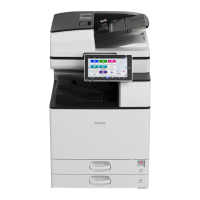
This document is a Field Service Manual for the Mail Box CS4010, with Machine Code D708, published in May 2016. It provides detailed information for trained service technicians regarding the installation, maintenance, and operation of the device.
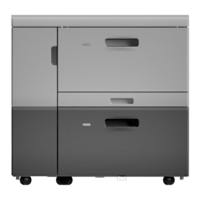
The Mail Box CS4010 is a 9-bin mailbox unit designed to sort and stack printed paper. It connects electrically to a finisher via a 14-pin drawer connector. When a print job starts, the main motor activates all rollers, and the paper is directed to a specified bin. The unit utilizes junction gate solenoids to switch the gate and direct paper to the correct tray. When the uppermost tray is selected, all solenoids remain off. Paper transport speed in this unit is typically synchronized with the finisher.
Important Technical Specifications:
- Number of Bins: 9 bins
- Paper Sizes Supported: A5, A4, A3, 5 1/2" x 8 1/2", 8 1/2" x 11", 8 1/2" x 14", 11" x 17"
- Paper Weight: 60 to 128 g/m² (14 lb - 34 lb Bond)
- Dimensions (W x D x H): 540 x 600 x 660 mm (21.3 x 23.6 x 26 in.)
- Weight: Less than 15 kg (33 lb.)
- Power Consumption: Less than 48 W
- Noise Level: Less than 74 dB
- Stack Capacity: 100 sheets per bin
- Power Source: DC24V, 5V from the main machine
Usage Features:
The device's basic operation involves the main motor driving all rollers to transport paper to the selected bin. Junction Gate Solenoids (1-9) control the opening and closing of gates to direct paper to specific trays. Junction Gate Solenoid 1 manages the entrance to the mailbox, while Solenoids 2-9 control gates for trays 1-8.
Paper Tray Full Detection is a key feature. Each bin has a "Paper Tray Full Sensor 1" (paper overflow sensor) to prevent overloading. If the output from this sensor remains at a "High" level for more than a specified time (T seconds), full detection occurs. For example, at the lowest print speed (12 sheets/A3), if the sensor doesn't switch to "Low" within 40 seconds after detection, the print job will stop. The machine's response to full detection depends on its current state. If it's receiving paper, it will output 8 sheets in a row to the same tray while the overflow sensor remains ON. In other states (door closed, no jam, no remaining paper), the sensor will stay ON for more than 1.5 seconds. The sensor turns OFF when the tray is not full.
Jam Detection is implemented using five Vertical Transport Sensors (1-5) located throughout the paper path. These sensors detect misfeeds between trays and at the exit to tray 9. The manual lists various jam types, including "Late Jam" and "Lag Jam" for each sensor, along with corresponding Log Codes (350-359). A "Main Machine Ordering Data-Wrong Jam" (Log Code 360) indicates an issue with ordering data from the main machine, requiring a reboot or indicating unavailable paper reception.
Maintenance Features:
The manual outlines procedures for replacement and adjustment of various components, emphasizing safety precautions.
Covers and Trays:
- Trays [A] can be removed by gripping the front and lifting them out.
- The Front cover [B] is secured by 2 screws.
- The Rear cover [C] is secured by 3 screws.
- The Top cover [D] is also removable.
Sensors:
- To access sensors, the machine must be switched off and unplugged, and the tray removed.
- The Bin cover [A] needs to be removed.
- The Tray sensor [B] (1 screw), Tray overflow sensor [C] (1 screw), and Vertical transport sensor [D] (1 screw) can be replaced. To remove these sensors, the pawl must be raised, and the bottom of the sensor gripped.
Main Motor and Control Board:
- Access requires removing the Rear cover (refer to page 11).
- The harness of the main motor bracket needs to be disconnected (2 connectors).
- The main motor bracket [A] is secured by 3 screws, and the timing belt (1) needs to be removed.
- The main motor [A] itself is secured by 2 screws.
- For the Control Board, the Rear cover must be removed.
- A bracket [A] secured by 4 screws needs to be removed.
- The Control board is secured by 2 screws and 15 connectors.
Safety, Conventions, and Trademarks:
The manual includes a section on safety, conventions, and trademarks. It defines common terms and symbols used throughout the document, such as "Blue screw," "Bushing," "C-ring," "Connector," "E-ring," "Flexible film cable," "Harness clamp," "Hook," "Screw," "Spring," and "Timing belt." Abbreviations like JG (Junction Gate), LEF (Long Edge Feed), SEF (Short Edge Feed), and TE (Trailing Edge of paper) are also defined.
Warnings, Cautions, Notes:
- WARNING: Indicates potentially hazardous situations that could result in death or serious injury.
- CAUTION: Indicates potentially hazardous situations that could result in minor or moderate injury or damage to the finisher or other property.
- Important: Provides guidelines to avoid problems like misfeeds, damage to originals, data loss, and machine damage.
- Note: Offers tips and advice for servicing the machine.
General Safety Instructions:
- Always obey safety precautions.
- Switches and symbols conform to IEC60417.
Responsibilities of the Customer Engineer:
- Maintenance must be performed using special tools and procedures outlined in reference materials (service manuals, technical bulletins, operating instructions, and safety guidelines).
- Adhere to "CE Safety Guide" recommendations.
- Use only consumable supplies and replacement parts designed for the machine.
Before Installation, Maintenance (Power):
- WARNING: Always disconnect the power plug before maintenance. Switch off the machine, wait a few seconds, then unplug to prevent electrical shock.
- Avoid touching electrical components or moving parts (gears, timing belts) when the machine is off or covers are removed.
- Keep hands away from electrical components and moving parts when the machine is on with covers removed.
Installation, Disassembly, and Adjustments:
- WARNING: After installation/maintenance, always check normal operation. Ensure all shipping materials, wires, tags, metal brackets, and tools are removed, and interlock switches are restored.
- Never use fingers to check moving parts or lubricate them while the machine is operating.
- CAUTION: Use only standard tools approved for maintenance. For special adjustments, use only tools and lubricants described in the service manual. Incorrect tool usage can cause damage or injury.
During Maintenance (General):
- CAUTION: Before maintenance, switch off, disconnect power, and allow 10 minutes for cooling.
- Avoid touching hot surfaces inside the machine.
Safety Devices:
- WARNING: Never remove safety devices unless replacement is required, and always replace them immediately.
- Do not defeat the function of any safety device (fuse, switch). Always test machine operation after removal/replacement of safety devices.
- Use only correct fuses or circuit breakers. Incorrect devices can lead to fire and injury.
Organic Cleaners:
- CAUTION: Use only organic cleaners described in the service manual.
- Ensure good ventilation when using organic cleaners to avoid fumes.
- Switch off, unplug, and cool the machine before using organic cleaners near heat-generating parts to prevent fire/explosion.
- Wash hands thoroughly after cleaning with organic cleaners to prevent contamination.
- Clean up silicone oil or other spills completely to prevent slippery surfaces. Use "My Ace" Silicone Oil Remover or dry rags.
Ozone Filters:
- CAUTION: Replace ozone filters when their service life expires. Excessive ozone can cause discomfort.
Power Plug and Power Cord:
- WARNING: Ensure the power plug is fully inserted. A partially inserted plug can cause heat and fire.
- Check the power plug for dust/lint and clean if necessary.
- Inspect the power cord for cuts/damage and replace if necessary.
- Ensure the power cord is not coiled or wrapped around objects, which can cause heat buildup.
- Keep the area around the power source clear for quick cord removal in emergencies.
- Ensure the power cord is grounded.
- Connect the power cord directly to the power source; do not use an extension cord.
- Pull on the plug, not the cable, when disconnecting.
After Installation, Servicing (Disposal of Used Items):
- CAUTION: Dispose of used items (developer, toner, OPC drums) according to local laws.
- Do not dispose of this product or waste from consumables at household collection points; use dealers or authorized collection sites.
Points to Confirm with Operators:
- Instruct users on removing jammed paper and troubleshooting minor problems.
- Point out parts they should not touch or remove.
- Confirm they know how to store and dispose of consumables.
- Ensure access to and understanding of the operating instruction manual and safety instructions.
Safety Instructions for this Machine:
- Installation by trained service technicians only.
- Machine weighs 92 kg (202.9 lb.); requires at least four persons for removal from pallet and positioning.
- Never use flammable solvents around the machine.
- Do not place objects on the machine.
- If anything falls into the machine, turn off the main power switch, then disconnect the power cord.
- Locate the machine on a sturdy, flat surface, away from excessive vibration.
- Ensure ventilation ports are not blocked.
- Gas from molten glue can irritate eyes, throat, and nose; use in a well-ventilated room.
- Avoid exposing the machine to excessive high temperatures/humidity, dust, water, direct sunlight, open flame, or corrosive gases to prevent fire and electrical shock.
Trademarks:
The manual lists several registered trademarks, including Microsoft®, Windows®, MS-DOS®, PostScript®, PCL®, Ethernet®, and PowerPC®. It also states that other product names are for identification purposes only and disclaims rights involved with those marks.

 Need help?
 General

 To Next Page