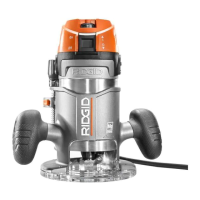
OPERATOR’S MANUAL
MANUEL D’UTILISATION
MANUAL DEL OPERADOR
R2200 ROUTER WITH R2901
MOTOR AND R2911 FIXED BASE,
R2200 TOUPIE AVEC R2901 MOTEUR ET
R2911 BASE FIXE
R2200 FRESADORA CON R2901 MOTOR Y
R2911 BASE FIJA
To register your RIDGID
product, please visit:
register.RIDGIDpower.com
Pour enregistrer votre
produit de RIDGID,
s’il vous plaît la visite :
register.RIDGIDpower.com
Para registrar su producto
de RIDGID, por favor visita:
register.RIDGIDpower.com
TABLE OF CONTENTS
****************
General Power Tool Safety
Warnings ............................................ 2-3
Router Safety Warnings .........................4
Symbols .................................................5
Electrical .................................................6
Features ............................................. 6-7
Assembly ................................................7
Operation ......................................... 8-12
Adjustments .........................................13
Maintenance .........................................14
Accessories .......................................... 14
Illustrations ..................................... 15-18
Parts Ordering and
Service ....................................Back page
TABLE DES MATIÈRES
****************
Règles de sécurité relatives aux
outils électriques ................................ 2-3
Avertissements de sécurité relatifs
toupie ..................................................... 4
Symboles ...............................................5
Caractéristiques électriques ..................6
Caractéristiques ................................. 6-7
Assemblage............................................7
Utilisation ......................................... 8-12
Réglages ..............................................13
Entretien ...............................................14
Accessoires .......................................... 14
Illustrations ..................................... 15-18
Commande de pièces et
dépannage ........................... Page arrière
ÍNDICE DE CONTENIDO
****************
Advertencias de seguridad para
herramientas eléctricas .....................2-3
Advertencias de seguridad
fresadora .............................................. 4
Símbolos .............................................. 5
Aspectos eléctricos .............................. 6
Características ..................................6-7
Armado ................................................. 7
Funcionamiento ...............................8-12
Ajustes ................................................ 13
Mantenimiento.................................... 14
Accesorios .......................................... 14
Ilustraciones ..................................15-18
Pedidos de piezas y
servicio .............................Pág. posterior
Includes: Router Motor, Fixed Base, Router
Table Attachment Screws (3), 1/4 in. Collet
Adaptor, 1-1/4 in. Vacuum Adaptor, Vacuum
Adaptor Screws (2), Centering Tool (includes
cone and pin), Collet Wrench, T-Handle
Wrench, Tool Bag, Operator’s Manual
Inclut : Moteur de toupie, base fixe, vis de
fixation de table à toupie (3), adaptateur
de collet de 6 mm (1/4 po), adaptateur de
sac de 1-1/4 po (32 mm), vis d’adaptateur
d’aspiration (2), outil de centrage (comprend
un cône et une goupille), clé à collet, clé en
T, sacoche, manuel d’utilisation
Incluye: Motor de la fresadora, base fija, tornillos
del aditamento de mesa para fresadora (3),
adaptador para portaherramientas de 6 mm (1/4
pulg.), adaptador para aspiradora 32 mm (1-1/4
pulg.), tornillos del adaptador de la aspiradora
(2), centrador (incluye cono y clavija), llave para
portaherramientas, llave de mango en “T”, bolsa,
manual del operador
WARNING:
To reduce the risk of injury, the
user must read and understand
the operator’s manual before
using this product.
AVERTISSEMENT :
Pour réduire les risques de
blessures, l’utilisateur doit lire
et veiller à bien comprendre
le manuel d’utilisation avant
d’utiliser ce produit.
ADVERTENCIA:
Para reducir el riesgo de
lesiones, el usuario debe leer
y comprender el manual del
operador antes de usar este
producto.
SAVE THIS MANUAL FOR
FUTURE REFERENCE
GUARDE ESTE MANUAL
PARA FUTURAS CONSULTAS
CONSERVER CE MANUEL
POUR FUTURE RÉFÉRENCE

 Need help?
 General

 To Next Page