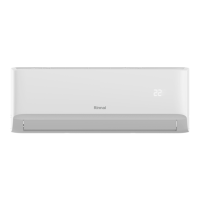
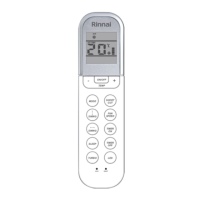
This document is the Owner's Manual for the Rinnai Slim Four-Way Cassette air conditioner. It provides information on operation, maintenance, and troubleshooting.
Function Description:
The Rinnai Slim Four-Way Cassette is an air conditioning system designed for residential and light commercial applications. It offers cooling, heating, and dry modes to maintain human comfort within specified temperature ranges. The unit features a four-way air outlet for efficient air distribution. It can be operated via a remote control or a manual button on the indoor unit's display panel. Some models include an auto-restart function after power failure, a louvre angle memory function, and a refrigerant leak detection system.
Important Technical Specifications:
The manual lists specific indoor and outdoor unit model numbers:
- Indoor Units: CIN070R, CIN100R, CIN120R, CIN140R
- Outdoor Units: DONSR07Z72, DONSR10Z72, DONSR12Z72, DONSR14Z72
- Cool Mode:
- Room Temperature: 17°C ~ 32°C
- Outdoor Temperature: -15°C ~ 50°C
- Heat Mode:
- Room Temperature: 0°C ~ 30°C
- Outdoor Temperature: -15°C ~ 24°C
- Dry Mode:
- Room Temperature: 17°C ~ 32°C
- Outdoor Temperature: 0°C ~ 50°C
The appliance uses R410A refrigerant.
Usage Features:
- Remote Control: The primary method of operation, requiring AAA (1.5 V) batteries. A slide-in cradle is provided for wall mounting. The remote control transmits signals to a receiver on the indoor unit.
- Manual Operation: A display panel on the indoor unit allows for basic operation (AUTO, FORCED COOL, OFF modes) in case the remote control is unavailable or out of batteries.
- Auto-Restart: In some models, the unit will automatically restart with previous settings after a power failure.
- Louvre Angle Memory Function (where fitted): Horizontal louvres return to their previous position after a power failure. The manual button can reset louvre settings.
- Refrigerant Leak Detection System (where fitted): Displays "EC" on the LCD screen and flashes the LED indicator light in case of a refrigerant leak.
- Energy Saving Tips: Recommendations include setting moderate temperatures, closing curtains and windows, avoiding blocking air inlets/outlets, using timer/sleep/economy modes, removing remote control batteries during long non-use periods, and regular air filter cleaning.
- Safety Precautions: Emphasizes installation by authorised personnel, proper electrical wiring, safe lifting due to weight, stable mounting, and avoiding installation near sea wind for outdoor units. Users are warned against modifying electrical wiring, inserting objects into air inlets/outlets, using flammable sprays, or operating with wet hands.
Maintenance Features:
- General Maintenance: Requires turning off the system and disconnecting power before cleaning. Avoid using harsh chemicals, solvents, or water hotter than 40°C on the unit. Clean with a damp, lint-free cloth and neutral detergent, then dry.
- Air Filter Cleaning: The air filter should be cleaned every two weeks, or more frequently in dusty areas, to maintain efficiency. Replacement is recommended if heavily clogged.
- Procedure:
- Unlock the grill by pushing two tabs simultaneously.
- Unplug the display panel cable from the control box.
- Detach the grill by holding it at a 45° angle, lifting, and pulling forward.
- Remove the air filter.
- Clean the filter by vacuuming or washing in warm water with mild detergent. If washing, the inlet side should face down and away from the water stream.
- Rinse with clean water and air-dry, avoiding direct sunlight.
- Reinstall the filter.
- Reinstall the front grill and reconnect the display panel cable.
- Note: Some models have an auto-lifting panel for easier filter cleaning.
- Caution: Filter removal and cleaning should be performed by a qualified service technician. For households with animals, regular grill wiping is recommended to prevent airflow blockage from pet hair.
- Repairing Refrigerant Leaks: If a leak occurs, turn off the unit, ventilate the room, and contact a qualified service technician immediately. Refrigerant is toxic and flammable.
- Preparation for Periods of Non-Use:
- Maintenance after Extended Non-Use: Remove obstacles from vents, clean air filter and front grill, and turn on the main power switch at least 12 hours before operating.
- Storing the Unit: Run on FAN mode for 12 hours to dry and prevent mould, then turn off and unplug. Clean and reinstall the air filter, and remove batteries from the remote control.
- Service Maintenance Schedule: Rinnai recommends annual maintenance by a qualified licensed technician to prolong unit life and ensure optimum efficiency. Failure to adhere to this schedule may void the warranty. The schedule includes checks for electrical components, major components (clearances, condensate trays, refrigerant charge, fan assemblies), controls (louvre and remote operation), and system operation (temperatures, pressures).
- Troubleshooting: The manual provides a table of common problems, possible causes, and solutions, including power failure, poor cooling/heating, frequent stopping, white mist emission, noises, and issues with the grill. It also lists error codes associated with the number of flashes per second on the timer indicator.
- Disposal Guidelines: The appliance contains hazardous materials and should not be disposed of as household waste. Special collection and treatment are required by law. Disposal in natural surroundings is harmful to health and the environment.


 To Next Page

 General