This document serves as an operation and installation manual for the Rinnai Hotflo Solar Enabled Electric Storage Water Heater. It provides comprehensive information for consumers, installers, and service personnel regarding the device's function, specifications, usage, and maintenance.
Function Description:
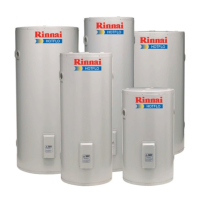
The Rinnai Hotflo Electric Storage Water Heater is designed to provide quality heating solutions for domestic and commercial applications. It stores water in a vitreous enamel-lined steel tank, which is then heated by an electric element located at the base of the cylinder. The water temperature is automatically controlled by a preset thermostat to 65 °C, ensuring disinfection against Legionella. The system is also solar-enabled, meaning it can be integrated with a solar installation, though specific operating and installation requirements for solar setups are detailed in separate manuals. The water heater is suitable for both indoor and outdoor installations and offers left or right-hand plumbing connections.
Important Technical Specifications:
The manual provides a table of various Hotflo models with their dimensions (A, B, C, D, E, F in mm) and empty weights (kg).
- Hotflo 135 L (HFE12545): 1245mm (A), 590mm (B), 515mm (C), 1020mm (D), 225mm (E), 155mm (F), 62kg (empty).
- Hotflo 180 L (HFE16045): 1530mm (A), 590mm (B), 515mm (C), 1310mm (D), 225mm (E), 155mm (F), 71kg (empty).
- Hotflo 215 L (HFE20045): 1825mm (A), 590mm (B), 515mm (C), 1605mm (D), 225mm (E), 155mm (F), 98kg (empty).
- Hotflo 270 L (HFE25045): 1265mm (A), 760mm (B), 685mm (C), 985mm (D), 260mm (E), 155mm (F), 87kg (empty).
- Hotflo 340 L (HFE31545): 1510mm (A), 760mm (B), 685mm (C), 1200mm (D), 260mm (E), 155mm (F), 101kg (empty).
Pressure Ratings:
- Pressure Limiting Valve: 700 kPa (approx.) for 135, 180, 215 L models; 500 kPa (approx.) for 270, 340 L models.
- Cold Water Pressure Relief Valve: 850 kPa (approx.) for 135, 180, 215 L models; 700 kPa (approx.) for 270, 340 L models.
- Temperature & Pressure Relief Valve (TPR): 1000 kPa for 135, 180, 215 L models; 850 kPa for 270, 340 L models.
- Thermostat Setting (maximum): 75 °C (factory preset to 65 °C).
- Hot and Cold Water Connections: ¾" (20 mm).
- Ingress Protection Rating: IPX4.
- Electrical Supply: AC 230 V 50 Hz, connected to an independent, fused power supply with an isolating switch.
Safety Devices:
- Temperature Pressure and Relief (TPR) Valve: Ensures water remains at a safe pressure and temperature.
- Automatic Thermostat: Maintains water temperature.
- Temperature Override Cutout: For the heating element, indicating a potentially dangerous situation if activated.
- Sacrificial Anode: Extends tank life by slowly dissipating to protect the cylinder from corrosion.
Water Quality Limits (to maintain warranty):
- TDS (Total Dissolved Solids): Up to 600 mg/L or ppm.
- Total Hardness CaCO3: Up to 200 mg/L or ppm.
- Dissolved (free) CO₂: Up to 25 mg/L or ppm.
- pH: 6.5-8.5.
- Langelier Index: Between -1.0-0.8.
Hard or aggressive water may require treatment.
Usage Features:
- Thermostat Adjustment: The thermostat is adjustable from 60 °C to 75 °C. Turning the knob anticlockwise decreases temperature, and clockwise increases it. Rinnai factory sets it at 65 °C, which is sufficient for most users. Adjustment should only be performed by an electrician or suitably qualified tradesperson.
- Solar Integration: Designed to be solar-enabled, but requires reference to separate solar operation and installation manuals for specific instructions.
- Hot Water Delivery Temperature: Local regulations require hot water to be stored at a minimum of 60 °C. For personal hygiene areas, delivery temperature is limited to 45 °C (for early childhood centers, schools, nursing homes) or 55 °C (for all other buildings), necessitating a temperature limiting device like a tempering or thermostatic mixing valve.
- Turning On/Off: To fill and turn on, open all hot water taps, then open the cold water isolation valve to the heater until water runs freely. Close taps, check for leaks, then switch on power. To turn off, switch off electricity at the isolating switch and close the cold water isolation valve.
- Draining: Turn off the water heater, close all hot water taps, gently operate the TPR Valve release, open the drain valve, and operate the TPR Valve again to allow air in and water to drain.
Maintenance Features:
- TPR Valve Operation: Every six months, operate the easing gear on the TPR valve to remove lime deposits and verify it's not blocked. This will discharge hot water, so ensure no one is nearby. Failure to do so can result in the water heater exploding. If the valve doesn't discharge water or doesn't seal, an authorised person must be called.
- System Check and Replacement: Every five years, the entire system should be checked and serviced, and the TPR valve and anode replaced by an authorised person. More frequent replacement of the anode may be necessary in hard/aggressive water areas.
- Anode Replacement: The sacrificial anode should be changed every five years. Space should be left above the cylinder to allow for anode replacement.
- Draining and Filling: Normally only required during installation or servicing and must be carried out by an authorised person.
- Servicing and Repair: If any electrical component is damaged or a problem occurs, contact Rinnai on 0800 RINNAI (0800 746 624). Only authorised persons should carry out service work, and genuine Rinnai replacement parts must be used.
- Water Pipe Insulation: All hot water pipe work should be insulated with Polythene foam or equivalent to optimize performance and energy efficiency.
- Drain Line Maintenance: Copper drain lines (1½" or DN15) must be fitted to the TPR Valve and ECV, as short as possible, with a continuous downward slope and no restrictions. In areas prone to freezing, drain lines must be insulated. An air gap must be provided to ensure complete drainage.

 Need help?
 General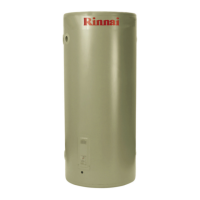




 To Next Page