Installation and Programming Manual 1-1
Section 1: About Your Pro-24
I
I
n
n
t
t
r
r
o
o
d
d
u
u
c
c
t
t
i
i
o
o
n
n
t
t
o
o
t
t
h
h
i
i
s
s
M
M
a
a
n
n
u
u
a
a
l
l
This Pro-24 Installation and Programming Manual is designed to take you through the required steps so you can
successfully install the Pro-24 and have it perform as desired. To this end, the manual is divided into two distinct
installation and programming sections. The first of these, beginning on page 2-1, discusses how to install and wire
the panel to its peripherals. The next section, beginning on page 3-1, covers the programming of the panel using
an attached keypad.
While not required for these purposes, the following documents are also available to assist you in the installation of
your Pro-24.
DOCUMENT PART NO. DESCRIPTION
The Upload/Download Programming
Manual
5INUD
explains how programming can be done through the use of
an IBM
®
-compatible Personal Computer
The Pro-24 User’s Manual 5IN224UM provides information intended for Pro-24’s end users
A
A
b
b
o
o
u
u
t
t
t
t
h
h
e
e
P
P
r
r
o
o
-
-
2
2
4
4
The Pro-24 is a full-featured security system and provides sophisticated solutions for protecting, alerting, and
reporting premises’ alarm signals, intended to address the needs of virtually every home, office, and commercial
facility. It is designed around microprocessor and EEPROM (Electrically Erasable Programmable Read-Only
Memory) technology–which will store, without the need for power, the system’s operating program as well as its
programmable parameters. The Pro-24 supports most standard detectors and sensors, along with a variety of
accessories and output devices.
It can provide monitoring and supervision for up to 24 zones. Through its 4-wire BUS, it can support a variety of
optional modules including multiple Keypads, Zone Expanders, a Wireless Interface, supplemental Power
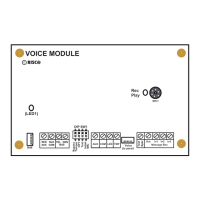
Supply(ies), an X-10 Interface, Utility Outputs and interface with a voice module. All these devices communicate
with the system by sending commands and data over the BUS, which originates at the Main Board.
The Pro-24 utilizes commercial electricity as its primary means of power and supports a rechargeable standby
battery. Its components and features are listed below:
Main Board
The Main Board is the center of the system’s operation. It supports 8 hardwired zones, provides continuous
auxiliary power for detectors like PIRs, and other peripherals (e.g. Audio Switches and certain Shock and Glass-
Break Sensors) which require it. The Main Board also maintains a source of resettable power for Smoke Detectors
when latched in the alarm state. It supplies power for the operation of an external sounder and offers the
appropriate type of voltage for an electronic siren(s), a bell(s), or a loudspeaker(s).
Up to 20 Zone Types are supported.
Zone terminations include Closed-Circuit, Open-Circuit, End-of-Line (EOL) Resistor, and Double End-of-Line
(DEOL) Resistor (see Figure 2-4 on page 2-10).
It is from the Main Board that the 4-wire BUS originates and from which all system expansion takes place (see
Figure 2-6 on page 2-11).
Zone Expansion
In addition to its eight hardwired zones, the Pro-24 can support up to another 16 such zones (24 total) which are
derived through the connection of either 8 hardwired and 8 wireless zones or 16 wireless zones (8 or 16 wireless
expanders module). Note: The Wireless Expansion Modules are not for UL Installations.
Wireless Expansion
When it's either necessary or desirable to utilize wireless zones, the Pro-24's Wireless Expansion Modules will
respond to RISCO Group's own NOVA transmitters and to Orbit’s Rolling Code Transmitters. The Wireless Module
employs superheterodyne technology, has programmable supervision time, detects a low battery condition in
transmitters, tamper attempts, and provides indications of signal jamming. Wireless and hardwired zones may be
mixed in the same system, with the total of all zones (hardwired plus wireless) limited to 24.



 To Next Page