12
16/01/2020
RECOMMENDATIONS FOR USE
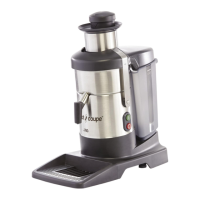
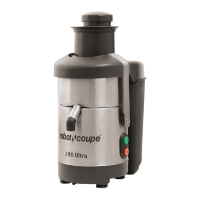
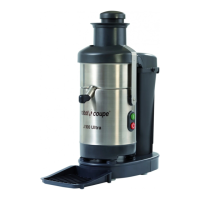
• J 80 - J 80 Buffet - J 100
- Before you use your juicer for the first time, it is a
good idea to wash all the parts that will come into
contact with food.
- Always check that the safety arm has been closed
before using your appliance.
- Always place a container under the spout and either
the pulp container or the ejection chute under the
ejector after switching your machine on but before
you start feeding the fruit or vegetables in.
- Remember to peel citrus fruit before juicing.
- Thick-skinned fruit and vegetables (e.g.
pineapples, mangoes) need to be peeled
beforehand and any large pips (e.g. melon) removed.
Always remove the stones of stone fruit (e.g. peaches,
apricots, cherries). Remove all the stems from the
grapes before putting them into the juicer.
- Some foods are not suitable for processing in
a juicer, due to their hard consistency (e.g.
coconuts).
- The J 80 - J 80 Buffet - J 100 juicer features a
unique patented Auto Feed system which does
away with the need of a pusher.
- To make the best use of your J 80 - J 80 Buffet - J 100
juicer therefore, introduce the ingredients into the
feed tube by hand (without the pusher), according
to throughput.
- Introduce the pieces of fruit or vegetables slowly
and in small quantities.
- When all the ingredients have gone through,
leave the machine on for a few more seconds to
extract every last drop of juice.
- Never put ice cubes or frozen fruit in the feed
tube.
- The pulp may become unevenly distributed inside
the basket, creating an imbalance. If the juicer
starts vibrating during operation, turn it off and
clean the basket. You can then resume juicing.
- Check that the flange and lid are correctly
positioned.
• J 80 - J 80 Buffet
- With J 80 - J 80 Buffet, you can make several
quarts of juice without having to empty the pulp
container.
Nonetheless, remember to check the level of the
pulp in the container on a regular basis.
- Check that the flange and lid are correctly fitted.
- Always make sure that the pulp container has
been properly positioned.
• J 100
- J 100 with pulp container:
You can make several quarts of juice without
having to empty the pulp container.
Nonetheless, you should check the level of pulp in
the container on a regular basis.
- J 100 with ejection chute:
The ejection chute (supplied with your appliance)
has been designed specifically to cope with
high-volume juicing. With the chute, there is no
need to keep on emptying the pulp container while
juicing.
- If you are using your juicer on the edge of
a worktop, make sure that all its feet are
firmly on the work surface. You must also
organize your work station so that there is no risk
of the juicer tipping over or falling off.
NB: If you intend to carry out high-volume juicing
every day, it is best to use the continuous pulp
ejection chute, with or without the booster base.
Fruit and vegetable preparation
Preparation
CARROTS
Peeled and left whole, topped and
tailed. Feed in 2 or 3 at a time.
APPLES
Washed and left whole
(remove stalk and any labels).
STRAWBERRIES
Remove stalks for the taste.
CITRUS FRUIT
Peel all citrus fruit.
Oranges and lemons can be left
whole.
PINEAPPLES
Peel and cut into eight chunks
(3 cuts)
MELONS
Peel and cut into eight chunks.
TOMATOES
Washed and left whole (remove hard
green core).
Feed in 2 or 3 at a time.
PEPPERS
Washed and cut into quarters
lengthwise, according to shape.
CELERIAC
Cut into 6-7 cm chunks
CUCUMBERS
Peeled. Cut into sections measuring
approx. 15 cm long.
FENNEL
Cut into 6-7 cm chunks
GINGER
Cut into pieces to make it easier to
feed into the juicer.
Do not put too many in at a time, to
prevent a blockage.
GRAPES
Remove stalks to avoid bitterness.
WARNING
Always wash fruit and vegetables thoroughly to
remove all traces of dirt and pesticides.


 To Next Page
 Loading...