Need help?
Do you have a question about the Rohr HP-200PP and is the answer not in the manual?
Instructions for performing TIG welding with the machine, including gas supply and electrode settings.
Instructions for performing MMA welding with the machine, covering earth clamp and electrode connection.
This manual describes the RÖHR INVERTER TIG/MMA welding machine, available in models HP-160L, HP-200PP, and HP-250PP, designed for quality welding through advanced technology. It provides essential information for setting up, operating, and maintaining the welder, emphasizing safety and optimal performance.
The RÖHR INVERTER TIG/MMA welding machine is a versatile tool capable of performing both TIG (Tungsten Inert Gas) and MMA (Manual Metal Arc) welding. Its inverter technology ensures stable arc performance and efficient power usage, making it suitable for a range of welding tasks. The machine is designed to provide precise control over the welding process, allowing users to achieve high-quality welds on various materials. The TIG function is ideal for applications requiring clean, precise welds, often used with argon gas to create an inert atmosphere around the weld pool, preventing contamination. The MMA function, also known as stick welding, is more robust and suitable for thicker materials and outdoor use, where environmental factors might make TIG welding challenging. The machine's pulse function, available on some models, allows for better control over heat input, which is particularly useful when welding thin materials or when precise bead control is required. This feature helps to minimize distortion and achieve a more aesthetically pleasing weld. The integrated control panel allows for easy adjustment of welding parameters, ensuring that the machine can be adapted to different welding scenarios and material types.
Setting up the RÖHR welding machine involves several key steps to ensure safe and effective operation. First, it is crucial to ensure that the machine's air intake is not blocked, as proper airflow is essential for cooling the unit during operation. The gas supply, typically argon for TIG welding, must be securely attached to prevent leaks, which could compromise weld quality and safety. A pressure-reducing valve is used to regulate the gas flow. Grounding the unit is a critical safety measure; the ground clamp should be connected to a clean, grounded metal point free from the weld surface. For TIG welding, the TIG welding gun is inserted into the front panel connector and fastened clockwise, with the HF (High Frequency) plug connected to its designated port. For MMA welding, the electrode holder cable is securely attached to the negative terminal.
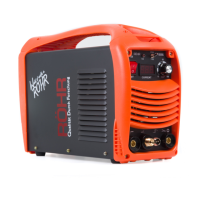
The control panels, which vary slightly between models, provide intuitive access to various settings. The HP-160L model features a power switch, current LCD display, welding mode switch, and an amp output dial. The HP-200PP and HP-250PP models include a power switch, a pulse function dial (with options for low frequency, high frequency, or normal pulse), an MMA/TIG function switch, a gas time delay dial, and an amperes (current) dial. These controls allow the operator to fine-tune the welding parameters to match the specific requirements of the task, such as material thickness, type of joint, and desired weld appearance. The pulse function, in particular, offers enhanced control for delicate work, enabling the user to manage heat input more effectively and reduce material distortion.
During operation, the machine's safety features are designed to protect both the user and the equipment. A safety cut-out circuit protects against excessive power, current, or heat, automatically shutting down the welding machine if these conditions are detected. The fans will continue to run to cool the unit. It is important not to overload the machine, as excessive input current can impair performance and cause damage. The internal fan requires a free flow of air, so the intake must not be blocked.
Regular maintenance is essential to ensure the longevity and safe operation of the RÖHR welding machine. Before any cleaning or maintenance, the power must be turned off and disconnected from the mains. All cleaning should be performed by a qualified professional. Dust should be removed using low-pressure compressed air to avoid damaging fragile internal components.
Troubleshooting guidance is provided to address common issues. If oxidization occurs during welding, users should check that the Argon cylinder is open and pressurized to a minimum of 0.5Mpa, and that the flow meter is open with sufficient flow (a minimum of 5 litres per minute is recommended). The torch should be checked for blockages, and the gas supply must be fully air-tight. If the arc is hard to strike or maintain, ensure a high-quality tungsten electrode is used, and check the end of the tungsten electrode for contamination or the need for grinding. The grounding cable must make good contact with the welding object. If the machine has no power or response, verify that the electric cable is in good condition and correctly connected; faulty cables must be replaced by a qualified professional. If the HF arc-striking sound is heard but there is no welding output, check that the torch and ground cables are correctly connected and undamaged.
Safety is paramount, and the manual emphasizes several precautions. Users must wear appropriate protective equipment, including welding gloves, ear protection, eye protection, and face protection. Onlookers should also be warned of potential risks. The work area should be well-insulated from the ground, and the user should be in a safe and secure position. Gas fumes can be harmful, so proper ventilation and an extractor are necessary. Welding sparks can cause fires, so the welding area must be fire-safe. Arc radiation is harmful to eyes and skin, necessitating protective gear. An isolator switch is recommended for use with the machine, and touching electrical components is dangerous. The machine is designed to operate in dry environments with a maximum humidity level of 90% and ambient temperatures between -10 to +40 degrees Celsius. Welding in direct sunshine or wet/damp conditions should be avoided. The machine should not be used in environments with conductive dust.
 General
| Efficiency | 85% |
|---|---|
| Insulation Class | F |
| Input Voltage | 220V |
| Duty Cycle | 60% |
| Protection Class | IP21 |


 To Next Page