40
For your first hoist you should be sailing downwind on a broad reach, with the
wind on your quarter. Your crew should stand astride the centre capping, and
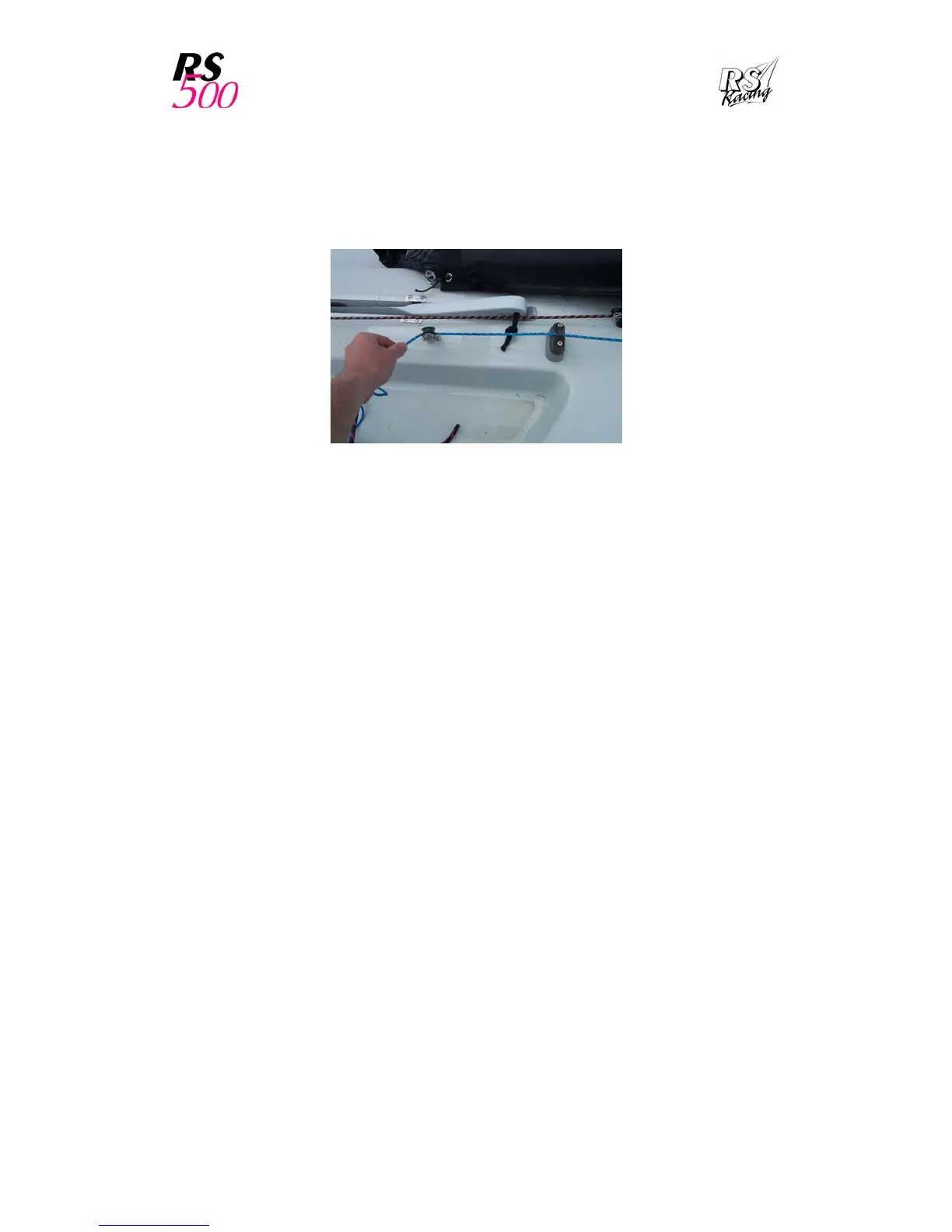
hoist the spinnaker from the right hand halyard block (see picture 5.1).
Picture 5.1 Hoisting the spinnaker.
The halyard pulls the pole out at the same time, and so as the halyard comes
to a stop when hoisted all is ready to go. The crew should now pull gently on
the sheet, whilst the boat is luffed up gently and the spinnaker will soon fill.
Spinnakers may be effectively used from a close reach to a broad reach, and
thus to get downwind one should become adept at gybing. Tacking is not
possible with the kite set. For best affect the sheet should always be eased as
far as possible, so that the luff is just on the point of curling.
Gybing with the spinnaker is fairly straightforward: Think of it exactly as a big
jib, and it should be pulled across as the main comes across. Pull across as
soon as possible as delay or allowing the kite to flog may result in an
“hourglass” effect. As soon as it has been pulled in and filled with wind it
should again be immediately eased for maximum efficiency and speed.
Dropping the spinnaker is the reverse of the hoist: The boat should be borne
off to a broad reach, and the slack in the downhaul, pulled in from the left
hand halyard block, taken up (see picture 5.2). As it goes tight the halyard
should be popped out of the cleat and the spinnaker then pulled sharply into



 To Next Page