39
You should hold the tiller extension across your body – with a knuckle
upwards grip, and you can then use one or two fingers as a temporary cleat
when adjusting the mainsheet.
As you tack, let the boat start to roll towards you before you cross the boat,
and push the extension across in front of you, turning round forwards, and
sitting down again with the extension round behind your back. Swap hands
when you are settled, making use of the mainsheet cleat.
If the boat slows right down and feels lifeless when close-hauled, as a general
rule it pays to ease both sheets and bear off away from the wind for a while to
get the boat going again.
5.5 Downwind and gybing.
When sailing offwind both sails should be eased as far as possible, with the
same rules applying to the tell-tails, unless the wind is aft of the beam, when
you should ease all the way unless either sail lifts near the luff.
When gybing you pull the tiller towards you, and again as you cross the boat
you push the extension across in front of you. The boom will often not want to
come across until you are well through the gybe so it often pays to give the
mainsheet a tweak to initiate the gybe, or the crew can “encourage” the boom
over! Swap hands after you are settled on the new gybe. The crew should
always concentrate on moving smartly to keep the boat as upright as possible.
5.6 Using the spinnaker.
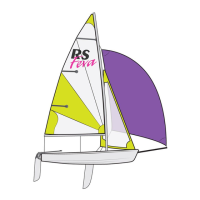
If you are inexperienced in using spinnaker then chose a fairly quiet day for
you first excursion with it. It will more than double your sail area, and should
be treated with a healthy degree of respect!



 To Next Page