22
4.6 Initial Leak Testing
Indoor coils have only a holding charge of dry
nitrogen. Keep all tube ends sealed until connections
are to be made.
WARNING: Do not use oxygen to
purge lines or pressurize system for leak test.
Oxygen reacts violently with oil, which can cause
an explosion resulting in severe personal injury or
death.
•
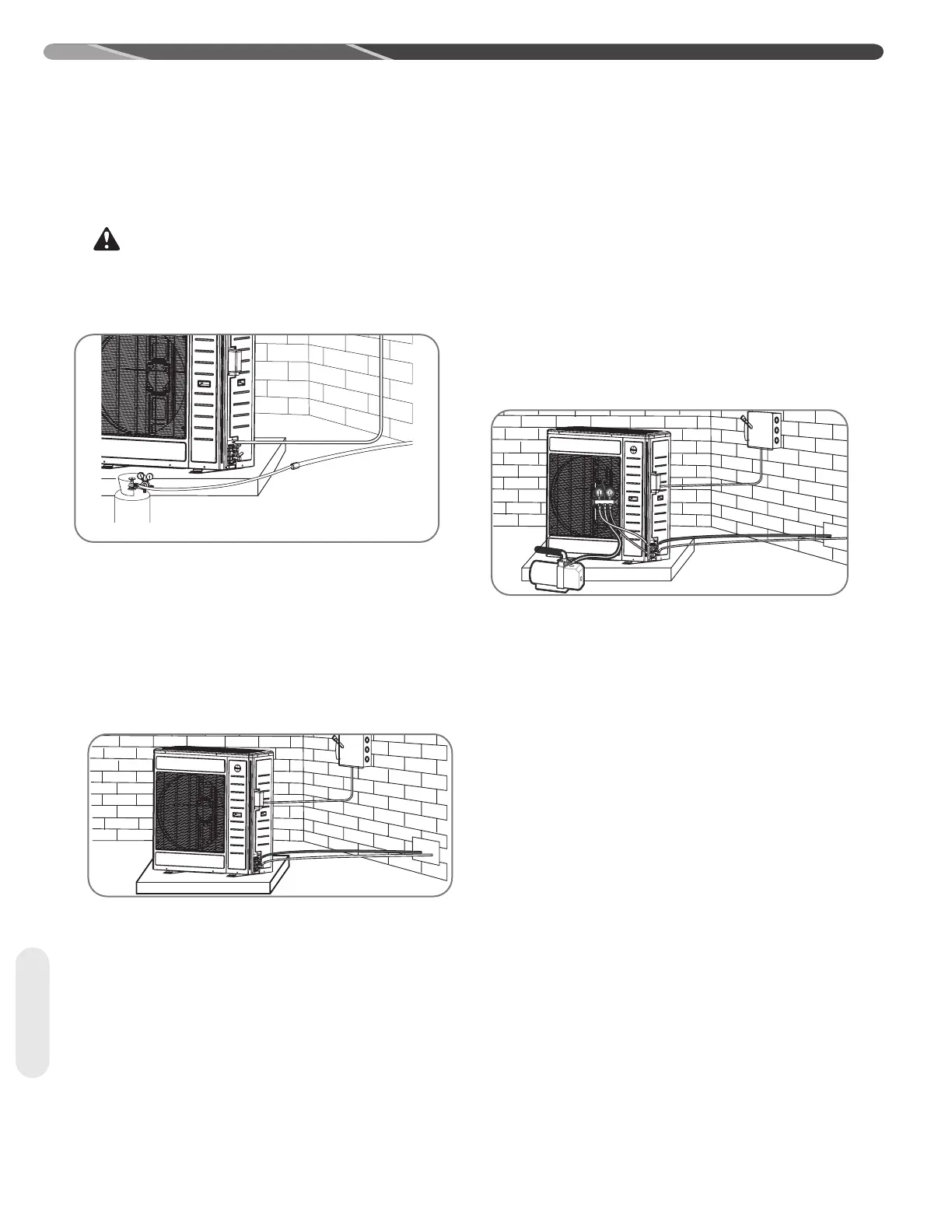
Pressurize line set and coil through service fittings
with dry nitrogen to 500 PSIG [3,447 kPa] (maximum).
Close nitrogen tank valve, let system sit for at least
15 minutes, and check to see if the pressure has
dropped. If the pressure has dropped, check for
leaks at the line set braze joints with soap bubbles
and repair leak as necessary. Repeat pressure test.
If line set and coil hold pressure, proceed with line
set and coil evacuation (see Sections 4.7 and 4.8
for evacuation and final leak testing).
• The vapor line must be insulated for its entire
length to prevent dripping (sweating) and prevent
performance losses. Closed-cell foam insulation
such as Armaflex and Rubatex
®
are satisfactory
insulations for this purpose. Use 1/2" [12.7 mm]
minimum insulation thickness. Additional
insulation may be required for long runs. The
liquid line must be insulated in any unconditioned
space when long line sets are used and anytime
the liquid line is run through an attic due to hot
temperatures that occur there.
4.7 Evacuation
Evacuation is one of the most important parts of the
entire installation and service procedure. The life
and efficiency of the equipment is dependent upon
the thoroughness exercised by the serviceman
when evacuating air and moisture from the system.
Air or nitrogen in the system increases condensing
temperature and pressure, resulting in increased
power consumption, erratic operation, and reduced
capacity.
Moisture chemically reacts with the refrigerant
and oil to form corrosive acid which attacks the
compressor motor windings and internal parts and
which can result in compressor failure.
• After the system has been leak-checked and
proven sealed, connect the vacuum pump and
evacuate system to 500 microns and hold 500
microns or less for at least 15 minutes. The
vacuum pump must be connected to both the
high and low sides of the system by connecting
to the two pressure ports. Use the largest size
connections available since restrictive service
connections may lead to false readings because
of pressure drop through the fittings.
Tubing
4.0 INSTALLATION


 To Next Page