Page 9
OPERATION
PREPARE THE SURFACE
For best results, the surface should be clean and dry. Most
high-gloss surfaces can be cleaned with a mild soap and
water solution. For removal of stubborn dirt such as road
tar, grease, and bug stains, you can use a mild ammonia
solution such as that used in glass cleaners. Before using
any cleaning product, check the label for recommended
applications and follow the directions for use.
Never apply cleaner directly onto surface to be polished.
Apply to a clean cloth then use the cloth to clean the
surface.
Do not use any type of abrasive cleanser as it may damage
or scratch the surface.
WARNING:
Before connecting your buffer/polisher to the power
source, always check to make sure the switch is not in
ON position. Failure to do so could result in accidental
starting of your buffer/polisher resulting in possible
serious personal injury.
ON/OFF SWITCH
The ON/OFF switch is located on each side of the buffer/
polisher. To turn the tool ON, push the switch to the left. To
turn the tool OFF, push the switch to the right.
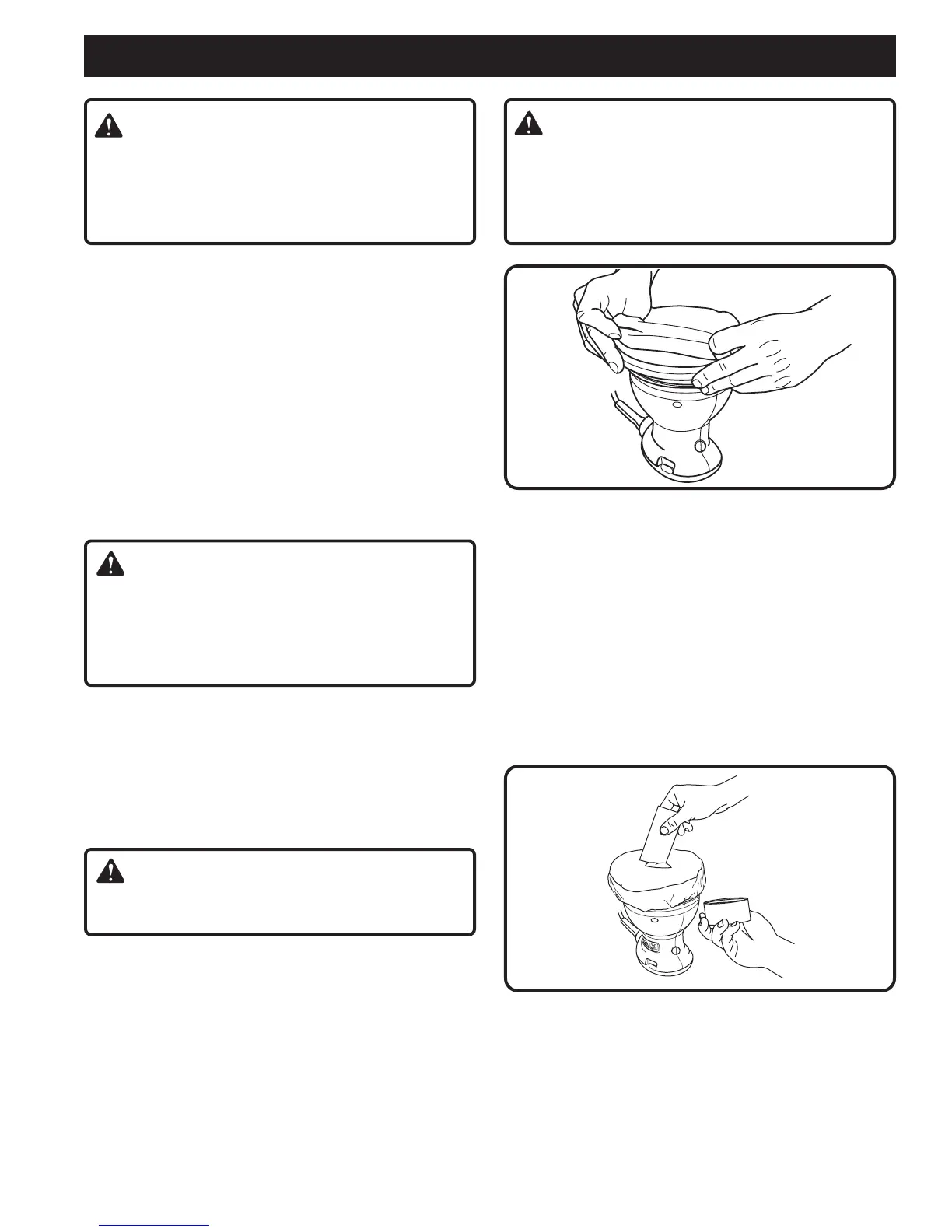
ATTACH THE APPLICATION BONNET
See Figure 2.
WARNING:
To avoid injury, always make sure the buffer/polisher is
unplugged before attaching bonnets.
Your buffer/polisher comes with two bonnets, one for
applying the polish to the surface and another for buffing
the surface. Both are fitted with a drawstring. The application
bonnet is the one made of synthetic tufted material.
To attach the application bonnet to the pad, loosen the
drawstring so that the bonnet fits completely over the pad.
Place the bonnet over the pad so that the outer edge can
be drawn over the top of the pad. Then carefully tighten the
drawstring around the pad and secure it with a double-tied
bow knot. Tuck the knot and the drawstring completely
inside the bonnet.
WARNING:
Always wear safety goggles or safety glasses with side
shields when operating this tool. Failure to do so could
result in dust, shavings, or loose particles being thrown
into your eyes, resulting in possible serious injury.
APPLY POLISH TO THE APPLICATION BONNET
Most polishes are either in paste or liquid form. Before
using any polish read all directions on appropriate
applications and proper use.
APPLICATION OF PASTE POLISH
See Figure 3.
Use a putty knife or other flat, blunt object to apply
approximately one rounded teaspoon of paste onto the
bonnet. Evenly spread the paste over the entire surface of
the bonnet.
Do not apply paste directly to the surface being polished.
Fig. 2
Fig. 3
WARNING:
The drawstring must be tucked securely inside the
bonnet before turning the buffer/polisher on. Failure to
do so could result in the drawstring being caught be-
tween the motor housing and orbiting pad, increasing
the risk of serious personal injury.
APPLICATION OF LIQUID POLISH
See Figure 4.
Apply a small circle of liquid (about the size of a half-dollar)
around the center of the bonnet, followed by two more
rings, each slightly larger than the previous one. After the
first application, the bonnet will not absorb as much polish.
Apply two rings of polish to the bonnet for subsequent
applications, using half of the initial quantity.


 To Next Page