30 Technical Description
Crankshaft
position
sensor
58
◊
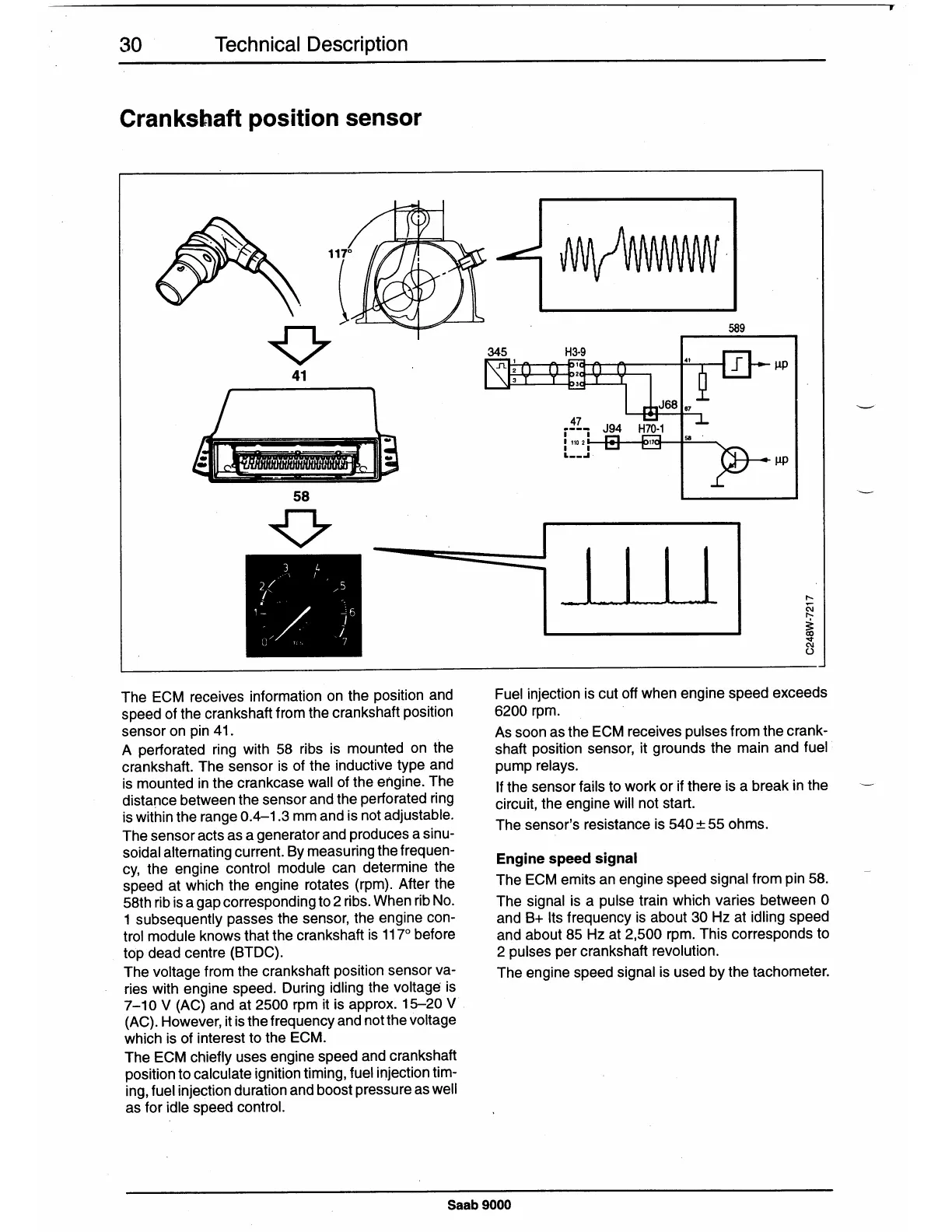
The ECM receives information on the position and
speed of the crankshaft from the crankshaft position
sensor on pin 41 .
A perforated ring with 58 ribs is mounted on the
crankshaft. The sensor is of the inductive type and
is mounted in the crankcase wall of the engine. The
distance between the sensor and the perforated ring
is within the range 0.4-1.3 mm and is not adjustable.
The sensor acts as a generator and produces a sinu-
soidal alternating current. By measuring the frequen-
cy, the engine control module can determine the
speed at which the engine rotates (rpm). After the
58th rib is a gap corresponding to 2 ribs. When rib No.
1 subsequently passes the sensor, the engine con-
trol module knows that the crankshaft is 117° before
top dead centre (BTDC).
The voltage from the crankshaft position sensor va-
ries with engine speed. During idling the voltage is
7-10 V (AC) and at 2500 rpm it is approx. 15-20 V
(AC). However, it is the frequency and not the voltage
which is of interest to the ECM.
The ECM chiefly uses engine speed and crankshaft
position to calculate ignition timing, fuel injection tim-
ing, fuel injection duration and boost pressure as well
as for idle speed control.
47
i--i
I 110 2
l----li....&----lrl
,_---&,;;;;
58
--
1
I
L--.1
J. I I J
589
µp
µp
Fuel injection is cut off when engine speed exceeds
6200 rpm.
As soon as the ECM receives pulses from the crank-
shaft position sensor, it grounds the main and fuel
pump relays.
If the sensor fails to work or if there is a break in the
circuit, the engine will not start.
The sensor's resistance is 540
±
55 ohms.
Engine speed signal
The ECM emits an engine speed signal from pin 58.
The signal is a pulse train which varies between 0
and B+ Its frequency is about 30 Hz at idling speed
and about 85 Hz at 2,500 rpm. This corresponds to
2 pulses per crankshaft revolution.
The engine speed signal is used by the tachometer.
Saab 9000


 To Next Page