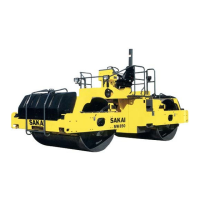
Need help?
Do you have a question about the Sakai SV400D-2 and is the answer not in the manual?
Provides essential safety information, including symbols, general rules, and qualifications for personnel.
Details the critical checks to perform before operating the machine to ensure safety and proper function.
Outlines the correct procedure for starting the machine safely, including pre-operation checks.
Provides guidelines for safe and efficient operation of the machine, emphasizing situational awareness.
Describes the correct procedure for safely stopping and parking the machine.
Covers essential safety precautions and procedures for performing maintenance on the machine.
Details safety procedures and considerations for transporting the machine.
Lists detailed technical specifications for various models like SV400D-2, SV400T-2, SV400TB-2, SV400TF-2, SV400FB-2.
Covers engine, propulsion, hydraulic, steering, brake, and oil/grease capacity specifications.
Details fuel and lubricant requirements, including ratings and recommended brands.
Provides torque values for various fasteners based on nominal diameter and strength classification.
Details engine mounting, exterior components, and cooling system specifications.
Explains throttle control and forward-reverse control mechanisms.
Illustrates pump mounting and attachment procedures.
Explains hydraulic graphic symbols and provides circuit diagrams for different machine models.
Details hydraulic piping, equipment specifications, motors, and blocks for the propulsion system.
Covers hydraulic piping and equipment specifications for the vibrator system.
Provides details on steering hydraulic piping, frame components, wheel, and cylinder.
Details hydraulic piping and equipment specifications for the blade system.
Presents the overall electrical wiring diagram for the machine.
Illustrates the layout of electrical components on the machine.
Provides specifications for components like the fuse box and diode unit.
General safety guidelines for handling machine parts during disassembly and reassembly.
Details the removal, installation, assembly, and disassembly of the vibratory drum.
Covers rear axle components, lubrication, and structure, including differential and brakes.
Explains the brake pedal, circuit configuration (ON/OFF conditions), and piping.
Details the internal components and structure of the brake system.
Provides procedures for adjusting brake clearance and manually releasing the brake.
Covers safety precautions, preparation, and warm-up procedures for inspections.
Details the procedure for measuring the maximum circuit pressure.
Explains how to adjust the pressure by referring to the multifunction valve.
Describes how to measure the standard charge relief pressure setting.
Covers the procedure for adjusting the standard charge relief pressure setting.
Details the procedure for measuring the standard charge relief pressure setting for speed change.
Explains how to measure the standard charge relief pressure setting for the parking brake.
Details the procedure for measuring the maximum standard vibration pressure setting.
Covers inspection of the high-pressure relief valve for the vibrator circuit.
Details the procedure for measuring the standard charge relief pressure setting for the vibration circuit.
Covers inspection of the vibration charge relief valve.
Details the procedure for measuring the maximum steering hydraulic circuit pressure.
Covers inspection and potential replacement of the orbitrol relief valve.
Explains how to adjust the throttle lever linkage for proper engine speed.
Details the procedure for adjusting the forward-reverse lever linkage for correct control lever stroke.
Highlights critical safety measures to follow during troubleshooting procedures.
Provides essential information and tips for effective troubleshooting.
Guides users through diagnosing and resolving electrical system faults.
Offers guidance on diagnosing and resolving issues within the hydraulic systems.
 General
| Brand | Sakai |
|---|---|
| Model | SV400D-2 |
| Category | Construction Equipment |
| Language | English |

 To Next Page