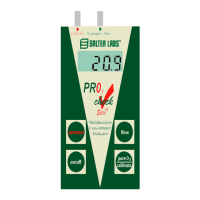
The Salter Labs PRO₂ check® Ultrasonic Oxygen Indicator is a portable device designed for intermittent measurement of oxygen concentration. Its primary function is to assess the oxygen output of oxygen concentrators, but it can also be used for spot checks of gaseous or liquid oxygen. The device operates using ultrasound technology, a method also employed in many oxygen concentrators to trigger "Low O₂" alarms. This design choice makes the PRO₂ check® a cost-effective alternative to fuel cell analyzers, offering faster response times and eliminating the need for fuel cell replacements.
Function Description
The PRO₂ check® Ultrasonic Oxygen Indicator measures oxygen concentration by analyzing the ultrasonic properties of the gas sample. It features a microprocessor and temperature circuit that compensate for variations in temperature within its operating range (32°F to 105°F / 0°C to 41°C). The device has two primary modes of operation, controlled by its software:
-
Concentrator Mode (Default): When the unit is turned on, it defaults to this mode. In Concentrator Mode, the software is enabled to measure the output of an oxygen concentrator and automatically compensates for the argon that passes through the sieve beds. This compensation is crucial because oxygen concentrators, while producing oxygen, also allow a small percentage of argon to pass through, which can affect the accuracy of a direct oxygen measurement. In this mode, the display will show "PRO", then "O₂", and finally "Concentrator O₂" followed by a numeric reading. If connected to an operating concentrator, it will automatically measure and display the oxygen concentration. If not connected to an oxygen source, it will measure and display the oxygen concentration in the ambient air (typically around 20.9%). It's important to note that if connected to a pure oxygen source (like a cylinder) in this mode, it will display a false reading (approximately 90%) due to the argon compensation.
-
Pure O₂ Calibrate Mode: This mode is activated by pressing and holding the "pure O₂/calibrate" button. When this button is depressed, the software measures oxygen without adjusting for argon. This function is essential for verifying the unit's calibration against a pure oxygen source (U.S.P. oxygen >99.0%) or for spot-checking the purity of gaseous or liquid oxygen. In this mode, the display will show "Pure O₂" and a numeric reading. Once the "O₂ calibrate" button is released, the unit automatically returns to the Concentrator Mode.
The device is designed for intermittent use and does not have clinical diagnostic or therapeutic functions. It is not intended for use in anesthesia applications or for monitoring oxygen concentration from sources other than conventional oxygen concentrators using molecular sieve beds.
Usage Features
The PRO₂ check® is designed for ease of use with two simple controls:
- "on/off" button: A press and release of this button turns the unit on or off. To conserve battery life, the unit automatically shuts down if no function is utilized for approximately 5 minutes.
- "pure O₂ calibrate" button: This button is used in conjunction with a compressed gas or liquid U.S.P. oxygen source (>99.0%) to verify or perform calibration.
Measuring Oxygen Concentrations from Concentrators:
- Ensure the concentrator has run long enough to reach full operational output (per manufacturer guidelines).
- Verify the flow rate is above 2 LPM, preferably at the concentrator's highest output.
- Remove any humidifier from the concentrator.
- Connect the supply tubing from the concentrator oxygen outlet to the inlet port on the PRO₂ check®.
- Turn on the PRO₂ check® device.
- The indicator will stabilize in about 10 seconds, providing an accurate reading on the LCD display.
- If there are questions about accuracy, users can perform the "Pure Oxygen Verification Procedure" or the "Quick One Step Pure Oxygen Calibration Procedure."
Important Usage Notes:
- Never check a concentrator with a humidifier in place, as humidity can affect readings and damage the unit.
- Do not hold down the "pure O₂/calibrate" button when checking a concentrator, as this will result in a false reading due to the argon compensation being overridden.
- The unit will not withstand fluid spillage, mechanical shock, or vibration.
- Oxygen is heavier than room air, so it will linger inside the unit. To clear it, apply a small suction or flow of room air; do not exhale into the unit.
Spot Checking Liquid Oxygen Vessels or Oxygen Cylinders:
- Connect the inlet port of the PRO₂ check® to the gaseous or liquid oxygen source via a supply tube.
- Set the oxygen flow to 2 LPM.
- Turn on the PRO₂ check® unit.
- The display will initially read "Concentrator O₂ 91.8" (approx. concentration).
- Press and hold the "pure O₂/calibrate" button.
- The unit will display "Pure O₂" and a numeric reading.
- For pure oxygen, the display should read between 99% and 101%. Readings outside this range (e.g., "err", "---", "-U-") may indicate impure oxygen, requiring further testing with a more sophisticated analyzer.
- Note: This device is for spot checks of identity and purity only; it cannot verify U.S.P. oxygen (>99.0%) to the required ±0.1% accuracy.
Calibration and Verification:
The unit is factory-calibrated. However, routine verification and calibration procedures are available:
- Pure Oxygen Verification Procedure: This quickly verifies the unit's accuracy by connecting it to a U.S.P. oxygen source (>99.0%) and holding the "pure O₂/calibrate" button. A reading between 99% and 101% indicates proper calibration.
- Quick "One Step" Pure Oxygen Calibration: If verification shows a need for calibration, this procedure can be performed using a U.S.P. oxygen source.
- Full "Two Step" Calibration Procedure: This more comprehensive procedure calibrates the unit to both room air and U.S.P. oxygen, typically required by accreditation organizations or internal policies.
Environmental Effects:
- Temperature: The unit compensates for temperatures between 32°F and 105°F (0°C to 41°C). If stored outside -29°F to 160°F (-34°C to 71°C), allow 15-30 minutes for stabilization at room temperature.
- Barometric Pressure: The microprocessor adjusts for minor altitude changes. However, recalibration is recommended if used over 5,000 feet.
- Vibration: Use in a stable position to prevent fluctuating readings. The unit is not designed to withstand excessive shock or vibration.
- Relative Humidity/Water Vapor: High humidity or water vapor in the sample gas can dilute the oxygen, leading to lower readings (up to 10% lower than actual). Always remove humidifiers before checking concentrators.
Maintenance Features
Battery Replacement:
- When "LO BATT" appears on the LCD display, the 9-volt battery is low and needs replacement.
- The PRO₂ check® must be removed from its carrying case to access the battery compartment.
- Slide the battery door (located on the rear) away from the case.
- Connect a new standard 9-volt "transistor" alkaline type battery to the polarized terminals. Rechargeable batteries are not recommended.
- Lay the battery sideways in the compartment and slide the door back into place.
- The unit retains its calibration even after battery removal.
Cleaning:
- The PRO₂ check® unit can be cleaned by wiping its case with a mild detergent or a standard topical disinfectant and a soft cloth.
- Caution: Do not allow cleaning solution to spill on or inside the unit. The unit is not intended for any type of sterilization.
Troubleshooting:
The manual includes a comprehensive troubleshooting checklist to address common issues such as:
- Blank display or "LO BATT" (suggests battery issues).
- "PRO O₂ @ CAL" flashing (indicates calibration is needed).
- "err" during calibration or use (suggests incorrect calibration, wrong gas, or readings outside normal ranges).
- Readings outside expected ranges for pure oxygen (may require recalibration or repair).
- "---" or "-U-" displays (indicate incomplete calibration or out-of-range readings).
- If issues persist, Salter Labs Customer Service can be contacted for repair authorization.
The PRO₂ check® is designed to be a reliable and efficient tool for oxygen concentration measurement, offering a practical solution for professionals in the oxygen concentrator industry.

 Need help?
 General

 To Next Page