EB 5868-1 EN 3-1
Design and principle of operation
3 Design and principle of oper-
ation
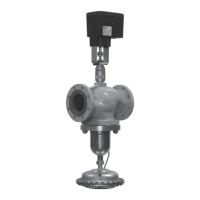
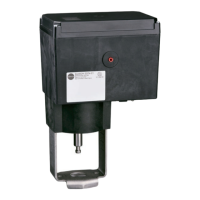
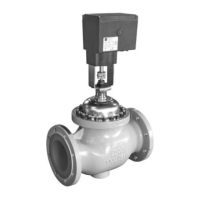
The control valves consist of the Type3214
Globe Valve balanced by a diaphragm and
an electric actuator. The medium ows
through the valves in the direction indicated
by the arrow on the valve body. The cross-
sectional area of ow between the seat (2)
and plug (3) is determined by the position of
the plug stem (6).
The downstream pressure p
2
is applied to the
inside of the valve; the upstream pressure p
1
acts on the outside. The forces acting on the
valve plug due to the upstream and down-
stream pressures are balanced by the dia-
phragm (4).
The plug is moved by changing the control
signal applied to the actuator. For the
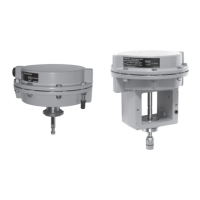
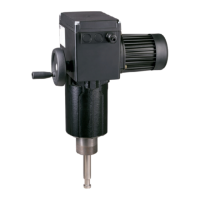
Type3374 and TypeSAM Electric Actuators,
this signal is a three-step signal.
3.1 Fail-safe action
When the Type3214 Valve is combined with
one of the following actuators, the valve
moves to the fail-safe position up upon fail-
ure of the supply voltage:
− Type3374-21 and Type3374-27
Electric Actuators
Fail-safe action
A safety mechanism in the actuator is trig-
gered when the supply voltage fails or the
control signal is interrupted by the limitation
equipment due to the temperature or pres-
sure exceeding the adjusted limit. The actua-
tor stem is moved by the force of the com-
pression springs in the actuator. One of two
different fail-safe positions can be assumed
by the control valve:
− Actuator stem extends: if fail-action is
triggered, the actuator stem extends and
closes the valve.
− Actuator stem retracts: if fail-action is
triggered, the actuator stem retracts and
opens the valve.
The fail-safe action of electric actuators is al-
ready determined at the ordering stage.
Note


 To Next Page