Need help?
Do you have a question about the S&C Vista Series and is the answer not in the manual?
Defines requirements for personnel operating the switchgear.
Emphasizes the importance of thoroughly reading the instruction sheet before operation.
Instructs users to keep the instruction sheet as a permanent part of the switchgear.
States that equipment must be selected for specific applications within its ratings.
Outlines the warranty terms and conditions for the switchgear.
Explains the meaning of DANGER, WARNING, CAUTION, and NOTICE signal words.
Advises contacting S&C for assistance if any part of the instruction sheet is unclear.
Details how to obtain replacement instruction sheets and labels for the equipment.
Identifies the location and provides reorder information for safety labels on the switchgear.
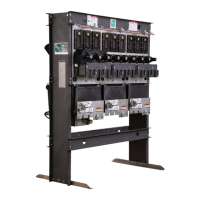
Describes the Vista Underground Distribution Switchgear, its features, and styles.
Explains the four color-coded zones of the SF6 gas pressure gauge and their indications.
Details how ambient temperature changes can affect the gas pressure gauge needle readings.
Lists essential checks before operating the switchgear, including SF6 pressure and blade position.
Provides step-by-step instructions for opening the load-interrupter switch or fault interrupter.
Details the procedure for moving the switchgear from the Open to the Grounded position.
Explains how to operate the switchgear from the Grounded to the Open position.
Outlines the steps for closing the load-interrupter switch or fault interrupter.
Guides users on how to reset a fault interrupter after it has tripped due to a fault.
Describes how to lock the switchgear in the Grounded position to prevent operation.
Details the procedure for locking the switchgear in the Closed position to prevent operation.
Explains how to lock the switchgear into any of its operational positions.
Provides instructions on testing and using the optional VOLTAGE indicator for voltage checks.
Explains how to perform low-voltage phasing using the optional VOLTAGE indicator.
Outlines the steps for safely returning the switchgear to service after maintenance or testing.
Discusses general maintenance requirements for switchgear components, emphasizing inspection and exercising.
Describes the maintenance of the switchgear enclosure's outdoor finish and touch-up procedures.
Provides guidance on cleaning and maintaining the switchgear in corrosive environments.
Lists appropriate withstand test values for Vista switchgear and necessary precautions.
Describes de testing of cables and fault locating methods, referencing industry standards.
Advises that routine testing of vacuum fault interrupters is not recommended.
Details the procedure for measuring resistance to identify poor contact in current-carrying parts.
The S&C Vista® Underground Distribution Switchgear, available in UnderCover™ (vault-mounted) and pad-mounted styles, is designed for underground electric distribution systems. Its primary function is to provide switching and protection for 600-ampere main feeders, as well as 200-ampere taps, laterals, and subloops. The switchgear features SF6-insulated, welded-steel tanks, ensuring a submersible and robust enclosure for its components.
The switchgear incorporates load-interrupter switches and microprocessor-controlled, resettable vacuum fault interrupters. The load-interrupter switches are manually operated and offer three-position (CLOSED/OPEN/GROUNDED) live switching for 600-ampere three-phase circuits. These switches provide a visible gap when in the open position and internal grounding for all three phases, enhancing safety and operational clarity.
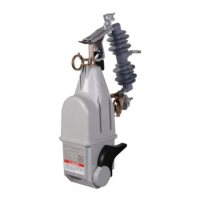
The fault interrupters, available in 200-ampere and 600-ampere ratings, feature resettable vacuum interrupters in series with manually operated three-position (CLOSED/OPEN/GROUNDED) disconnects. This configuration allows for isolation and internal grounding of each phase. The fault interrupters provide three-pole load switching and fault interruption, with interruption initiated by a programmable overcurrent control. For single-pole fault interrupters, the overcurrent control can also be programmed for three-pole fault interruption.
An optional VOLTAGE indicator (option suffix "-L1" or "-L2") significantly enhances operational safety and efficiency. When this feature is specified, all routine operating tasks, including switching, voltage testing, and grounding, can be performed by a single person without the need for cable handling or exposure to high voltage. This indicator also facilitates cable testing for faults through the back of a user-supplied elbow with an insert or feedthru bushing insert, further reducing the need for manual cable manipulation or parking stands.
The switchgear is designed for intuitive and safe operation. Pre-operation checks are crucial, including verifying the SF6-gas pressure gauge is in the green zone (or green and yellow-striped zone) and visually confirming the position of the load-interrupter switch or fault interrupter blades through viewing windows. For fault interrupters, trip flags or disconnect switch blade positions are also checked. Operators are warned against operating the switchgear if the SF6-gas pressure is in the red zone or if there are signs of dislodged hardware, arcing, or significant blade misalignment.
The OPERATION selector prevents inadvertent operation directly from the Closed position to the Grounded position, and vice versa, requiring a deliberate rotation to engage the desired operation. Manual operating handles are used to rotate the operating disk, moving the switch or interrupter between Closed, Open, and Grounded positions. The mechanism is padlockable in any position, allowing for secure lockout.
For voltage checking, the optional VOLTAGE indicator must be tested for proper operation first. This involves shining a flashlight on the photocell and covering the test button to check for a dot in the test window and flashing lightning bolts in each PHASE indicator. If these indications are present, the VOLTAGE indicator is functioning correctly. A blank LCD panel on the PHASE indicator signifies either no voltage at the bushing or a malfunctioning indicator.
Low-voltage phasing, when the VOLTAGE indicator with phasing is present, involves cleaning the indicator surface and phasing pins, testing the VOLTAGE indicator, and then using a high-impedance voltmeter to measure phase-to-ground and phase-to-phase voltages between the ways to be phased. This ensures proper cable installation and phase alignment.
While no mechanical maintenance is typically required, occasional inspection and exercising of the load-interrupter switches and fault interrupters are recommended. Access to high-voltage components for inspection or repair necessitates strict adherence to safety precautions, including restricting access to qualified persons, following safe operating procedures, using personal protective equipment, de-energizing and grounding all power sources, and testing for voltage.
The enclosure finish, S&C's Ultradur® II Outdoor Finish, provides lasting protection. Maintenance involves periodic corrective actions such as touching up any penetrations to bare metal with S&C touch-up finish and primer. An occasional simple washdown with a mild household detergent solution is recommended to remove surface contaminants. For units in extremely corrosive environments, periodic cleaning with a mild detergent and potable water, followed by a water-displacing oil-based spray, can extend the equipment's life.
Dielectric testing, including routine switchgear testing and cable testing/fault locating, is outlined with specific withstand test values. These tests should only be performed when the switchgear is completely de-energized and disconnected from all power sources, and the SF6-gas pressure gauge is in the Green zone. Resistance measurements are used to identify poor contact between current-carrying parts, taken from bushing conductors across each way to the same phase. These measurements ensure the integrity of the electrical connections.
 General
| Voltage Rating | Up to 38 kV |
|---|---|
| Continuous Current | 600 A |
| Frequency | 60 Hz |
| Interrupting Rating | Up to 25 kA |
| Interrupting Current | 20 kA, 25 kA |
| BIL | 95 kV, 125 kV, 150 kV |
| Insulation Medium | SF6 |
| Enclosure Type | Metal-clad or Metal-enclosed |
| Number of Ways | 2, 3, 4, 5, or 6 |
| Switching Mechanism | Vacuum Interrupters |
| Operating Mechanism | Manual |
| Standards Compliance | IEEE C37.60 |
| Fault Interruption | Yes |

 To Next Page