
 Need help?
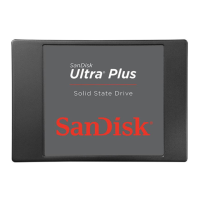
Do you have a question about the SanDisk Ultra Plus and is the answer not in the manual?
Identify and acquire the necessary software for cloning your existing HDD data.
Verify that you have all the essential components for the SSD installation.
Follow essential safety guidelines to prevent damage to your Solid State Drive during handling.
Connect your new SanDisk SSD to your computer using the appropriate cables.
Launch your chosen data cloning software and prepare for the data transfer process.
Identify the current HDD as the source and the new SSD as the destination for data cloning.
Configure data exclusion and initiate the cloning process, monitoring its progress.
Detailed steps for replacing the HDD with an SSD in a notebook computer.
Detailed steps for replacing the HDD with an SSD in a desktop computer.
Access resources for installation videos, further information, and product warranty details.
This document outlines the quick-start installation process for a SanDisk Solid State Drive (SSD), designed to replace an existing hard disk drive (HDD) in both desktop and notebook computers. The guide emphasizes ease of use, breaking down the upgrade into three main steps: connecting the SSD, cloning data, and physically replacing the old drive.
The SanDisk SSD serves as a high-performance storage solution, offering a significant upgrade over traditional HDDs. Its primary function is to store operating systems, applications, and user data, providing faster boot times, quicker application loading, and overall improved system responsiveness. The installation process facilitates a seamless transition from an HDD to an SSD by guiding users through data migration, ensuring that all existing files, settings, and the operating system are transferred to the new drive without loss. This allows users to retain their familiar computing environment while benefiting from the speed and efficiency of solid-state technology. The guide specifically addresses SATA-based systems, making it applicable to a wide range of modern computers.
The installation guide is structured to be user-friendly, even for those with limited technical experience. Before beginning, it highlights the necessary hardware components, such as SATA data cables, USB-to-SATA data cables, 3.5-inch mounting adapters (for desktops), and a Phillips screwdriver. It also stresses the importance of obtaining data cloning software, recommending Apricorn® EZ Gig IV with Data Select as an example.
The first step, "Connecting Your SSD to Your Computer," details how to physically link the new SanDisk SSD to the computer using a USB-to-SATA cable. This external connection is crucial for the data cloning process, allowing the computer to recognize the SSD as an external drive. A key note advises users that if the SSD is not recognized, they should disconnect other USB devices to ensure sufficient power delivery, as SSDs may draw more power than some USB ports can provide.
The second step, "Clone your data," walks users through the software-based data migration. This involves running the chosen cloning software, selecting the existing HDD as the "source drive," and the newly connected SanDisk SSD as the "destination drive." The guide provides visual aids and prompts from the Apricorn® EZ Gig IV software to illustrate the process of initiating the clone. A critical "NOTE" in this section addresses scenarios where the used data space on the HDD exceeds the SSD's capacity. In such cases, the guide recommends using the cloning software's "Data Select" option to exclude certain file types (e.g., photos, videos, music, documents) from the clone, thereby reducing the data size to fit the smaller SSD. This feature is particularly useful for migrating from high-capacity HDDs to smaller SSDs. The cloning process can take time, depending on the amount of data being transferred, and users are advised to keep the computer's power cable plugged in throughout this step to prevent interruptions. Once cloning is complete, the software will prompt the user to shut down the computer.
The final step, "Replacing your HDD," covers the physical swap of the drives, differentiating between notebook and desktop computer installations.
For Notebook Computer SSD Installation:
For Desktop Computer SSD Installation:
Throughout the guide, "NOTE" sections provide important tips and warnings, such as handling the SSD with care, avoiding touching gold connectors, minimizing static electricity, and not disassembling the SSD to preserve the warranty.
While the guide primarily focuses on installation, it implicitly touches upon maintenance through its recommendations. The process of cloning data ensures that a complete, bootable copy of the user's system is transferred to the new SSD. This acts as a form of system backup, allowing for a quick recovery if the original HDD were to fail.
A significant maintenance-related feature is the suggestion to "keep your old hard disk drive as a backup drive." This provides users with an immediate, full-system backup that can be stored externally. In the event of an issue with the new SSD or the system, the old HDD can serve as a recovery point, either by being reinstalled or by allowing data to be retrieved from it. This practice enhances data security and provides a fallback option, minimizing potential data loss.
The guide also implicitly promotes good hardware handling practices, such as keeping the SSD in its anti-static sleeve until installation and avoiding contact with sensitive components, which contributes to the longevity and reliability of the device. By providing clear instructions for a smooth transition, the guide helps users maintain optimal system performance and data integrity with their new SanDisk SSD.
 General
| Read Speed | Up to 530 MB/s |
|---|---|
| Operating Temperature | 0°C to 70°C |
| Shock Resistance | 1500G |
| Vibration Resistance | 5 gRMS, 10-2000 Hz |
| Form Factor | 2.5-inch |
| Interface | SATA 6Gb/s |
| Capacity | 128GB, 256GB |
| Warranty | 3 years |



 To Next Page