FLATMAN ECO / PRO – User Manual
s&t embedded GmbH – Gutenbergstr. 2 – 85737 Ismaning - Germany
Phone: +49 89 370058 – 0 Fax: +49 89 37000 689
Mail to: info@snt-embedded.de
www.snt-embedded.de V1.7
7
4 Electromagnetic Compatibility
4.1 Electromagnetic Compatibility EU
This product is in conformity with the protection requirements of EU Council Directive 2004/108/EC on the
approximation of the laws of the Member States relating to electromagnetic compatibility. If the user modifies
and/or adds to the equipment (e.g. installation of add-on cards) the prerequisites for the CE conformity
declaration (safety requirements) may no longer apply.
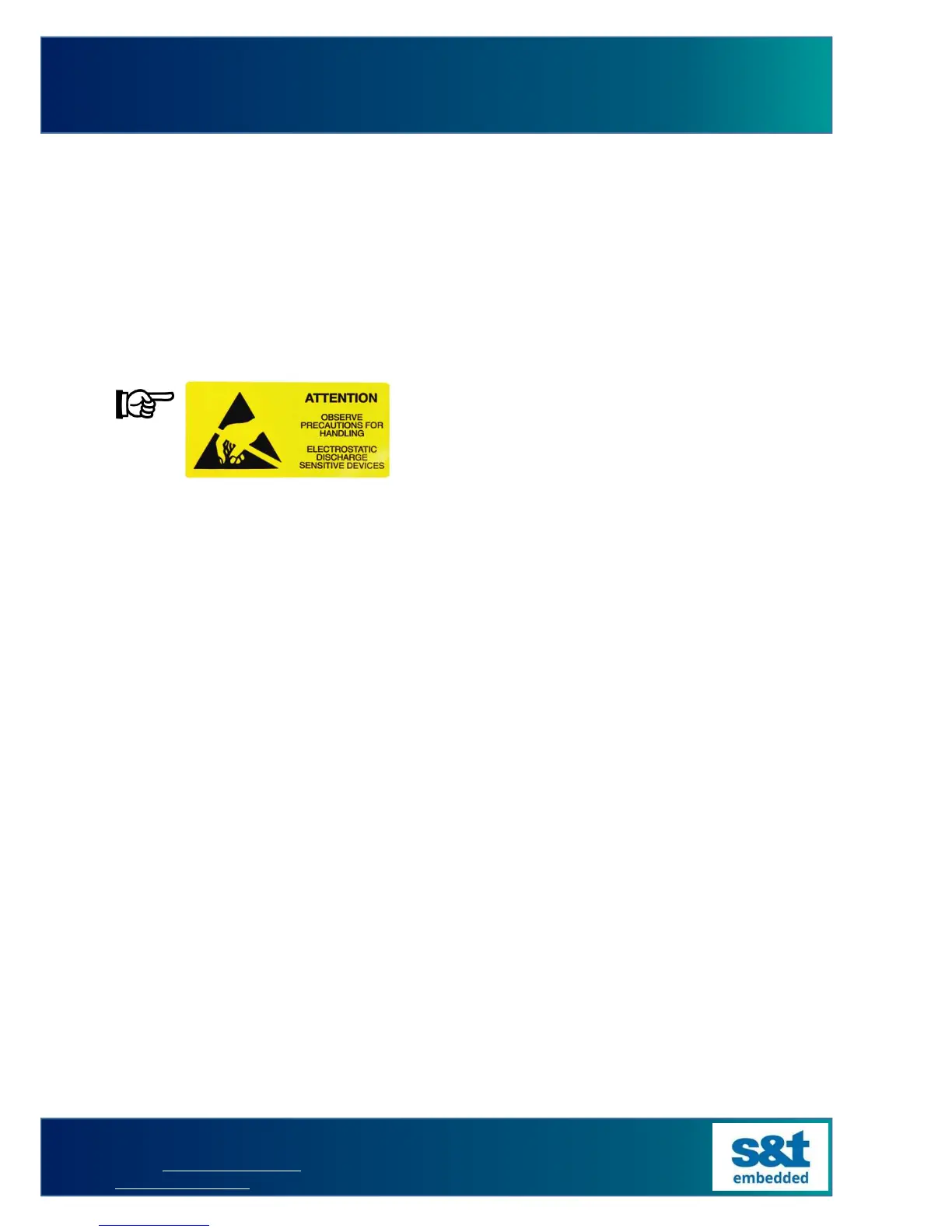
4.2 Electrostatic Discharge (ESD)
A sudden discharge of electrostatic electricity can destroy static-sensitive devices or micro-circuitry. Therefore
proper packaging and grounding techniques are necessary precautions to prevent damage. Always take the
following precautions:
• Keep electrostatic sensitive parts in their containers until they arrive at the ESD-safe workplace.
• Always be properly grounded when touching a sensitive board, component, or assembly.
4.2.1 Grounding Methods
The following measures help to avoid electrostatic damages to the device:
• Cover workstations with approved antistatic material. Always wear a wrist strap connected to
workplace as well as properly grounded tools and equipment.
• Use antistatic mats, heel straps, or air ionizers for more protection.
• Always handle electrostatically sensitive components by their edge or by their casing.
• Avoid contact with pins, leads, or circuitry.
• Turn off power and input signals before inserting and removing connectors or connecting test
equipment.
• Keep work area free of non-conductive materials such as ordinary plastic assembly aids and
styrofoam.
• Use field service tools such as cutters, screwdrivers, and vacuum cleaners which are conductive.
• Always place drives and boards PCB-assembly-side down on the foam.


 To Next Page