14
Continue... Step 1: Preparing the Pool
5b. Look at the Total Alkalinity reading rst. Adjustments
should be made to bring the Total Alkalinity in the range of
80 – 120 ppm prior to making any adjustments to pH even if
it throws pH off further.
5c. After Total Alkalinity is in range, test for pH. It should be
between 7.2 and 7.8. If higher or lower, add a pH adjuster.
5d. Then test your Water Hardness again. If lower than 200
ppm, add Calcium Increaser. Always maintain 200-400 ppm.
5e. Lastly test for stabilizer or conditioner levels. Add
conditioner if the level is below 20 ppm. This will prevent
chlorine burn off. If stabilizer level is above 80 ppm, partially
drain water and re- ll.
6.
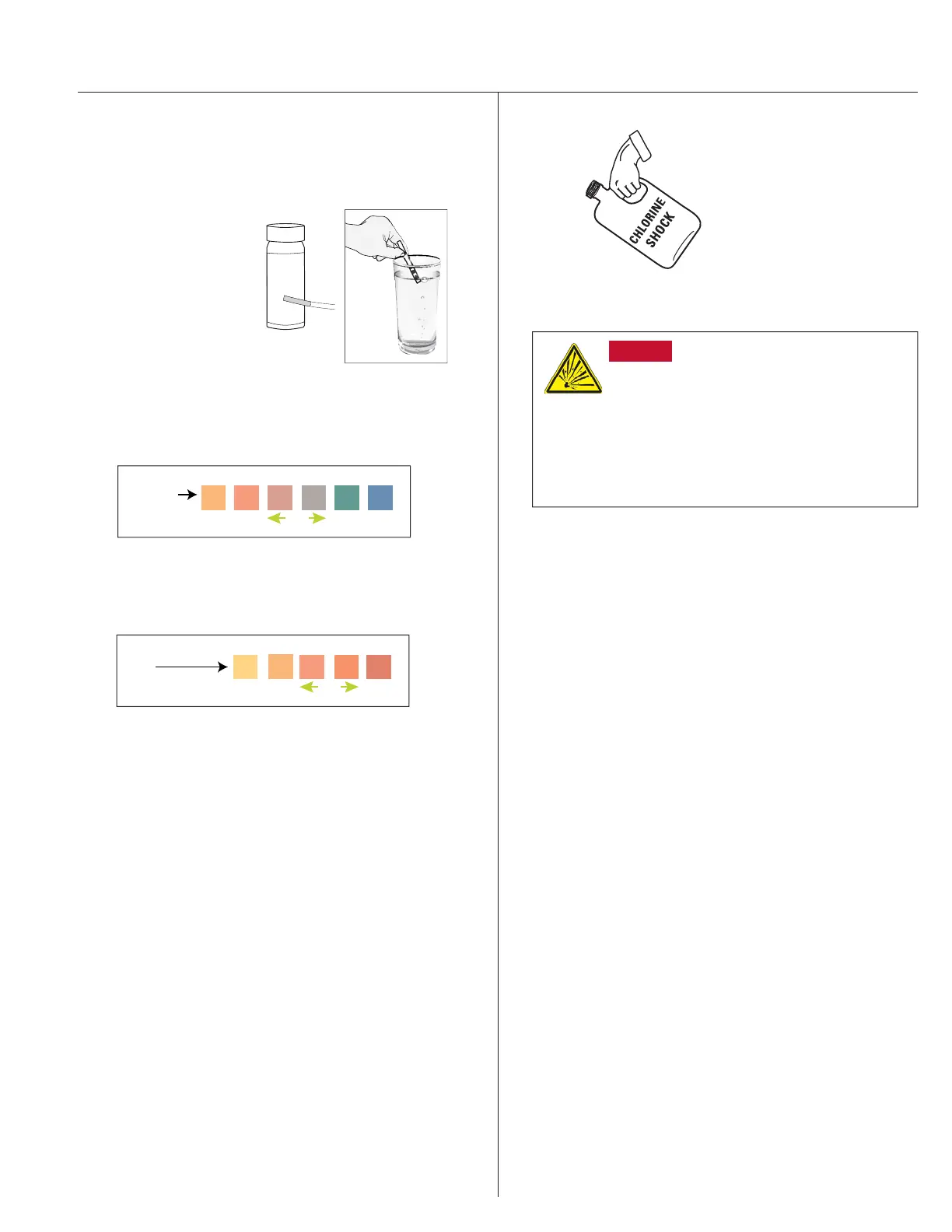
5a. Take a water sample
from the pool and dip a
test strip into it.
For best results in achieving water balance, follow
steps 5a through 5e in order.
6.2 6.8 7.2 7.8 8.4
LOW
BAJO
VERY LOW
MUY BAJO
HIGH
ALTO
pH
IDEAL
LOW
BAJO
VERY LOW
MUY BAJO
HIGH
ALTO
VERY HIGH
MUY ALTO
0 40 80 120 180 240
Total Alkalinity
(ppm)
Alcalinidad Total
(mg/L)
IDEAL
4EST 3TRIPS
P
o
o
l
S
t
r
i
p
s
T
e
s
t
a
n
d
S
p
a
Initially shock the pool with
a chlorine shock only to rid
the water of contaminants
and establish a chlorine
residual. Always follow the
manufacturer’s directions
carefully. See the DANGER
box below for important
guidance on shocking.
DANGER
• Never add any other types of chlorine, pH adjusters,
shock treatments or algaecides through the skimmer.
These products should be added directly into the
pool if required.
• Never use fast dissolving chlorine tablets, liquid
bleach, or calcium hypochlorite in the Perform-Max
Feeder.


 To Next Page